


Ad
This issue is supported by Berylls by AlixPartners
For today’s newsletter, I spoke with Alexander Timmer and Fritz Metzger from Berylls by AlixPartners. Both spent 5 days on the ground at Auto China 2026 in Beijing. Their observations and analysis shaped this issue.
Disclaimer: Berylls by AlixPartners had no influence on the content of this newsletter.
Welcome to Issue #116 of The German Autopreneur.
Mercedes CEO Ola Källenius: “I am Chinese.”
VW’s China chief: Young customers see us as their parents’ brand.
And an analyst from Shanghai: “German brands are being ‘murdered’ by their own legacy and a resistance to rapid change.”
3 quotes from Auto China 2026. The largest auto show in the world. And the entire German automotive industry was there.
The numbers explain why people are saying things like this:
In 2019, German manufacturers held 26% market share in China. Today: 16%. More than a third gone in 6 years.
For pure EVs, the German share sits at 1.6%. And that’s the segment where everything is at stake right now.
Today we’ll look at:
Why the powertrain no longer decides the winner in China
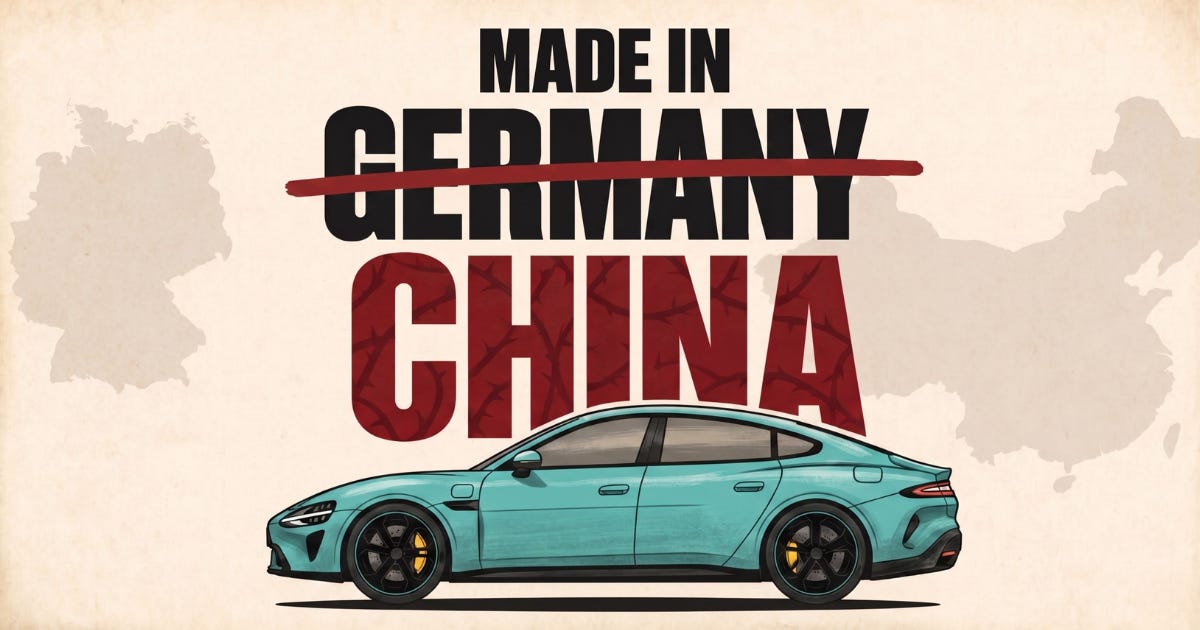
Why “Made in Germany” is becoming a liability in China
And why German automakers are going Chinese
One Foot in the Old World
The first thing you notice walking through Auto China:
The German stands are split in two. One side for combustion cars. The other for EVs.
Fritz from Berylls calls the two sides the “old world” and the “new world.” The old world is combustion. The new world is what the Chinese call the “Smart Car.”
And the focus in Beijing is clearly on the new world.
At Chinese manufacturer stands, there is no such split. For them, only the new world exists.
That’s the vibe of Auto China 2026.
The German industry stands with one foot in the old world and one in the new. And nowhere is that more visible than here. At the center of the new world.
Software Is the New Battery
What really separates the two worlds isn’t the powertrain.
Back in Germany, we still love to debate which powertrain has a future.
In China, that question is settled. Fritz puts it plainly: “EV is a done deal from a Chinese perspective.”
But when the powertrain is no longer a selling point, competition shifts. The question is no longer: How does the car drive? It’s: What can it do?
In the past, you differentiated on quality and powertrain.
That’s changed. Chinese manufacturers have reached a comparable level on quality. Same on powertrains. Range, charging speed, efficiency: in everyday use, there’s no meaningful difference anymore.
What counts now: software. AI. Speed. Software and electronics alone account for 30-40% of a car’s total cost. Alexander puts it this way: “What used to be the battery is now the software stack.”
Premium in China now means AI in the cockpit. Autonomous driving. How naturally the car fits into a digital life.
Local players are setting the standards. Whoever builds the smartest car defines what premium means. And right now, that’s not the Germans.
This is exactly why the old logic has flipped. “Made in Germany” is no longer a seal of quality. It’s becoming a problem. In China, it’s increasingly read as “not smart enough.”
But this isn’t just about the premium segment. The industry is seeing a kind of democratization of technology.
Here’s how it used to work: new technology arrived first in the S-Class, then the C-Class, then the A-Class. Premium buyers subsidized the development.
That mechanism no longer works in China.
There, high-tech goes straight into the mass market. BYD already puts LiDAR sensors and advanced driver assistance into the Seagull. For under $16,000.
The tech race runs in every price segment. And to stay in it, you have to move fast.
German manufacturers traditionally developed a new car in 4 years. The problem: by the time it hits the market, the technology is already 4 years old.
VW unveiled the ID. UNYX 09 in Beijing. Built on an Xpeng platform. In just 24 months. A real milestone. VW has cut its development time in half.
The absurd part: even that makes VW twice as slow as the Chinese benchmark. Some manufacturers now develop on an existing platform in 8 to 12 months.
How do you get to that speed? And why can’t German companies?
Market analyst Chris Liu says: “The real gap is software execution. A talent problem, above all.”
Not money. Not manufacturing. Talent and capabilities.
And if you don’t have those, you need partners.
In China, You Can’t Do It Without Chinese Partners
German manufacturers work with Chinese partners in China. Not occasionally. Systematically.
Berylls estimates that between a quarter and a third of all vehicles at the show were co-developed with a tech partner. Huawei, Xpeng, and others.
And the Germans aren’t the only ones. Hyundai is doing the same: “Designed in China, by China, for China.”
This plays out on 3 levels. 2 are already visible. The third is taking shape:
Buying components: Mercedes and BMW are using Momenta for autonomous driving. BMW integrates DeepSeek in the cockpit and relies on Huawei and Alibaba for the new iX3. Here, the OEM buys a specific tech capability from a partner.
Buying the platform: Here, the partner no longer provides a single module but the complete technical foundation of the car. A platform is the underlying hardware and software architecture everything is built on. VW uses Xpeng’s platform. Audi went further with SAIC and launched its own sub-brand. “AUDI” in capital letters. Without the 4 rings.
Licensing the brand: That hasn’t happened yet. But at level 2, the partner is already providing nearly everything. The next step: the Chinese manufacturer builds the car entirely and slaps your logo on it. In exchange, they pay you licensing fees for the brand. From a German perspective, that would obviously be the worst case.
The question: Are these partnerships a transition phase while German manufacturers build their own capabilities? Or is this the new normal?
Berylls has a clear answer: it’s permanent. Alexander says: “If this step had been taken 2 or 3 years earlier, we’d be talking about a balance of power today. Now the gap is too wide.”
What he means: the gap in software and AI has grown too wide. German manufacturers can no longer close it on their own.
The danger: the longer a platform sits with a partner, the more knowledge accumulates there. Whether that knowledge ever flows back into German organizations is an open question.
Which raises another one: what does the German manufacturer actually do anymore? If partners supply most of the product?
Alexander puts it bluntly: “You could reduce it to assembly and systems integration.”
Meaning: the individual components come from the partner. The German manufacturer assembles them into a car.
My Take
VW CEO Oliver Blume describes the China partnerships as “unavoidable, because you can’t do everything yourself and don’t want to.”
Sounds plausible. A modern car requires software, driver-assistance systems, chips, AI, cloud backend. All far from the core competency of a traditional automaker.
But there’s another way. Some automakers do all of this themselves. Tesla, Xpeng, Nio, and a handful of others. The industry calls this vertically integrated. Or full-stack.
So it’s possible. Why can’t the Germans do it?
The short answer: they tried. Twice.
Attempt 1: Build products for the new world using the existing organization. Didn’t work.
The lesson: you can’t build new-world products inside an old-world organization.
So attempt 2: Transform the old organization. Or build a new one alongside it. VW built a dedicated software unit for this: CARIAD. Also didn’t work.
The next lesson: you can’t build a new-world organization close to the old one. The old suffocates the new. Institutional inertia, entrenched power structures, the famous “this is how we’ve always done it.”
And that’s exactly what brought us here.
That’s the reason for the partnerships. And why more and more development is moving to China.
In Germany, we tend to explain this with 2 standard answers:
The global car no longer works. Meaning: developing one product in Germany that works everywhere. But that’s not really accurate. Tesla develops centrally in the US. One product. For the whole world. The issue isn’t location. It’s how technologically innovative the product is.
Bureaucracy and site costs. Both true. But if cost were the only factor, nobody would still develop in Silicon Valley. Development jobs are the most valuable jobs. You don’t offshore them because of cost. So this doesn’t explain why development specifically is moving to China.
The real reason goes deeper. And once again, it’s the organization.
You can’t rebuild the old organization into the new world. So you build a new one. Far away from the old one.
That’s exactly what’s happening right now.
“In China for China” doesn’t just mean: develop closer to the customer. Above all, it means: build a new organization. One that can actually deliver products for the new world.
That’s what we saw at Auto China 2026. German manufacturers building new organizations in China. With new partners, new processes. And a new speed.
Fritz says: in not a single conversation at the show did anyone write off the Chinese market as lost.
And that’s the good news:
What they’re building there isn’t just new products. It’s a new way of working. Exactly what the home organization failed to deliver.
The hope: what they’re building in China eventually comes back to Germany. Not the products. But the way they develop them.
🔗 berylls | re | ft | hb | re2 | zdf
That’s all for today.
Until next week,
Philipp
PS: If you find value here, share it with someone who should read it too.
Want to work with me?
I help global B2B companies connect with 80,000+ automotive decision makers in Germany.
Interesting insight. What do you see as the key changes German (and I guess all European) manufacturers need to get right as they build their “new organisations” to compete?
The 2-year investment is not about the product — it's about the unlearning.
Even a miserable failure on a China-first platform is worth it, because half-commitment produces half-transformation. One foot in the old world, one in the new, is exactly how you stay stuck.
What's being described is not recklessness — it's the discipline to stay in discomfort long enough for something genuinely new to emerge. And then — crucially — spread it globally. Not just adapt. Go bolder.
The real question is whether current leadership has the political will to protect that failure long enough for it to become something.
That answer determines everything.