


Ad
This issue is supported by Berylls by AlixPartners
What do car buyers actually want from their next car?
Berylls just surveyed 8,000 car buyers across 11 countries for their new study, CONFIGURED: What will car buyers drive next?
I got early access to the data and spoke with the authors, Theresa Stütz and Jonas Wagner. Today’s newsletter is my analysis from a German auto industry perspective.
Berylls by AlixPartners had no influence on the content of this newsletter.
Welcome to Issue #113 of The German Autopreneur.
No label in the auto industry means quality like Made in Germany. Nothing commands more trust worldwide. But with EVs, that promise is breaking.
Berylls by AlixPartners surveyed 8,000 car buyers in 11 countries for their new CONFIGURED study. I got early access and spoke with the authors.
At first glance, the results look good for German manufacturers. Look closer, and there’s a problem. Owners of German EVs are far less satisfied than owners of Chinese EVs. The brand delivers. The product doesn’t.
Today we’ll look at why Made in Germany no longer delivers on EVs. And why this follows a pattern that has destroyed entire industries before.
No Country Disappoints More EV Customers
Berylls asked the question differently than you’d expect.
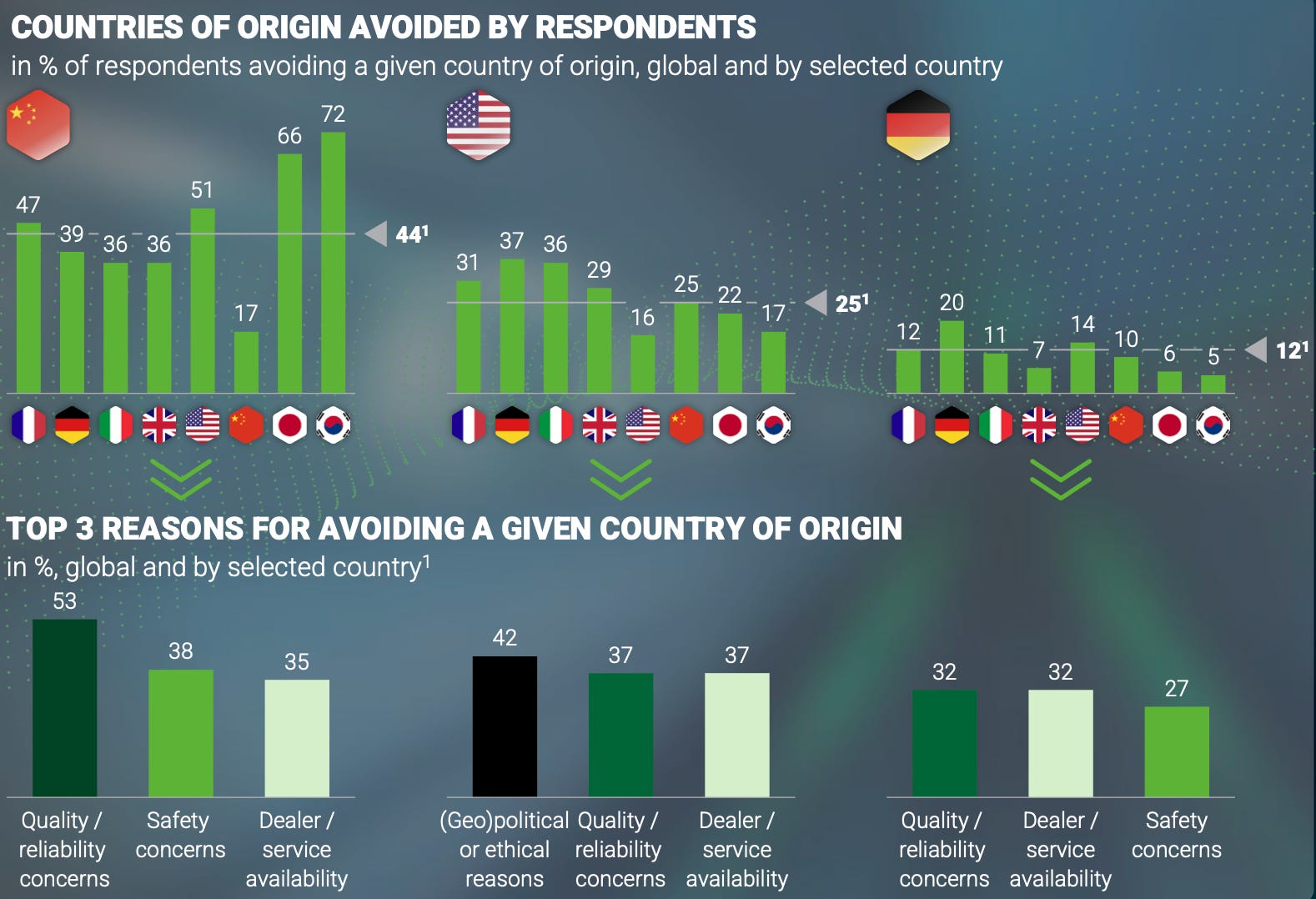
Not: Which car brands do you prefer? But: Cars from which country would you explicitly avoid?
Only 12% of respondents globally say a German car is off the table. That’s the lowest rejection rate of any country. American brands hit 25%. Chinese brands 44%.
Made in Germany is the industry’s strongest label. Stronger than Japan. Stronger than the US.
But that’s for combustion cars. Not EVs.
23% of German EV drivers wouldn’t buy German again. Among Chinese EV drivers, only 13%.
No country has more buyer trust globally. And no country has more disappointed EV customers.
Repurchase rate is the hardest metric. It doesn’t measure image. It measures experience. And the experience says: With EVs, the product doesn’t deliver what the brand promises.
Theresa Stütz is one of the study’s authors. She says German EVs don’t meet Made in Germany expectations. Not just on quality. On trust in the tech, too.
And it’s getting worse. The next generation of Chinese buyers knows German brands mainly as their parents’ cars. The average new car buyer there is 35. For this generation, Li Auto, Huawei, or Xiaomi mean innovation. Not Mercedes and BMW.
German manufacturers are losing customers on two fronts. Customers who try a German EV are disappointed. And the next generation doesn’t have German brands on their radar at all.
Where German EVs Actually Fail
The obvious explanation: They’re too expensive. Customers switch to cheaper alternatives.
The study proves otherwise.
Globally, 37% cite price as the biggest barrier to buying an EV. In China, it’s 8%. Price isn’t the problem.
China isn’t a budget market. China is a quality market. Or as Jonas Wagner from Berylls puts it: “China is high tech and high quality.”
Globally, 77% of EV buyers say material quality matters to them. For combustion buyers, it’s 63%.
German manufacturers aren’t competing against cheap cars. They’re competing against cars that offer more at the same quality level. More range. Better software. A better digital experience.
German Automakers Are Losing Autonomous Driving Before It Starts
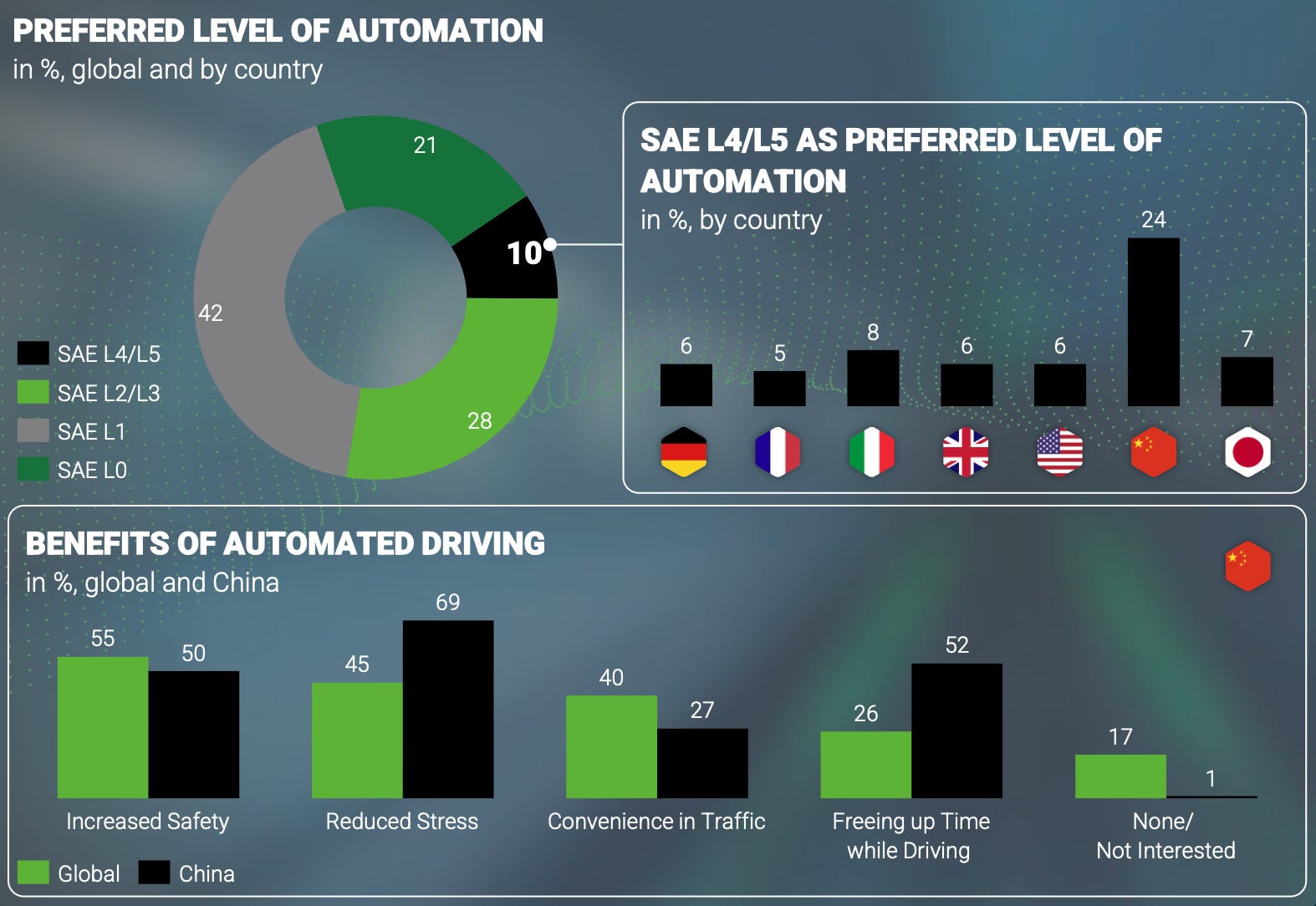
1 in 4 Chinese buyers expects Level 4 or 5 autonomous driving in their next car. In Germany and the US, it’s 6%. And this is about a technology no private vehicle delivers today.
But the real difference isn’t demand. It’s motivation.
69% of Chinese customers want autonomous driving to reduce daily stress. There, the technology means freedom.
Western customers see autonomous driving mainly as a safety feature. Nice to have. But not a purchase driver. Only 10% of Germans would pay extra for it. In the US, 7%.
In China, it’s a purchase driver. Only 1% of Chinese buyers have no interest in autonomous driving. Globally, it’s 17%.
The dilemma: Where autonomous driving matters most, customers already buy from competitors. Where German manufacturers are still strong, almost nobody wants to pay for it.
Made in Germany was never just about quality. It meant technology leadership. The best engines. The latest innovations. That justified the premium.
But today, different things define a modern car. Electric drivetrains. Software. Autonomous driving. And German manufacturers? Others are leading in all three.
My Take
There’s a book from the 90s. The Innovator’s Dilemma by Clayton Christensen. The idea is simple:
Successful companies don’t fail because they make bad decisions. They fail because they do the right thing. They listen to their customers. Optimize what works.
And while they do that, someone else builds something new. A product that’s worse at first. In everything that mattered before. But it can do something the old product can’t. And suddenly the standards shift.
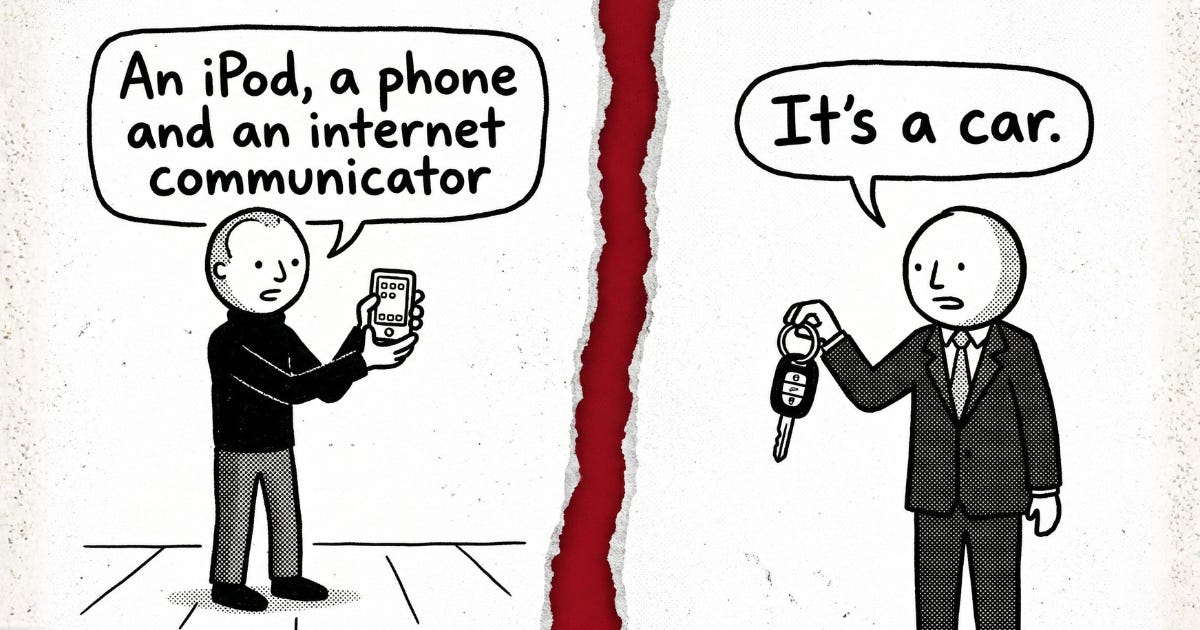
When Steve Jobs introduced the iPhone in 2007, he didn’t say: This is a better phone. He said: “An iPod, a phone, and an internet communicator.” He invented a new product category.
That’s exactly what happened in automotive. German manufacturers built the world’s best combustion cars. For decades. Better engines. Better build quality. Better chassis. But the car always remained a car. The way it had always been.
Then new players arrived. First from America. Then from China. They didn’t improve the car. They rethought it.
German manufacturers kept building better combustion cars. The Innovator’s Dilemma.
Eventually they reacted. But by then, the others were generations ahead. The result: The first generation of German EVs disappointed customers. The data proves it.
Now they know they’re no longer technology leaders. So they invest billions to catch up. But those billions have to come from somewhere.
That’s exactly the downward spiral:
The technology is no longer competitive
Customers are disappointed
So they invest billions to catch up
They cut corners on quality and materials to fund it. On the very thing that makes Made in Germany Made in Germany
Even more customers are disappointed
They end up losing on both sides. Behind on technology. No longer Made in Germany on quality.
But it’s not over. Made in Germany still commands the highest trust globally. The data showed that.
And the second generation of German EVs is arriving now. In a different technological league than the first. These are the make-or-break models. They’ll decide what Made in Germany is worth 10 years from now.
PS: Want to see the full data behind today’s analysis? Berylls’ CONFIGURED study surveyed 8,000 car buyers across 11 countries.
That’s all for today.
Until next week,
Philipp
PS: If you find value here, share it with someone who should read it too.
Want to reach European automotive decision makers?
I help global B2B companies connect with 80,000+ automotive decision makers in Germany.