


Ad
This issue is supported by KAIZENICS.
When a modern car is delayed, it’s usually not because individual teams did a bad job. It’s because the software, electronics, variants, and suppliers all come together into one finished car far too late.
That’s exactly where the German startup KAIZENICS comes in. Using documents every carmaker already has, KAIZENICS builds a working digital model of the whole car. So you can test the car long before the first real prototype exists.
Want to go deeper? The industry initiative digital.auto has written up how the industry can get from today’s integration problem to the AI-defined car.
KAIZENICS had no influence on the content of this issue.
Welcome to Issue #123 of The German Autopreneur.
“China is faster.” Nobody wants to hear that sentence anymore.
Dirk Slama doesn’t either. And he would know. He’s a VP at Bosch and the head of the industry initiative digital.auto. He’s spent years working on exactly this problem.
And the sentence is still true. Unfortunately. So the real question isn’t whether China is faster. It’s why.
The usual answer: Germans just can’t do software. Dirk’s take: “That’s too easy.” The problem isn’t what German carmakers build. It’s how they build it.
Here’s what I’ll cover today:
How a modern car gets built, and why that turns into a problem
What this problem costs in time and money
And the idea Dirk wants to fix it with
How a Modern Car Gets Built
A traditional carmaker is basically an integrator. It designs the car, and hundreds of suppliers build it. Bosch delivers the injection system, Continental the brakes, ZF the transmission. Each one builds its part. The carmaker’s real job is to plug it all together at the end.
That worked well for decades. Especially while a car was mostly mechanical. A brake was a brake. You installed it and it worked. Every part was self-contained.
Today almost everything in a car is connected and runs on software. The powertrain, the brakes, charging, driver assistance like automatic emergency braking, even the seat. Each of these parts has its own small computer with its own software. They’re called electronic control units, or ECUs. A modern car has more than 100 of them.
And these ECUs don’t work on their own. They talk to each other constantly. A single function in the car almost never sits in just one ECU. It runs across many, often from different suppliers.
So all those separate parts have turned into one tightly connected system. And German carmakers plug that whole system together and test it only at the very end.
Why That Becomes a Problem
First, the basics. There are roughly 2 ways to build a complex product:
The iterative way comes from software. You build a rough version fast, try it out, find problems early, and improve in small loops. Step by step, you work your way to a finished product
The sequential way is the classic way to develop a car. First you plan everything in detail. Then you build. And only at the very end do you assemble and test
That sequential approach is exactly how the auto industry works. It has a name: the V-model.
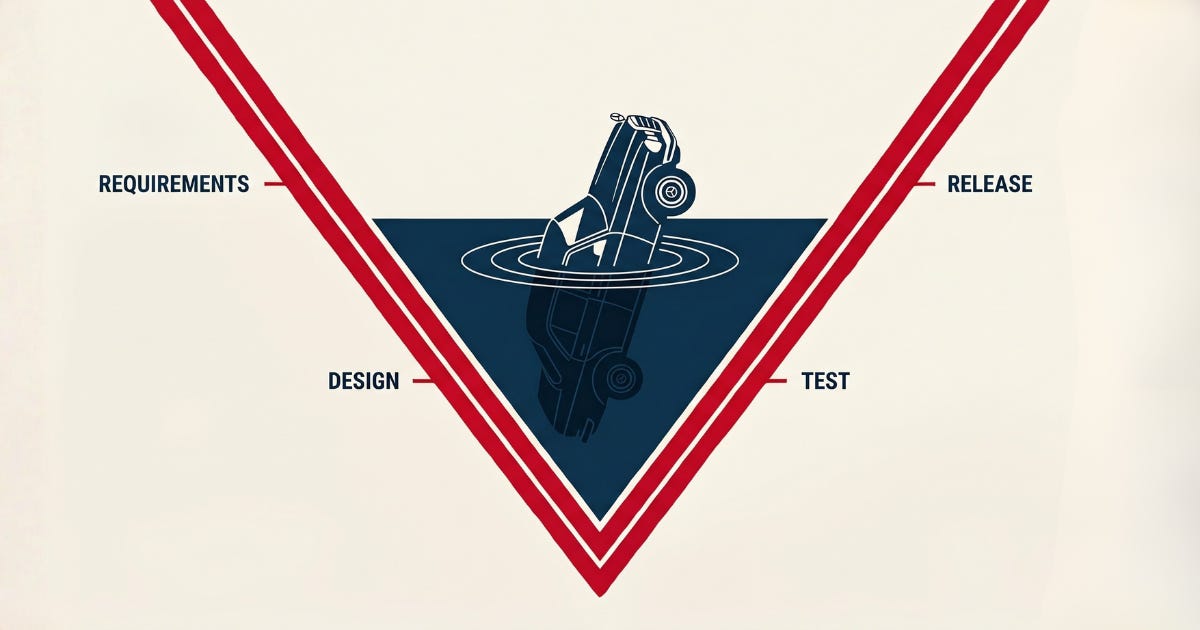
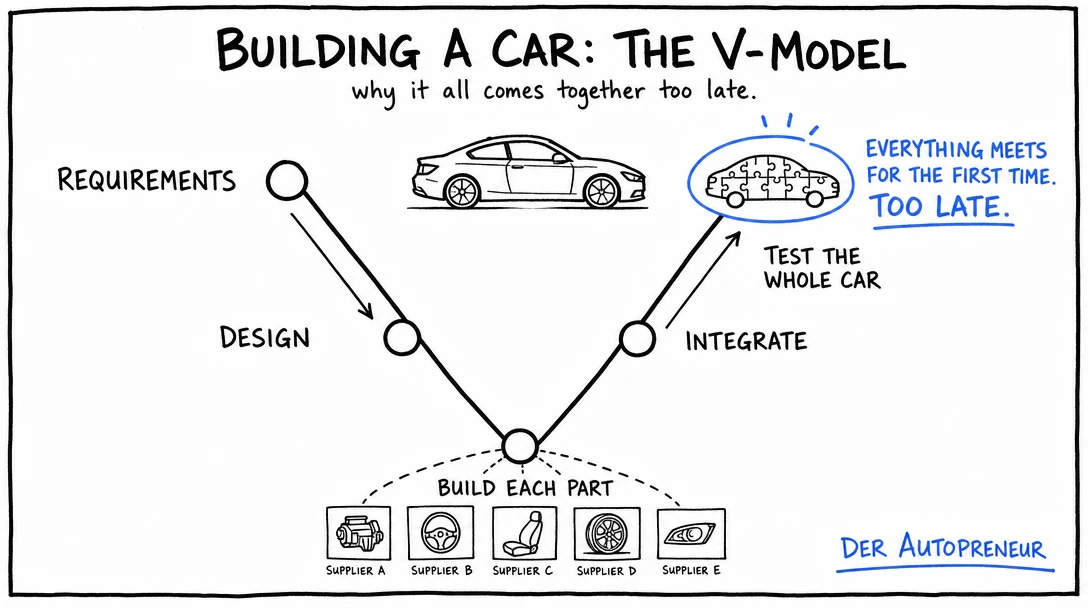
Picture a big V. To develop a vehicle, you walk through this V once. Down the left side first, then back up the right:
You start at the top left. There’s no car yet. It exists only as an idea: what should the car do?
From there you work down the left side and get more concrete. The idea becomes big systems like the powertrain, the brakes, and infotainment. Those systems become individual parts. For each part, you write down exactly what it has to do. Precise enough for a supplier to build it later
At the bottom point of the V, the building happens. Each supplier makes its part
Then you move up the right side. Now things get assembled and tested. First the single part. Then the parts get combined into bigger systems
And at the very end, all the systems come together into the complete car
Here’s the catch. Whether it all actually fits together only becomes clear here, at the top right. At the very end.
In classic vehicle development, you walk through this V once. Not in loops.
Now back to that tightly connected system of ECUs. That’s exactly where it becomes a problem. A single function doesn’t sit in one ECU. It runs across many, and across several suppliers.
Dirk gives an example of such a function: the welcome sequence. Every modern car has one today. You get in, and the car adjusts to you. The seat moves into your position. The headrest adjusts. The display starts up. It looks like a single function. In reality, multiple ECUs from dozens of suppliers mesh together to make it work. And a modern car has hundreds of functions like this.
The more of these functions interlock, the more can go wrong when you plug them together.
An interface is missing. One ECU behaves differently than expected. A function works on its own, but not in the whole car. That often surfaces only shortly before production starts.
Dirk puts it this way: “The problem is that we integrate too late, we see dependencies too late, and we test the full system far too late.”
Then the big repair job begins. About 6 months before production starts, the head of development pulls everyone together, often twice a day. “Preferably on the factory floor, nobody gets to sit,” Dirk says. “And then everyone gets blamed, one after another,” because their part doesn’t fit cleanly.
He has a name for it: integration hell. And it doesn’t happen now and then. “It’s not the exception. It’s the rule.”
What This Costs
German carmakers find problems late and have to fix them at high cost. That eats time and money.
From idea to start of production, German carmakers take 48 to 54 months on average. Chinese competitors do it in 24 to 30. Those numbers come from a Bain analysis covering 2020 to 2024. Since then the gap has only grown. Some Chinese carmakers now bring a new model to market on an existing platform in as little as 9 to 12 months.
And they do it cheaper. For a new model, they spend around 27% of what a German carmaker spends. For the development budget of one German car, they bring almost 4 cars to market. On top of that: while German models often sit nearly unchanged for years, Chinese carmakers keep launching the next version.
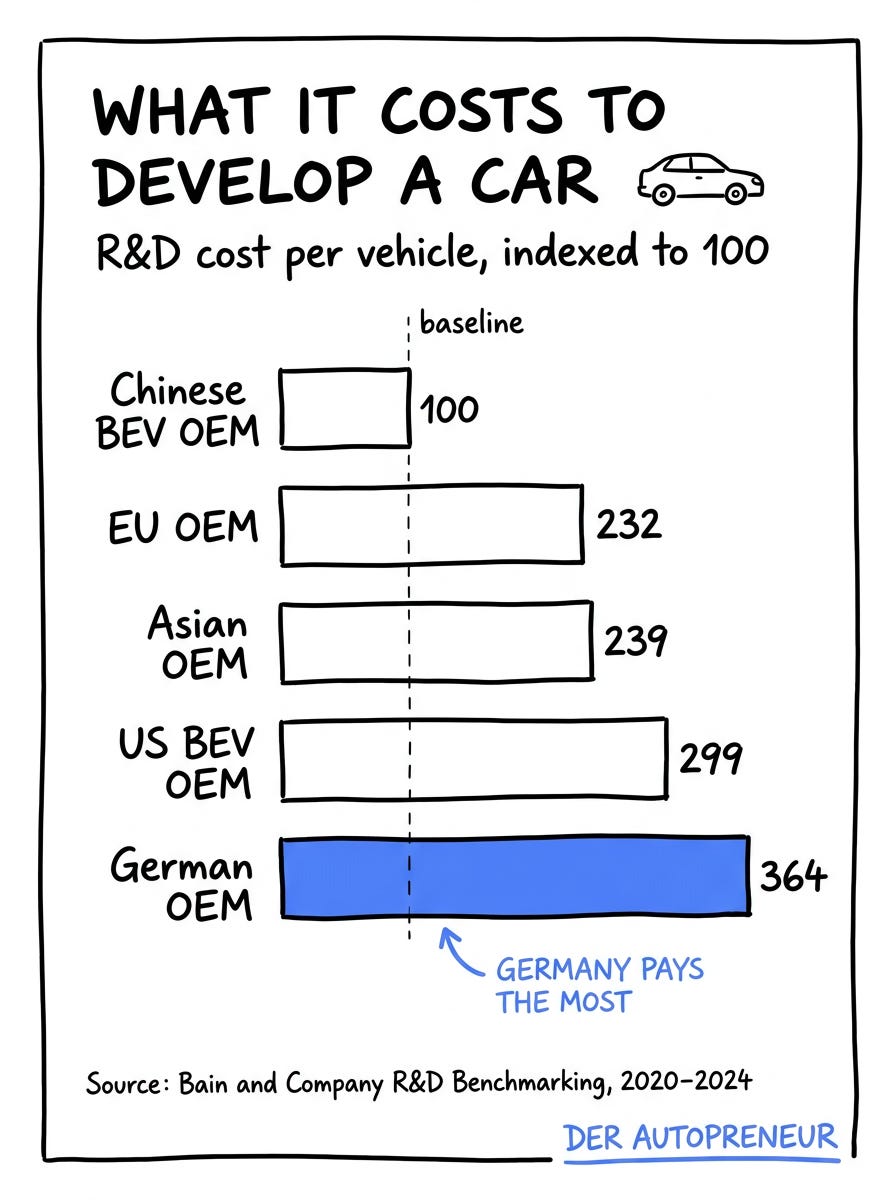
No country spends as much per car as Germany.
Why? Mostly the way they work. Tesla and many Chinese carmakers build their cars more like software. Exactly the first way we saw earlier. They don’t wait until the end. They plug the parts together from the start and find problems early. The big repair job at the end almost disappears.
That’s not the only reason, of course. But it’s one of the biggest.
A Wireframe for the Car
This early integration is exactly what Dirk wants to open up to everyone.
His initiative digital.auto has a concept for it called SDV Forge. The idea sounds simple at first. You have to pull integration forward. To the start instead of the end. On the V-model, from right to left. Developers call this shift-left. Dirk says: “Shift-left simply means that things which used to happen late now happen early.”
But how do you test whether the parts fit together when the car doesn’t exist yet?
I spent years working on the Mercedes configurator, the online tool you use to build your own car. That was basically web design. And we never started coding right away. We started with a wireframe.
A wireframe is a rough skeleton of boxes and arrows. Picture the floor plan of a house that hasn’t been built yet. You slide the rooms around and see right away whether the path from the kitchen to the dining room works. With our product it was the same. We saw how the whole thing worked together long before a single line of code was written. Step by step, the skeleton turned into a real prototype.
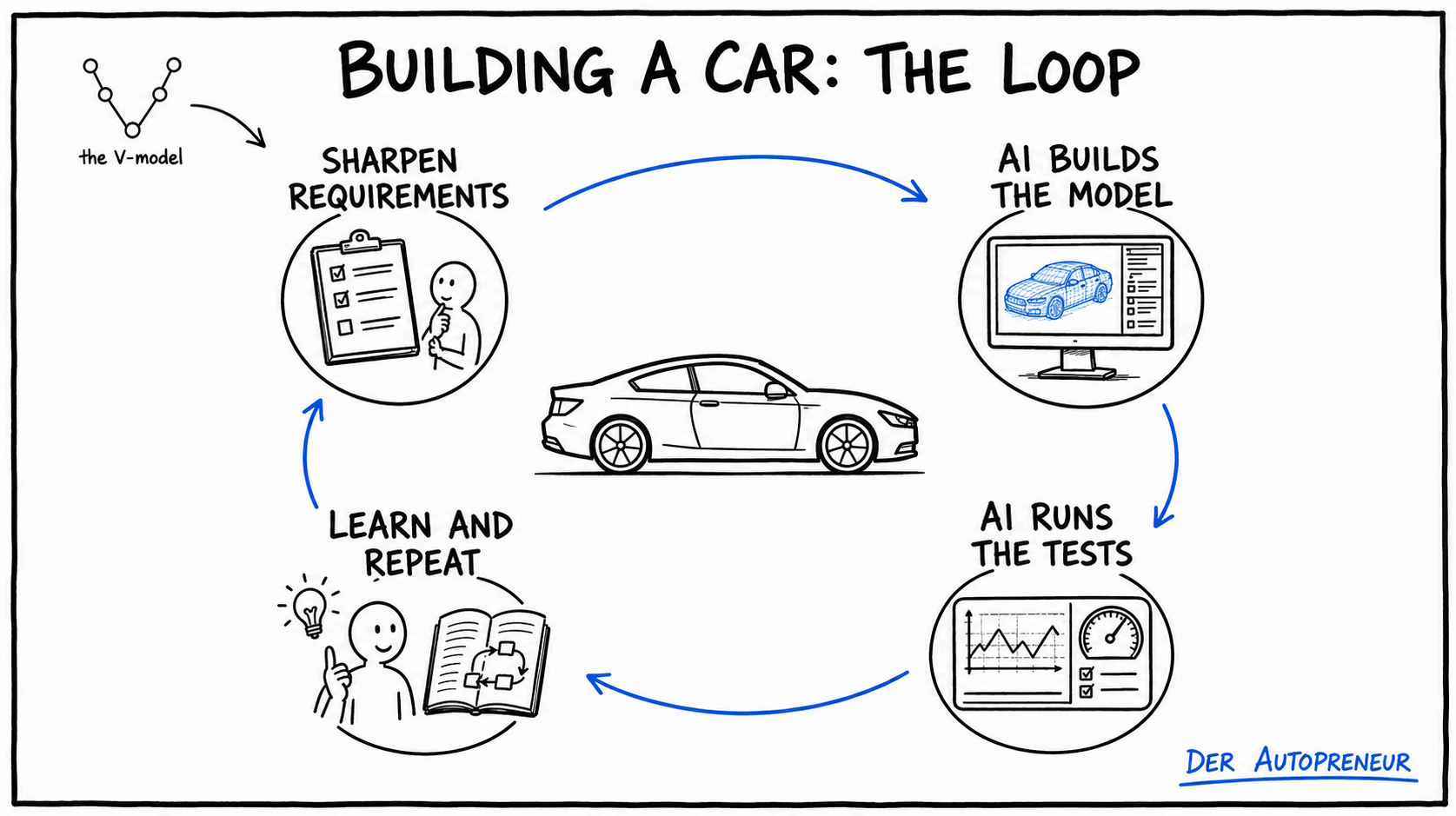
SDV Forge now applies this principle to the car. It builds a wireframe of the whole car. A rough model on the computer that you can already try out.
Here’s how the model gets built. Not by hand. From documents every carmaker already writes anyway. At the very start, everyone records what the car should do: requirements, function descriptions, interfaces. Until now, those documents sat scattered across thousands of files.
Now you hand those documents to an AI, and it builds the model of the car. Each team can test its part and see right away whether it fits with the rest. Where something doesn’t fit, they fix it on the spot.
The missing interface between the seat and the headrest no longer surfaces just before production. It shows up on the model, right at the start. While the problem is still small and cheap.
My Take
The question isn’t whether Germany is too slow. It’s whether German carmakers are ready to work differently.
Because the real issue is bigger than a tool. German carmakers build a different product today than they used to. The car used to be a machine made of sheet metal. A mechanical masterpiece, perfected over more than 100 years. Today software mostly decides what a car can do. And a different product calls for a different way of building it.
But decades shaped these organizations around the old product. German carmakers got incredibly good at building the car they know. Again and again. And better every time. That way of working sits deep in their DNA. It was the recipe for success for a long time. And it’s exactly what makes the shift so hard today.
So the biggest job is the organization behind it. The shift from a classic industrial corporation to a software-first company. It means rethinking the product. And the organization that builds it.
This is exactly where Dirk’s initiative comes in. It’s more than a concept. You’re not just bringing in a tool. You’re bringing in a new way of thinking. Test early. Fail early. Learn before everything is set in stone.
That sounds easy. It isn’t. It’s exactly what the big carmakers have struggled with for more than 10 years. Failing early doesn’t fit an organization built to never make a mistake.
Still, let’s be honest. SDV Forge today is still just a concept with an early rollout among partners. So far there’s no finished car built this way.
And the best concept changes nothing as long as the organization behind it stays the same. The hardest work is the shift in mindset. Showing something unfinished early, instead of hiding it until it’s perfect.
Because in the end this is about much more than development speed. It’s about who rebuilds their organization so it can build the car of the future at all. That decides which of today’s big carmakers will still exist in 20 years. And which won’t.
Even better that someone here in Germany is finally building a solution, instead of just analyzing the problem. Dirk’s initiative is independent and open to the whole industry. There should be more of that.
🔗 digital.auto | Bain
That’s all for today.
Until next week,
Philipp
PS: If you find value here, share it with someone who should read it too.
A word from me
Your shortcut into European automotive
Selling to BMW, Bosch, or Continental from outside Germany? Good luck.
German automotive is a closed club. Built on trust, relationships, and decades of doing business face to face. Cold outreach doesn’t work. Trade fairs cost $20,000 for maybe 3 real conversations. And nobody takes meetings with companies they’ve never heard of.
I spent 10 years inside Mercedes-Benz. Today, 80,000 European automotive decision-makers follow me. From team leads to board level. They trust me. Because I speak their language. Literally.
One partner generated 250 webinar signups. Another got 60 qualified leads at OEMs.
I’m your bridge into the German auto industry.
Interesting perspective. I agree that earlier integration and better software engineering can improve development efficiency. However, I think the comparison between software and cars has limits.
Cars are safety-critical systems. In software, "fail fast" and rapid iteration work because bugs can often be fixed after release. In the automotive industry, many failures can have life-threatening consequences. That's why validation, verification and long testing cycles exist in the first place.
I also think the article overlooks *why* modern cars have become so software-intensive. Much of that complexity wasn't driven by customer demand alone but by regulatory and policy decisions—from emissions compliance to electrification and mandatory digital systems. If that's true, then today's software challenges are at least partly a consequence of what manufacturers have been required to build, not simply how they build it.
Interestingly, there are already examples pointing in the opposite direction. Toyota's Hilux Champ deliberately goes back to the basics: a simple, affordable, modular vehicle focused on transportation and utility rather than maximizing software features. That suggests there is still a market for cars that prioritize reliability, affordability and simplicity.
Perhaps the question isn't just whether Germany should build cars more like software, but whether we've made cars unnecessarily complex—and whether we should focus again on building cars that customers actually want.
I spent 10 years of my life trying to get a US defense contractor to adopt agile (iterative) processes over their internal waterfall mindset. I met my marks. I'd never do it again. It was a waste of effort, as the result didn't come any faster. They still thought in a waterfall mindset and the government couldn't stop changing things at the last minute that invalidated the iterative approach of testing early.
I can't imagine private industry has it much better.