


Sponsored
For German-speaking automotive execs, free TOP 100 Supplier Study webtalk from Munich
In 2024, the world’s TOP 100 suppliers lost €50 billion in revenue. 2026 decides who recovers.
On May 22, Berylls by AlixPartners presents the new TOP 100 Supplier Study live online. The rankings, the financials, and where the industry is heading next. Free. Event language: German.
The new TOP 25 ranking and who moved
How senior leaders read the 2026 outlook
May 22, 2026 · 3:00 PM CET · Online webtalk · Free · In German
Welcome to Issue #117 of The German Autopreneur.
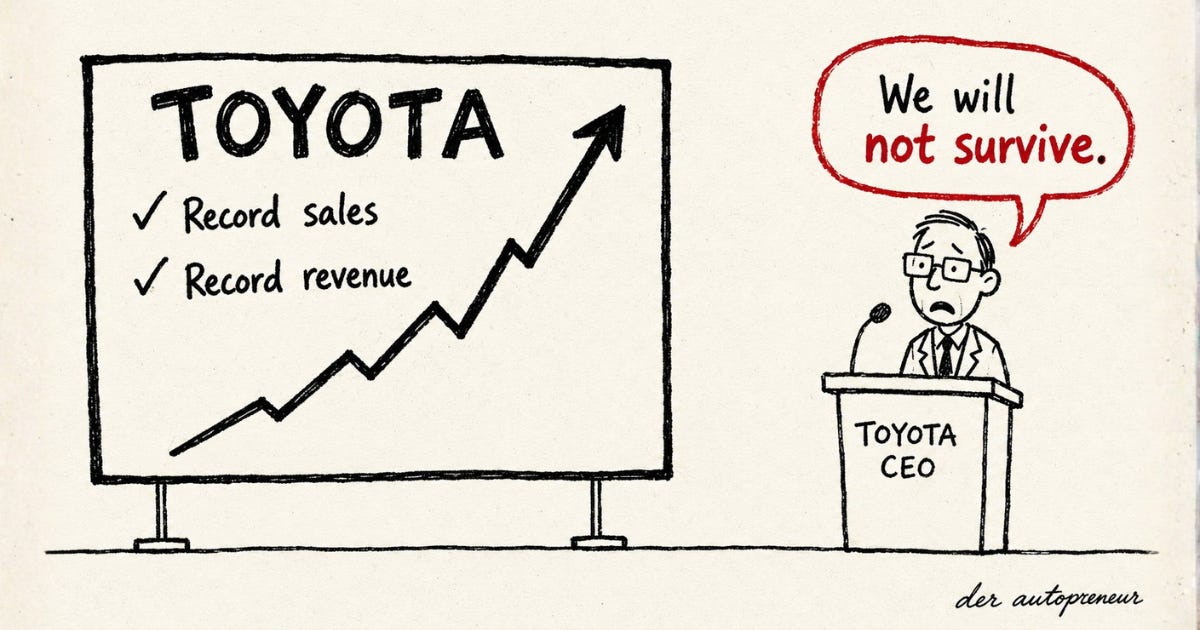
“Unless things change, we will not survive.”
That’s a direct quote from the CEO of the world’s largest automaker. Larger than Volkswagen. Larger than BYD. Larger than Mercedes, BMW, and Audi combined.
Toyota. 11.3 million vehicles sold last year. Global number 1 for the 6th year running. Record revenue. The highest operating margin among major volume manufacturers.
You hear this a lot in Germany: Toyota never went all-in on EVs. And now they’re sitting back, watching VW and Mercedes flail.
Toyota is doing everything right. At least that’s the story.
In late March, CEO Koji Sato stood before 700 of Toyota’s most important suppliers. It should have been a moment for good news. Sato thanked the suppliers. Then he said:
“Unless things change, we will not survive. Right now, we in the automotive industry are battling for our very survival.”
Toyota just posted record numbers. And says: we’re fighting to survive. How does that add up?
Today we’ll look at:
What the numbers actually say
Where Toyota stands on transformation
What legacy automakers can learn from Toyota
Record Revenue, Crashing Profit
Toyota’s fiscal year runs April to March. FY26 just ended. The numbers came out on Friday. All yen figures converted to US dollars (approx. $1 = ¥150, Toyota’s own FY27 planning rate).
$338 billion in revenue (+5.5%). Record. First Japanese company to cross 50 trillion yen.
11.3 million vehicles sold (+2.5%). Also a record.
Now the other side:
$25 billion in operating profit (-21.5%). That’s 7.4 cents per dollar of revenue. Still more than any other major volume manufacturer.
FY27 outlook: $20 billion operating profit (-20.3%). Margin drops to 5.9%.
Profit peak in FY24: roughly $33 billion. From peak to FY27 outlook: -39%.
Last quarter alone: operating profit -49%.
Revenue is breaking records. Profit is breaking down.
Toyota Has a Trump Problem
When revenue rises and profit crashes, it’s either price or cost. For Toyota, it’s cost.
The causes are external:
US tariffs hit Toyota with $9.2 billion in additional costs.
The Iran crisis is driving up aluminum prices. Toyota’s outlook includes $4.5 billion in extra costs tied to the Middle East. Japan’s auto industry imports roughly 70% of its aluminum from the region.
In North America, Toyota posted an operating loss: $1.3 billion.
Toyota has a Trump problem.
And yet, at 7.4% operating margin, Toyota is in better shape than the German manufacturers. VW came in at 2.8% in 2025. Mercedes at 5.0%.
Will next year be better? No.
Toyota’s own FY27 outlook: 5.9%.
Since April, Toyota has a new CEO: Kenta Kon. On Friday’s earnings call, he didn’t sound optimistic either:
“It is impossible to predict what the market will look like.”
His CFO: “Our measures are only effective in the short term.”
In plain English: Nobody knows what happens next.
Toyota is still making money. But the cash that should flow into technology is being eaten up by tariffs and raw materials.
Toyota Missed Its Own EV Targets
In the West, there’s a popular take: Toyota was smart not to lock itself into one powertrain technology. That’s only partly true.
In 2021, then-CEO Akio Toyoda announced 3.5 million EV sales by 2030. His successor Koji Sato raised the bar in 2023: 1.5 million per year by 2026.
Actual result: roughly 243,000. 84% below their own target. By comparison, VW sold close to 1 million EVs in 2025. 4 times as many as Toyota.
Toyota didn’t strategically hold back. Toyota missed its own EV targets by a wide margin.
This year, Toyota is aiming for 600,000 EVs. 40% of the original 1.5 million target.
Hybrids are keeping Toyota afloat. Toyota expects over 5 million hybrid sales this year. Nearly every other Toyota sold is a hybrid.
China shows how Toyota plans to catch up. Toyota’s entry-level EV is the bZ3X. But the platform isn’t Toyota’s. It comes from GAC, their Chinese joint venture partner.
Toyota develops almost everything in-house. Its own technology, tight supplier relationships, full control. But on future technologies, they can’t keep up alone. So they’re getting help from outside. From Chinese partners.
Toyota’s Software Stack Is Just Getting Started
For software, Toyota built a dedicated unit: Woven. Comparable to VW’s CARIAD. The result: Arene. An operating system for the car.
The vision: software and hardware fully decoupled. Over-the-air updates. New features without a new car.
The first model running Arene launched in May 2025.
The reality so far: Arene only handles infotainment and driver assistance. Everything else still runs on traditional control units from suppliers. When does the full software stack arrive? “For the next EV generation.” No date.
In the Gartner Digital Automaker Index 2025, Toyota ranks 21st out of 24. Behind all German manufacturers.
A Woven engineer describes the current state: “Horrendous, full of bugs.”
The problem is familiar. Traditional vehicle development runs on zero-defect tolerance. A brake can’t be buggy. Software development works the opposite way: ship fast, fix later, iterate.
Toyota has perfected hardware logic like no one else. And that’s what makes the leap to software so hard.
VW gave up building its own stack and now buys it from partners. Toyota is still trying to do it alone.
Toyota Builds AI for the Factory. Not for the Car
Toyota’s cars can do what most new cars can do today. Lane keeping, adaptive cruise control, emergency braking. Driver assistance at Level 2.
For true autonomous driving, Toyota has no in-house solution. They’re working with a Chinese partner. Since February 2026, self-driving Toyotas have been running in Guangzhou with Level 4 technology from Pony(.ai). Toyota provides the vehicle. Pony(.ai) provides the brain. Same pattern as with EVs.
But Toyota’s own AI work happens elsewhere. At the foot of Mount Fuji, Toyota is building a test city: Woven City.
The first residents moved in during fall 2025. There, Toyota is testing AI models that predict traffic accidents. Estimated investment: roughly $10 billion.
Last week, Toyota announced its own AI platform for manufacturing. Toyota’s goal: “To protect jobs, not replace workers.”
The rest of the industry is betting that AI inside the car will become a competitive advantage. Toyota’s own AI investments flow less into the car and more into production. The technology for the car? Toyota buys it from Chinese partners.
Three times the same pattern. Powertrain, software, AI. Wherever the future matters, Toyota is either struggling or buying from outside what it used to build itself.
And the core business keeps humming. 11 million cars. Record revenue. It’s never been better.
But that’s the problem. Why change something that still works this well?
My Take
I first visited Japan in 2019. In a small bar in Asakusa, Tokyo, I met this nice old Japanese guy. He had spent his entire career at the company that runs Tokyo’s subway system.
One job. One company. He never left Japan. When he got older, he started learning English. He wanted to talk to tourists. He told me it was his way of getting to know the world.
I’ve been back to Japan several times since. A career like his is the standard there. You don’t switch jobs. You get better within your system.
Toyota turned this culture into a management model. The business world knows it as the Toyota Way. Optimize every process over decades. Keep key technologies within your ecosystem. Make everything fit together perfectly.
This system made Toyota the world’s largest and most profitable automaker. When the game is optimization, Toyota is unbeatable.
But the game isn’t just about optimization anymore. Wherever the challenge is reinvention, Toyota struggles.
The problem: today’s business has an expiration date. A big chunk of Toyota’s profit doesn’t come from new cars. It comes from servicing roughly 150 million Toyotas worldwide. Maintenance, spare parts, service visits. EVs need 30-40% less maintenance. When cars update themselves, they often don’t need a service center. And Toyota won’t sell hybrids forever.
Toyota lives off a business model that won’t work in 10 years. And the better it works today, the harder it is to let go.
Toyota knows this. That’s how to read the March statement: “Unless things change, we will not survive.”
Toyota’s system was built over decades for stability and perfection. A system like that doesn’t change from within. It takes harsh words. Saying “we will not survive” in front of 700 suppliers was exactly that. A wake-up call. The first step toward making change possible at all.
This pattern isn’t unique to Japan. In the German auto industry, I’ve seen the same thing. Companies don’t fail because of technology. They fail because of organization and culture.
For Japan, that might be even more true than for Germany. Stability and perfection aren’t just embedded in the organization. They’re embedded in the culture itself.
Toyota is doing a lot of things right. But “right” isn’t enough anymore.
🔗 to | an | bl | ft | wsj | cnbc | re
That’s all for today.
Until next week,
Philipp
PS: If you find value here, share it with someone who should read it too.
Want to work with me?
I help global B2B companies connect with 80,000+ automotive decision makers in Germany.
Ironically, Toyota are doing the right thing. Software and Toyota won't ever mix because of the conflicting design philosophies behind software and Toyota; you mentioned this. When motor manufacturers changed from designing vehicles for robustness to designing vehicles for profitability, by moving revenue generation away from servicing and repeat sales to subscription, they made a fatal long term error: that of reduced quality.
Japanese makes moved there circa 2014, Germans around 2007, and this is seen in the repair costs of these now 10 to 10 year old cars. No contemporary car amde in the last 5 to 10 years will exist as a classic in 40 years becasue they're being designed to rely on an eco-system, to lock in long term dependance on unnecessary and pointless doodads.
When the accountants displaced the engineers the philosophy became one of making the most profitable vehicle, not the best they could within constraints. The enshittification of cars is seen in modern vehicles.
An Intel exec wrote a book, "Only the Paranoid Survive."
So Toyota is paranoid. That's good. Much better than complacent.