


Ad
Your code is ready. And it waits weeks for a free test bench
If you develop or test ECU software, you know the drill. The code is done, but you only get your turn once the hardware is free. So you wait. Often for weeks.
dSPACE lets you test the software in the cloud with its SIL Lab. No waiting for hardware. You generate virtual ECUs, run the simulation, and analyze. All in the browser.
dSPACE is your partner for simulation and validation in the automotive industry. Ford and Stellantis already work with it.
Try it yourself, no strings attached. 7 days free, access by email in minutes.
Welcome to Issue #127 of The German Autopreneur.
Early July, in Sindelfingen. That's the town near Stuttgart where Mercedes runs one of its largest plants. Around 20,000 workers stood outside the gates and chanted: "Ola out." Ola Källenius is the CEO of Mercedes.
The trigger was an email. The sender: the entire board. The recipients: every employee in Germany.
The key line: "We should all work more, in every area, for the same money."
For many, that means going from 35 to 40 hours a week. 5 more hours for the same pay.
Over the past few weeks, a lot of Mercedes employees have written to me. The message was always the same. Look at what's happening here.
Mercedes calls the plan a "productivity offensive." Insiders tell me it will backfire.
Today I'll look at:
What the board's email really says
Whether more hours actually make Mercedes more productive
What Mercedes actually needs
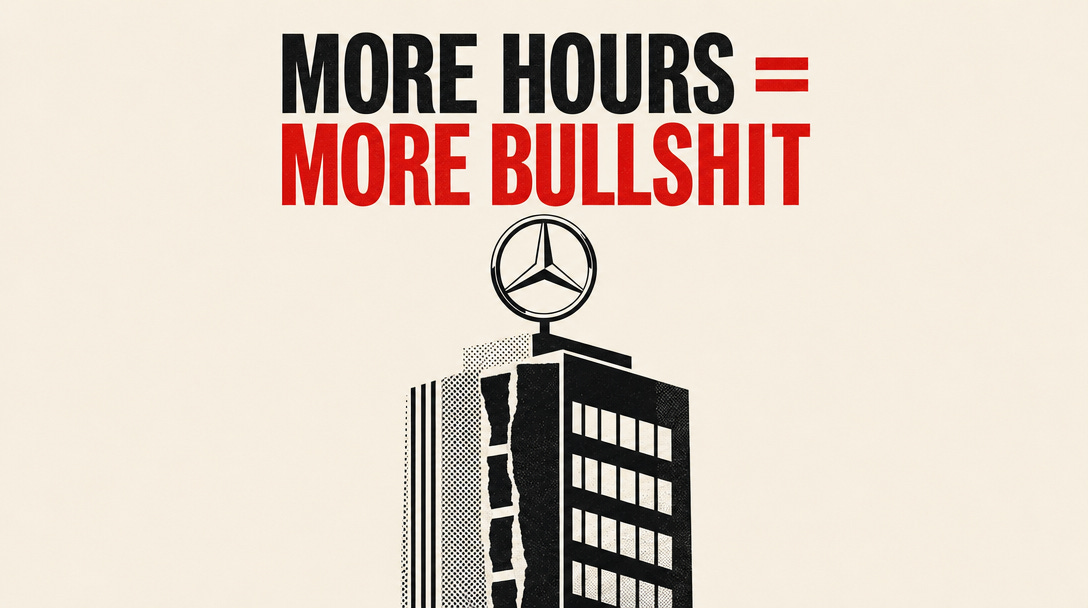
Mercedes Blames Everyone but Itself
The email opens with pride. 100 years of Mercedes-Benz: "We know how history feels."
A few lines later, the message changes. Now everyone has to work more. For the same pay. Roll up your sleeves. That's the board's answer to the crisis.
The board names 3 causes:
Tariffs and geopolitics
The price war in China
Germany as an expensive place to build cars
And the numbers are brutal:
837,200 cars sold in the first half, 7% fewer than a year earlier
China keeps sliding: 28% fewer cars in the first half, and 30% fewer in Q2
Auto margin of 4.1% in Q1, down from 7.3% a year earlier
Pure EV share of 11.6% in the first half (BMW: 17.7%)
So the crisis is real. But according to the board, the causes sit mostly outside the company. Plus one inside: Germans don't work enough.
Why Germany? The board says 2 of 3 employees work here, but only 15% of its cars sell in Germany.
Germany is too expensive and the plants are too big. So Mercedes is moving work abroad. The email says it plainly. More product and admin work will go to other countries.
At the same time, Mercedes is expanding its plant in Kecskemét, Hungary. About $1.1 billion is going in. The site will more than double in size. It will become the largest Mercedes factory in Europe.
So German workers should work more. For the same pay. Does that fix the crisis?
Mercedes and Its Bullshit Culture
Productivity comes down to 1 question. How much comes out for the hours that go in?
Mercedes' plan adds hours. But nothing more comes out per hour. So this isn't a productivity offensive. It's a working-time offensive.
Mercedes never had a problem with the number of hours. The problem was what happens inside those hours. I worked there myself for almost 10 years.
In a company that size, a large share of the work creates no value. People work on the process, not the product.
Steve Jobs once put it this way: "People get confused that the process is the content." As companies grow, they build processes. The goal is to make their own success repeatable and to avoid mistakes.
But at some point they treat the process itself as the goal. And they forget what it was all about. The product.
That's exactly what happens at Mercedes. Everyone follows the process. Because it has always been done that way. Not because a better car comes out at the end.
One example. Purchasing has a fixed target: negotiate 20% off every contract. The suppliers know this. So they add 20% up front. Purchasing negotiates it back down and reports the target as met. The supplier gets the price it wanted. The final offer is the same as before. Nobody saved anything. But the metric looks good. And everyone is happy.
This pattern runs through the whole structure. A company like this has dozens of divisions and departments. Each one works for itself, in its own silo. Every silo has its own language, its own acronyms, its own routines. A newcomer needs months to understand the language.
For the silos to work together at all, you need translation. And that happens in committees. Every decision gets a PowerPoint, gets discussed in one committee, and gets passed up to the next. A single decision wanders from meeting to meeting for months.
It's work. Everyone is busy. But none of it reaches the customer.
On top of that, many people sit in roles they aren't qualified for. They slid into these positions over the years. Through reorganizations, or simply because they had been around a long time.
Often they don't really understand their own field. So they talk about what they do understand. Processes, formats, wording.
And where the expertise ends, the buzzwords begin. Suddenly everything is "data-driven," "customer-centric," "AI-powered." It sounds cool. It sounds like innovation. But it's usually an empty phrase. People fake innovation by using "innovative" words. Nothing actually happens.
This culture even has a name. Former Daimler CEO Jürgen Schrempp once called his own headquarters the "Bullshit-Castle."
The productivity offensive changes none of this. More hours on top of a broken way of working don't produce a better result. Just more of it. More meetings, more PowerPoints, more bullshit.
The way Mercedes works is the problem. Not the hours. And this offensive hits the wrong people.
The Cuts Always Land at the Bottom
The high performers pay for it.
The 35-hour week was never what employees wanted. Mercedes made it the rule. Many wanted to work more. But they weren't allowed to.
Only the best got 40 hours. As a reward. More hours, more money.
Now those are exactly the people who lose out. They keep the 40 hours. But their pay drops by 12.5%.
Everyone else is supposed to work longer. On top of that, Mercedes is pushing its annual bonus into next year. Or scrapping it altogether. And it's cutting remote work sharply.
For shareholders, it looks different. In April, Mercedes paid out about $3.6 billion in dividends. Even though its profit had just been cut in half.
Around 20% of that goes to two large Chinese shareholders: Geely and BAIC. Both are building competing brands at the same time. So it goes to the very players Mercedes blames for the crisis.
Here's what a company insider told me:
"One savings program follows the next. Nobody takes the board's announcements seriously anymore"
"The board asks us to give things up. But it doesn't lead by example." (Ola Källenius paid himself about $9.5 million for 2025)
The cuts always land at the bottom. At least that's how it feels to everyone
"The productivity offensive will lead to less productivity. That was a massive management mistake, if that was the real intention"
If. Because maybe this isn't about productivity at all. Mercedes wants to cut staff in Germany. And that's nothing new. In the last year alone, the workforce shrank by more than 10,000.
Now even more are supposed to leave. Under the savings program "Next Level Performance," Mercedes recently ran a buyout offer. Some who left voluntarily got more than $550,000. But too few took it. 5,500 out of around 40,000.
Mercedes wants to get rid of its people. But the people want to stay.
And Mercedes can't just fire them. A job guarantee runs until 2034.
That leaves one path. Make the job so uncomfortable that they leave on their own. More hours, less remote work, no bonus, no future.
Read the measures that way, and they suddenly make sense.
But whether it's more hours or fewer people, both miss what Mercedes really lacks.
The Transformation Theater
The email tells the workforce what to deliver to fix the crisis. But the workforce didn't cause it. And if you didn't cause a problem, you can't really fix it.
So let's flip the question. What would the board actually have to do?
Mercedes has 2 real problems:
The company has fallen behind on the future technologies: batteries, software, and AI. That's why sales are collapsing in its most important market, China
To catch up, Mercedes would have to turn from a hardware company into a software company. It has been failing at exactly that for 15 years
Part of the problem is that there's no vision for the future. Why should anyone still buy a Mercedes in 2030?
Mercedes made plenty of bets on the future. Then scrapped almost all of them again.
The company has no strategy and no plan.
With a brand like Mercedes, you don't just buy a car. You buy the myth. You buy what it stands for. And when Mercedes no longer knows that itself, it burns its most valuable asset.
Mercedes knows it should change. But Mercedes doesn't want to change. So it takes the middle road. It fakes change.
It talks about change, renames things, builds new buzzword slides. Then keeps working exactly as before.
Why? Fear of losing power. Real change would break up power structures. Many managers rose through the old system. Today they're the ones in charge.
An insider put it this way. Mercedes couldn't afford the really good software people even 10 years ago. They've been gone for years. And the ones still there just want out.
One fitting detail. The CIO was supposed to drive this exact transformation. She's leaving on September 1. Her own decision.
In the end, it's a leadership team that won't push change through. And an organization that only pretends to. Everyone talks transformation. And keeps working the way they always have.
My Take
No question, the pressure is real. Mercedes has to act. But this offensive is the wrong answer. To me, it's mostly one thing. Posturing. The board shows toughness and a will to act. But it changes nothing about the structural problems.
The fix is fewer meetings, fewer silos, less bullshit. That does far more than 5 extra hours a week.
But the bigger question runs deeper. How does a hardware company become a software company?
And it looks like the German carmakers have already answered that for themselves. Their answer? Not at all.
Nobody has ever turned an old industrial company into a software company. There's no precedent for it. In any industry.
If that's true, the offensive suddenly makes sense. Then it isn't about productivity. It's about shrinking the old German part as much as possible and building something new somewhere else entirely.
With new people, without the old culture. No longer in Germany. What stays here is just the cuts.
But wherever they start fresh, one question remains. Not: how do we squeeze out more hours? But: who do we want to be in 2030?
That's the email the workforce is really waiting for. But it won't come. And the reason is sad. There is no answer. Mercedes has no vision.
The world has changed. And with it the car business. Different skills matter now. Different experience.
And it's not only the regular employees struggling with that. It runs through every level. From middle management up to the board.
That's not an accusation. Many did a great job for decades. They made "Made in Germany" what it is.
But for today's challenges, many of them are no longer the right people.
In the end, only the board can solve this crisis. Not the workforce. But for that it would need the right people. And an idea of the future. Mercedes has neither right now. And 5 more hours a week won't change that.
🔗 wiwo | hb1 | hb2 | re | ts | bi | cio | mb
A word from me
Your shortcut into European automotive
Selling to BMW, Bosch, or Continental from outside Germany? Good luck.
German automotive is a closed club. Built on trust, relationships, and decades of doing business face to face. Cold outreach doesn't work. Trade fairs cost $20,000 for maybe 3 real conversations. And nobody takes meetings with companies they've never heard of.
I spent 10 years inside Mercedes-Benz. Today, 100,000 European automotive decision-makers follow me. From team leads to board level. They trust me. Because I speak their language. Literally.
One partner generated 250 webinar signups. Another got 60 qualified leads at OEMs.
I'm your bridge into the German auto industry.
That’s all for today.
Until next week,
Philipp
And as always: If you find value here, share it with someone who should read it too. That helps me a lot.
None of this has to do with Mercedes. Every large engineering company in Germany is exactly like this. They had decades where almost nothing mattered, slow gradual improvements were more than enough to keep your world class status, the actual competition was laughable and never a real threat.
This has filled every single one of these companies with enormous amounts of fat. Fat in the form of processes and fat in the form of people. The board can not cut that fat, nobody knows how to. So you get endless „transformations“ and „Sparprogramme“, which do literally nothing except shuffling around organization diagrams.
Another big aspect, often ignored, is that a large part of the workforce is old. Especially the management. And these people are quite frank about their motivations, namely to keep the ship afloat so that they can peacefully go into retirement. They have zero interest in real restructuring, making difficult decisions or even trying hard. They just want to make things work for a while longer until they can leave.
Strong piece. The China comparison is uncomfortable for old OEMs because it is not mainly about cheaper labor anymore. Chinese automakers have industrialized iteration itself: batteries, electronics, software teams, suppliers and factories sit close enough that product cycles become a manufacturing process. Mercedes is trying to add hours to an organization that still moves by committees. That may buy cost relief, but it does not create software speed.