


Ad
I’ll be at Vehicle Tech Week in Stuttgart in less than a week. Will you?
If you work in the auto industry and you’re near Stuttgart next week, this is a must.
June 23 to 25. Messe Stuttgart. 3 events under one roof: Automotive Testing, Autonomous Vehicles, Automotive Interiors.
More than 10,000 attendees. Mercedes, BMW, Ford, and Volvo among them.
The best part? Your free ticket is right here:
Welcome to Issue #122 of The German Autopreneur.
Look at Germany, and the picture seems clear. Plants are closing, jobs are disappearing, and the mood is at rock bottom.
Then look at the global numbers. In 2025, the world sold around 90 million cars, almost as many as in the best years before Covid. By 2030, it should pass 100 million a year for the first time.
How does that fit together?
So it’s worth looking beyond Germany, at the whole world market. That’s what today is about:
Why India now builds more cars than Germany
Why 1 in 4 new cars is already electric
Who controls tomorrow’s market
The World Buys Around 90 Million Cars a Year
After the Covid crash of 2020, the world market has fully recovered. In 2025 it reached around 90 million cars sold (passenger cars and light commercial vehicles), almost back to pre-Covid levels. And the forecasts keep pointing up, toward 100 million.
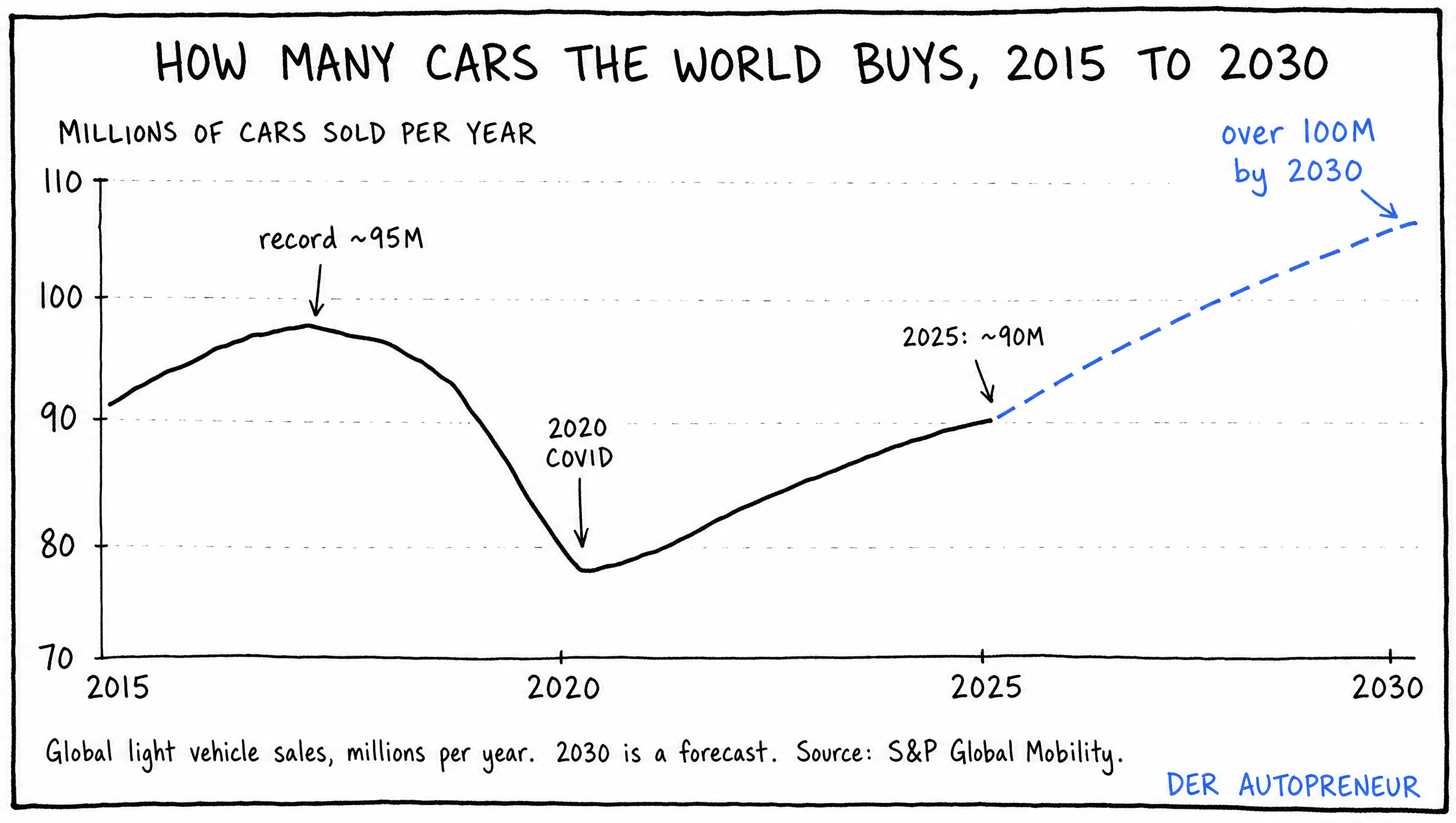
A global car crisis looks different. The pie is getting bigger. It just isn’t getting bigger everywhere. Almost all of the growth happens outside Europe and North America.
For Germany, that’s exactly the problem. German carmakers make their money in the world’s growth markets.
So where is that growth?
The 4 Big Auto Regions Are Drifting Apart
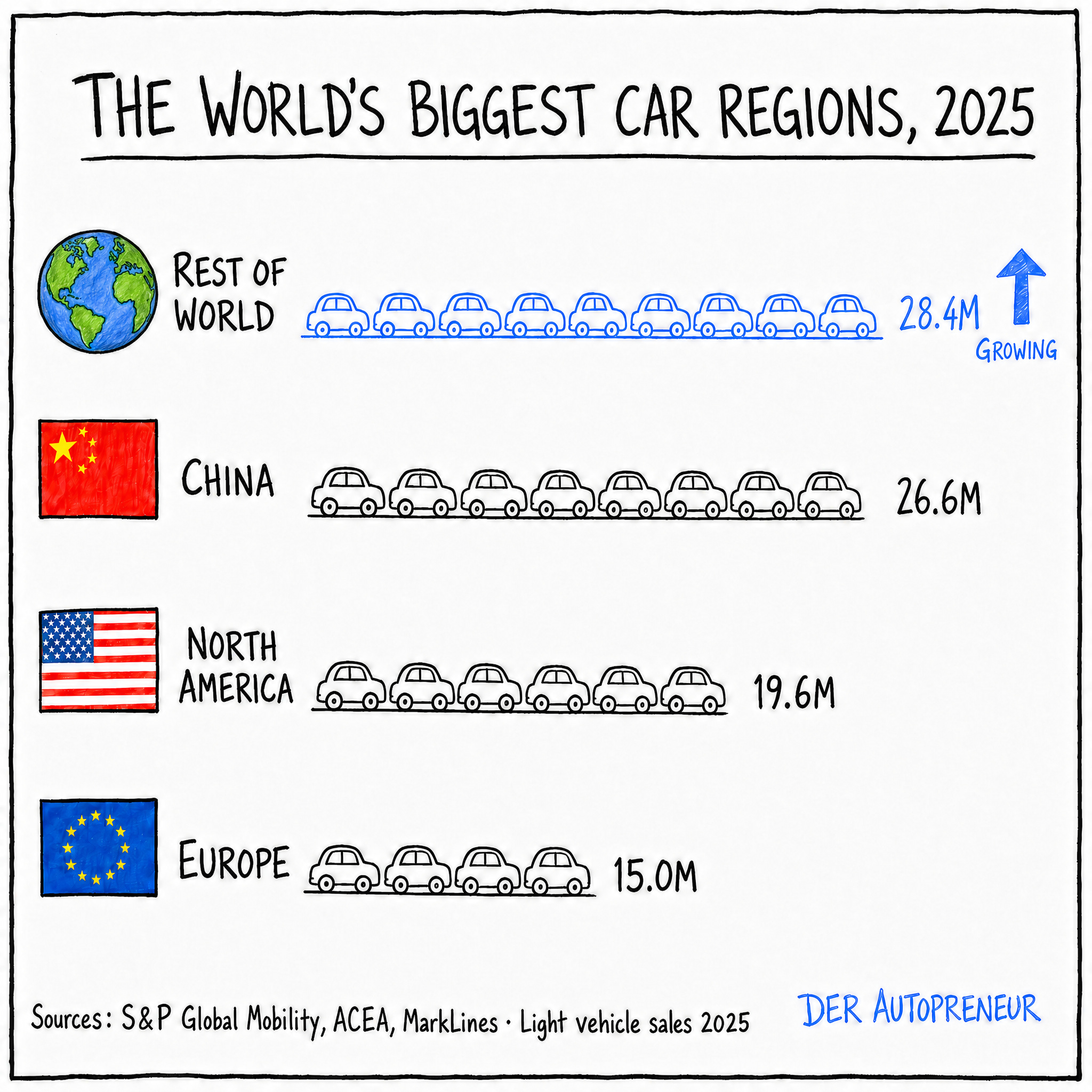
The industry splits the world market into 4 big regions. New car sales in 2025 at a glance:
China: 26.6 million. The largest single market in the world. After 2 decades of boom, it’s now heading for a plateau
North America (US, Canada, Mexico): 19.6 million. Barely any growth left, but stable at a high level
Europe: around 15 million. Selling about the same for years
Rest of World, meaning everything outside these 3 regions: around 28 million combined. As a block, even a bit bigger than China, and bigger than Europe and North America on their own. And the fastest-growing region of all
Rest of World sounds like an afterthought. That’s where the name comes from. On their own, these markets were long too small. They didn’t show up next to China, Europe, and North America.
It mainly includes (2025 sales):
India: 4.5 million, now the third-largest single market in the world
Japan: 3.8 million, the exception here. A mature market with barely any growth, where buyers mostly pick hybrids
Brazil: around 2.5 million
Plus Southeast Asia, the Middle East, Latin America, and Africa
Completely different markets. But this is exactly where the growth will come from in the coming years.
For context, Germany sold around 2.8 million cars in 2025.
So much for where cars are bought. Who builds them is just as interesting. And who sells them to the world.
China Exports Almost 2x as Many Cars as Germany Builds
Where are the most cars built? The top 5 in production in 2025:
China: 34.5 million, 1 in every 3 cars in the world
US: around 10.2 million
Japan: around 8.4 million
India: 6.5 million
South Korea and Germany: around 4.1 million each
China has been number 1 since 2009. India has clearly overtaken Germany.
How much of that production goes abroad? The 3 biggest car exporters in 2025:
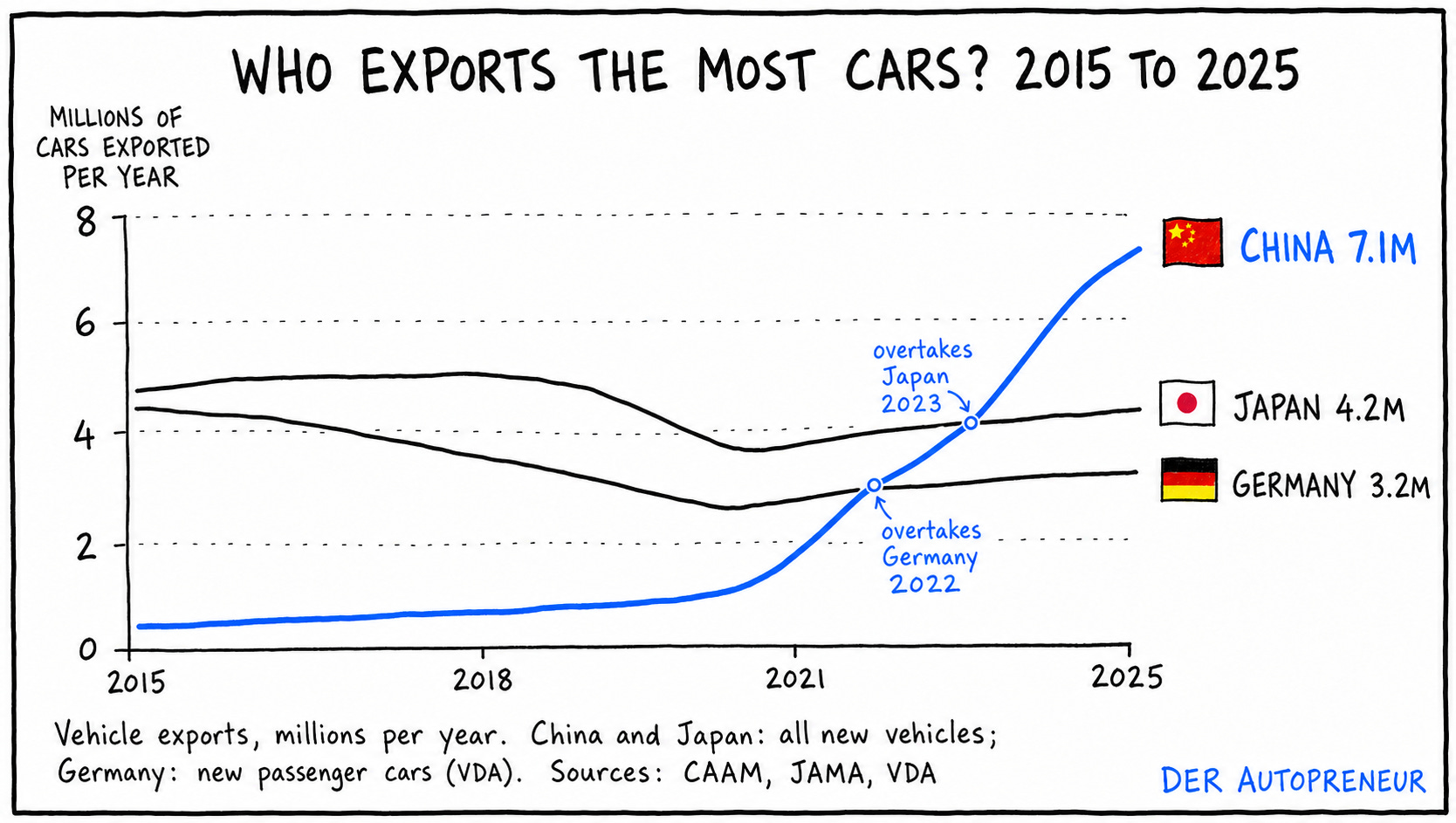
China: around 7.1 million (a record)
Japan: around 4.2 million
Germany: 3.2 million
For decades, Germany was THE export champion. In 2022, China first overtook Germany, then Japan in 2023. Since then, China has been number 1. And today China exports almost 2x as many cars as Germany even builds.
But that’s only the view by volume. By value, the ranking looks different. German passenger-car exports brought in around $170 billion in 2025, more than any other country. China ships more than twice as many cars but brings in an estimated $120 billion. So there are 2 export champions. China by volume, Germany by value.
But why does China export so much in the first place? Because its factories can build far more than its own market absorbs.
Capacity: an estimated 45 million cars a year
Sales at home: around 27 million
This overcapacity pushes Chinese cars onto the world markets. Especially the growing ones. And these exports are getting more electric. In April 2026, more than half of them were EVs for the first time.
1 in 4 New Cars Is Electric
In 2020, 1 in 20 new cars worldwide was electric. In 2025, it’s 1 in 4. And the world’s biggest EV maker is no longer Tesla. It’s BYD (2.26 vs 1.64 million pure EVs sold).
The combustion engine is past its peak. In 2017, the world sold around 86 million pure combustion cars. In 2024, around 60 million. Down 30% in 7 years.
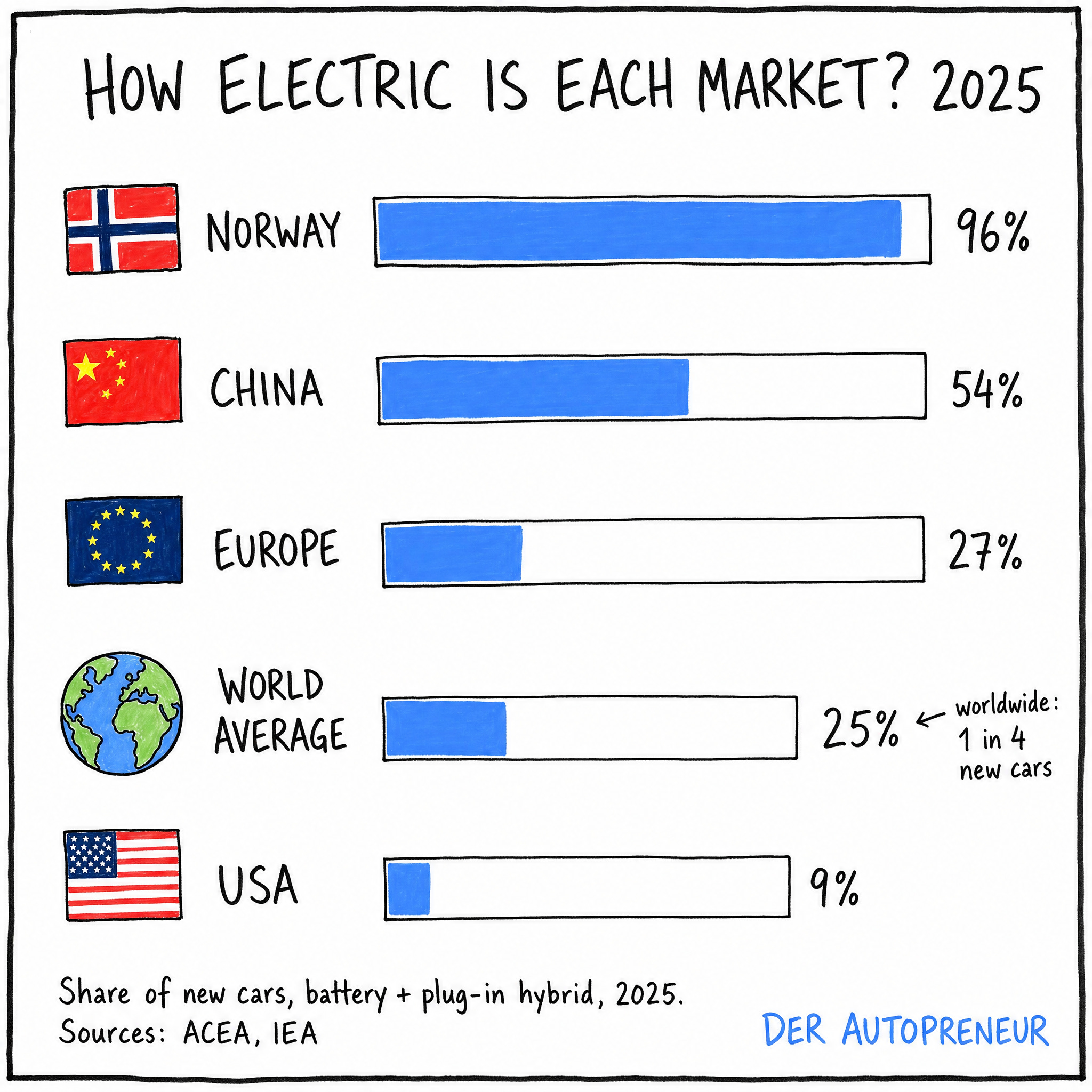
But every market switches at its own pace. The share of EVs and plug-in hybrids in new cars in 2025:
Norway: around 96%
China: around 54%
Europe: around 27%
Global: around 25%
US: around 9%, and falling since the purchase subsidy ended in 2025
Rest of World: still in the single digits, but +48% growth in 2025, faster than any other region
The driver is almost always the same. Imports from China.
4 Numbers Worth Keeping in Mind
Almost 1 in 2 new cars worldwide is an SUV. In Europe it’s 54%
Europe’s most popular powertrain is the hybrid without a plug, at 34.5%. Diesel comes last among the major powertrains, at 8.9%
New cars are at record prices almost everywhere. In the US and Germany, around $49,000 on average. Only in China are they falling. A new car there costs around $23,500 on average, roughly half
Hydrogen stays a niche. In 2025, more than 20 million EVs sold against around 16,000 hydrogen cars. 1,000 to 1
But who actually sells all these cars?
Who Controls the World Market
So far this was about markets, production, and powertrains. Now it’s about who sells them. Here, each carmaker counts under its home country, no matter where in the world it sells.
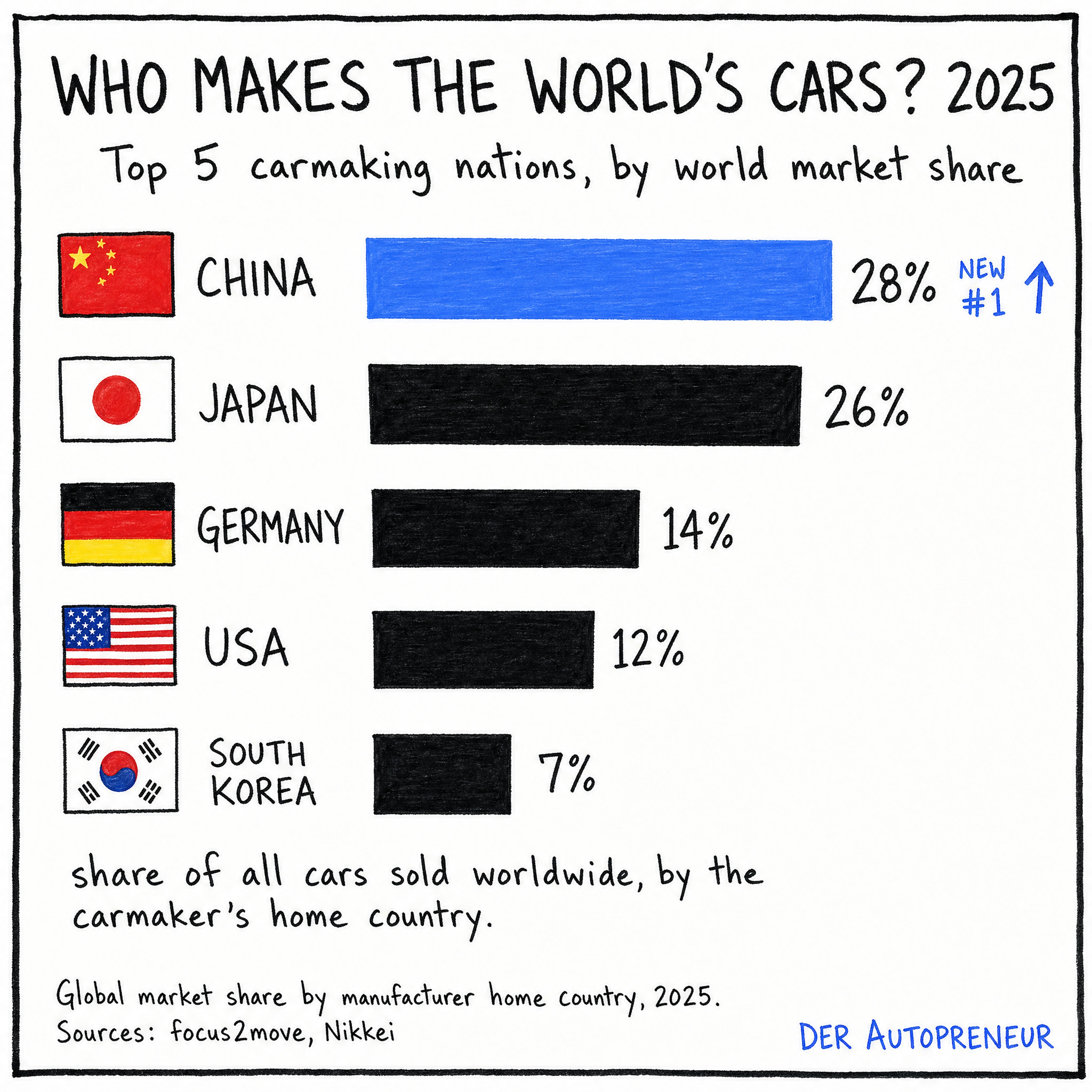
For more than 20 years, Japan was number 1 in this count. In 2025, that’s over. China has overtaken Japan.
The world market ranking for 2025, measured by share of all vehicles sold worldwide:
China: around 28% world share (27 million vehicles), rising fast
Japan: around 26% (25 million), stagnant
Germany: around 14% (13 million), slightly falling
US: around 12% (12 million), stable
Korea: around 7% (just over 7 million), stable
It happened fast. In 2022, China was still 8 million vehicles behind Japan. And the forecast: by 2030, 1 in every 3 cars sold worldwide will come from a Chinese brand.
The biggest single group is still Toyota. It’s the only one that sells more than 10 million cars a year.
And Germany? That always means 3 groups. VW, BMW, and Mercedes, with all their brands from Audi to Porsche. Together they hold around 14% of the world market. Put differently, about 1 in 7 cars sold worldwide comes from a German group. For EVs and plug-in hybrids, it’s still 1 in 9.
Here’s the German market share by region:
Europe: around 36%, the strongest region
China: around 16%, a few years ago it was still over 20%. And still falling
US: around 8%, stable at a small level
Rest of World: under 10%, with big differences by market
So the old growth engine stalls. In 2025, VW, BMW, and Mercedes all lost share in China. Mercedes and BMW even by double digits. And 2026 doesn’t look any better so far.
My Take
The German auto industry lives off exports. The model was always the same. Develop in Germany, sell worldwide. Especially where the market is growing.
For 20 years, that growth market was China. That’s over now. In 2025 it did grow strongly once more, driven mostly by government purchase incentives. But the boom is done. In the coming years, the market heads for a plateau. And what growth is left, Chinese brands increasingly take for themselves.
For German carmakers, that means one thing. Their business in China will get smaller in the coming years, not bigger.
That makes Europe as a home market even more important. But Europe hasn’t grown for years. At the same time, Chinese brands are attacking here. Their share of the entire European car market has almost doubled in just one year, from around 4% to over 7%. By April 2026, almost 10%.
In a market without growth, that only happens at the expense of the established players. In plain terms, German carmakers will likely sell less in Europe too, not more.
Then the US. This market isn’t growing either. For German carmakers, it’s a stable but small premium niche. And US tariffs make the business even harder. Don’t expect big jumps here.
In none of these 3 regions will German carmakers grow in the coming years. That leaves just one growth region. Rest of World. Almost all the growth in the coming years comes from these markets. That’s where carmakers will win the customers of the next 20 years.
Chinese carmakers have figured this out. They are expanding into exactly these markets. The market share of Chinese brands there:
Southeast Asia: in the big markets, up from around 6% to over 10% in a single year
Middle East and Africa: from 10% to more than a third by 2030
Brazil and Thailand: recently around 85% of all EVs sold
And they change these markets in the process. Where Chinese brands move in, the market tips from combustion to electric much faster. So the same fight repeats there. First China, then Europe, now these markets. German carmakers can compete on combustion engines. On EVs, they struggle to keep up with China.
Still, there’s no way around these markets. Only there can German carmakers offset the coming losses from China and Europe. So the focus has to move to where the growth is.
But there’s a catch. Rest of World isn’t one market. It’s dozens. India isn’t Brazil. Thailand isn’t Saudi Arabia. There’s no single strategy for all of them. Whoever wants to win these markets needs a separate answer for each one.
So the growth isn’t gone. It’s just somewhere else. The next decade of the car industry won’t be decided in China or Europe. It’ll be decided in the rest of the world.
And the best part: this race has only just begun.
🔗 sp | oica | dst | cnp | acea | iea1 | iea2 | f2m | alix | nik
That’s all for today.
Until next week,
Philipp
PS: If you find value here, share it with someone who should read it too.
Want to work with me?
I help global B2B companies connect with 100,000+ automotive decision makers in Germany.
I read up to the point where the author wrote: China exports so much because there is over-capacity.
This is entirely the wrong perspective.
This isn’t exporting surplus because they’ve accidentally produced too many cars and domestic demand has been weaker than expected.
They’ve produced so many because they want to compete, they want to eat your marketshare, they want to dominate the sector.
This is normal, every company in the world wants to dominate the global market. Since when did VW say,
“whoops sorry, I’ve become too dominant, I’ll cut production so Nissan can sell more cars next year and survive?”
It’s a competition, the Chinese have the right technology, they have the vertically integrated market, they have the economies of scale, they have the automated systems, they’ve got the software.
And with that combination, they’ve built compelling cars and are able to manufacture them at a compelling price.
It’s never been about over-capacity, as the Americans and Europeans have framed it. It’s about competition, market share and dominance and all the traditional ICE car makers in Europe, the U.S. Japan are losing.
I’m betting on a rise in palladium prices. Booming ICE and hybrid vehicle sales would be welcomed.