


Ad
How to get engineers without hiring anyone
Engineers in Germany are expensive. And for a single project, a permanent hire rarely pays off.
The answer is nearshoring. RecruTec brings engineers, software developers or testers from Poland into your team. They work remotely, in the same time zone as Germany. And only for as long as the project runs.
Hourly rates start at €30.
RecruTec has been working for the German auto industry for years. The Polish company specializes in engineering and IT professionals.
You don't need to book a meeting. You'll get a personal reply with a cost estimate.
Welcome to Issue #136 of The German Autopreneur.
In Germany, there's a story we like to tell ourselves: China is to blame for the crisis in our car industry. Subsidies let Chinese carmakers build cheaper cars. And German carmakers can't keep up with those prices anymore.
And it's true: China builds cheaper cars. But the real problem for Germany's car industry is somewhere else.
What this crisis is really about: the old car industry against the new one. Not the West against China.
Over the past 20 years, a new car industry has emerged in China and the US. But not in Europe.
Here's what I'll cover today:
What the new car industry is and how it emerged
Why Europe's car startups really failed
Why Europe will lose its old car industry if it doesn't build a new one
And at the end, I'll tell you how Europe can save its car industry.
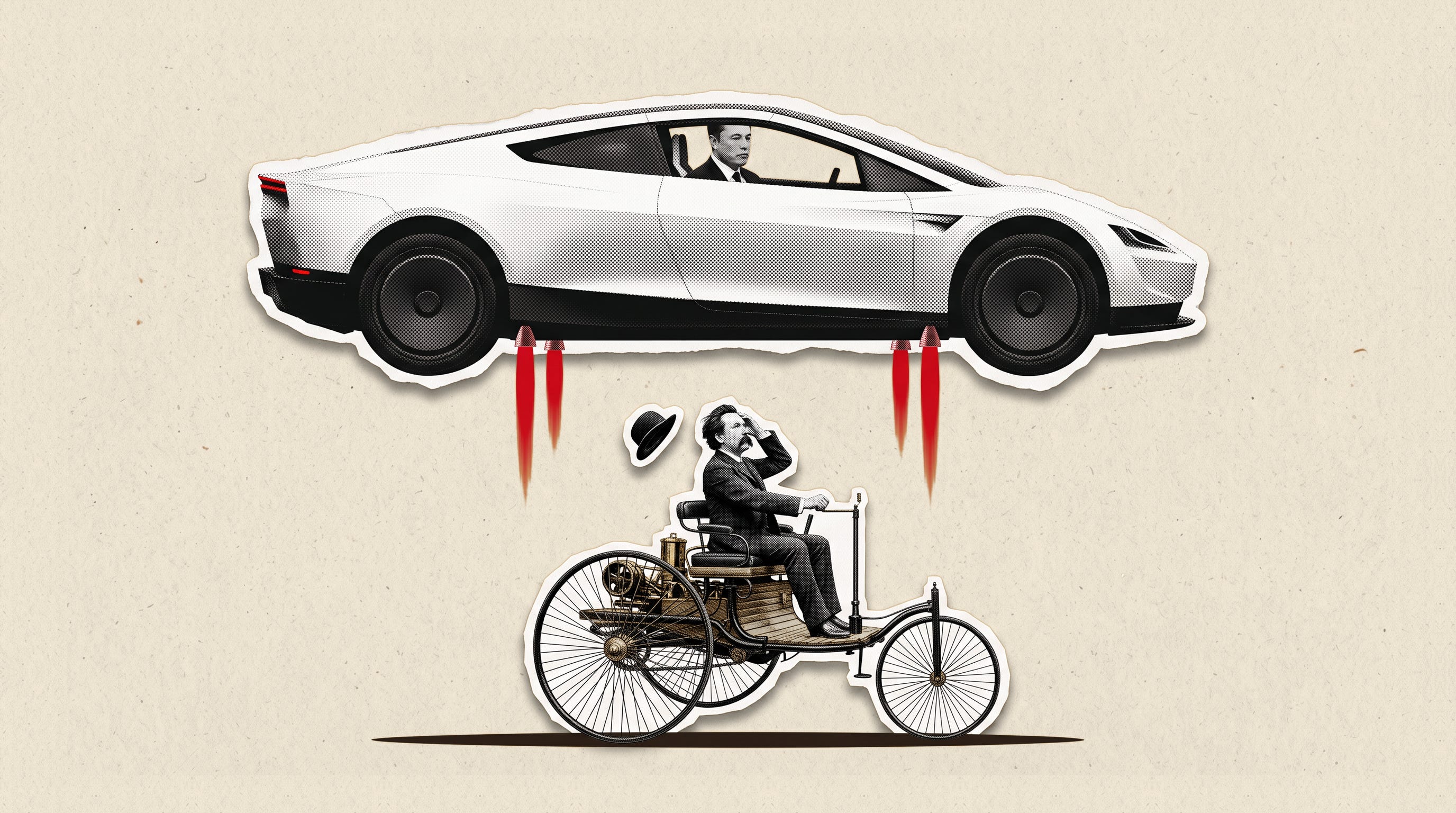
The New Car Industry Is Already Worth More Than the Old One
First, what do I mean by old and new?
The old car industry emerged in the 19th and 20th centuries. It was built on mechanical engineering and the combustion engine. Everyone knows the names: VW, Toyota, GM and Bosch.
The new car industry emerged over the past 20 years. It's built on batteries, software and AI. Legacy carmakers have a really hard time with these technologies. Yet soon, up to 80% of a car's value will come from them. I've written about this many times.
The new car industry is made up of a whole new generation of companies:
New carmakers like Tesla or Nio
New suppliers like battery manufacturer CATL
A new type of tech company like Momenta or Wayve. They supply software and AI for cars, not parts
And big tech companies entering the car business: Google with Waymo, Nvidia, Huawei, Xiaomi, Baidu and Alibaba
The clearest place to see both generations side by side is the US:
Detroit is home to the old car industry: GM, Ford and Stellantis
The new one is on the West Coast: Tesla, Rivian and Waymo
And on the stock market? The gap between old and new is huge:
Tesla is worth around 12x as much as GM, Ford and Stellantis combined
Waymo is worth about as much as all 3 together
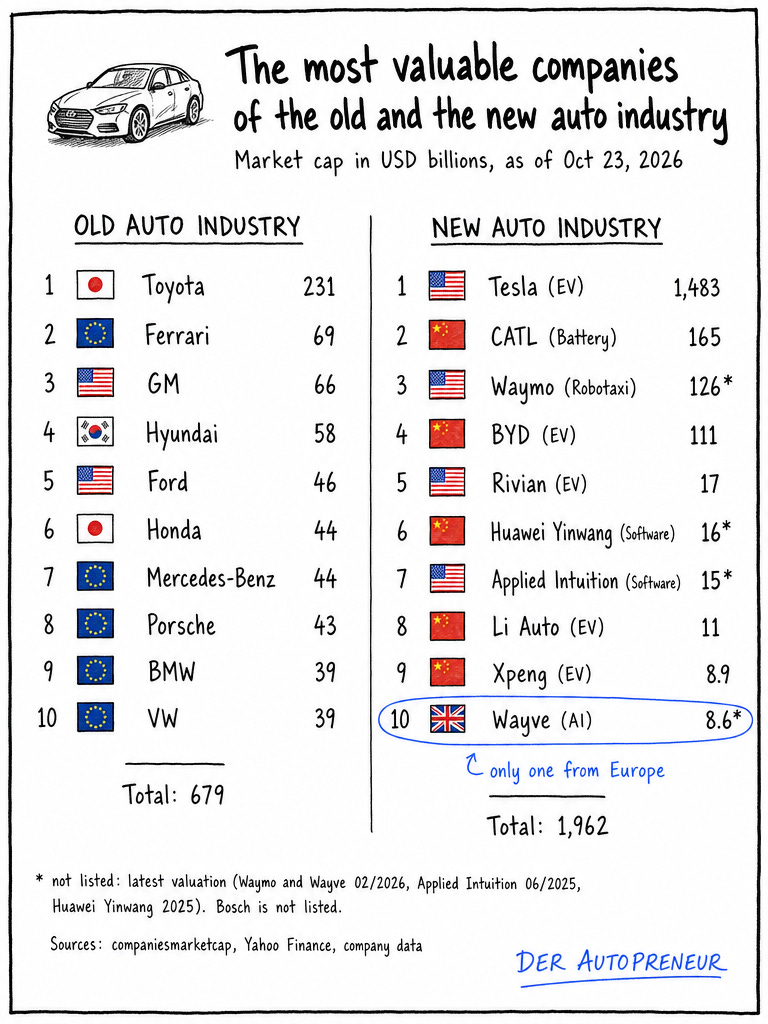
Europe has 5 of the 10 most valuable companies in the old car industry. In the new one, there's just 1: Wayve in London.
How did this new car industry come about?
How Tesla Invented the New Car Industry
For decades, hardly any startups entered the car industry. Combustion engines were so complex that they acted as a wall around the industry. They kept new competitors out.
In 2003, 2 engineers in California founded Tesla. Back then, almost nobody believed in EVs. Elon Musk did. In 2004, he joined Tesla as its biggest investor.
With EVs, Tesla tore down that wall. That's because an EV is much simpler to build than a combustion car. Suddenly, the market was open to startups.
Over the next few years, Elon bet on all 3 technologies of the new car industry:
Batteries: They're at the heart of Tesla. The car is built around a large battery
Software: Tesla treats the car as a software platform rather than a machine
AI: Tesla believes cars will soon drive themselves. That's why Tesla has spent around 10 years developing an AI that drives the car. In 2025, their robotaxis launched in Austin
That made Tesla a kind of blueprint for the new car industry. And hundreds of startups followed Tesla's example.
These included new carmakers, suppliers and tech companies:
In the US, there were new carmakers like Lucid (2007) and Rivian (2009). Plus autonomous driving companies like Zoox, Aurora and Nuro. And in 2009, Google launched the self-driving car project that later became Waymo
In China, hundreds of EV companies were founded, including Nio, Xpeng, Li Auto and Leapmotor. Plus new suppliers: CATL for batteries, Horizon Robotics for chips, Momenta and Pony(.ai) for autonomous driving. And from 2013, the big tech companies got into cars too: Baidu, Alibaba, Huawei and Xiaomi
In Europe, there were new carmakers like Rimac (2009), e.Go (2015), Sono and Lightyear (both 2016). Plus Northvolt for battery cells and Wayve in London for autonomous driving
That's how a whole new generation of car companies emerged in 20 years.
What happened to these companies?
Car Startups Only Grow Big in the US and China
It's normal for startups to fail. What matters is whether a few eventually become very big. And that's where the regions differ.
US:
EV startups like Fisker and Lordstown went bankrupt. So did electric truck startup Nikola
The ones that got big are mainly Tesla and Waymo. Waymo is now at over 500,000 paid rides a week with driverless robotaxis
Rivian and Lucid have survived, but they're still much smaller than Tesla
China:
More than 400 EV brands have disappeared since 2018. Even big names like Neta and HiPhi went bankrupt
But Leapmotor, Xpeng, Xiaomi, Li Auto and Nio have grown big. In 2025, each of them delivered between roughly 330,000 and 600,000 cars
China also produced the world leaders in batteries and EVs: CATL and BYD
Several startups already run driverless robotaxis there, like Pony(.ai) and WeRide
Europe:
Europe had plenty of startups too. But almost none of them made it. No EV startup in the EU has ever sold 10,000 cars in a single year. Many failed:
Electric van startup Arrival went bankrupt. So did Sono and Lightyear with their solar cars
e.Go even went bankrupt 2 times
Germany's postal service Deutsche Post bought the startup StreetScooter and later shut down production
And even Europe's biggest new supplier went bankrupt: the battery maker Northvolt
Only a few survived: Croatia's Rimac with its sports cars and London's Wayve in autonomous driving.
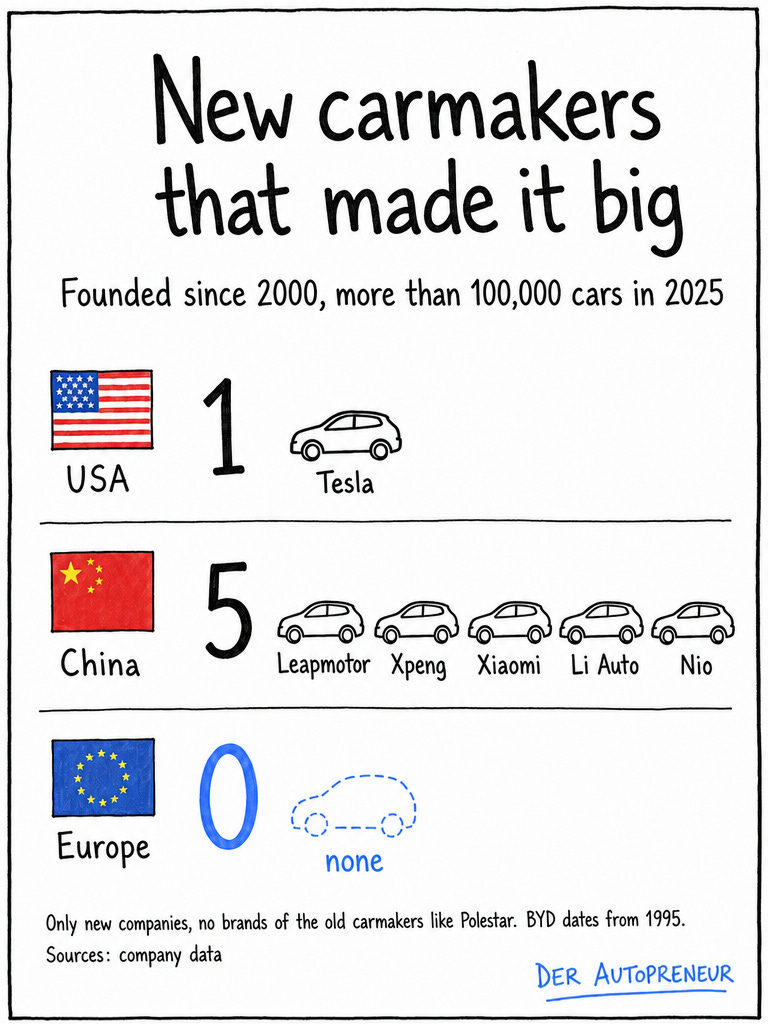
So startups were founded everywhere. But only the US and China ended up with a new car industry. Why not Europe?
Why Europe Has No New Car Industry
Here's what we usually hear:
Too much bureaucracy and regulation
A fragmented market
And costs are too high
That may all be true. But Silicon Valley is expensive too. Salaries there are even higher than in Europe. And yet that's where startups grow big. I think the main reason is something else.
For startups to grow big, they need 4 things:
Experienced people
Research
A large market
And money for risky bets
Europe has the first 3, at least to some extent. What's missing most is the money: venture capital.
Here's where the world's venture capital goes:
52% in the US
40% in China
Just 5% in the EU
Why does Europe raise so little?
With venture capital, everyone knows from day one: most of the money will be lost. Investors don't get their money back in 3 of 4 startups. But a few grow huge and make up for all the losses.
And that just doesn't fit Europe's culture. Especially in Germany, we value security and want to avoid risk. I'm sure that also comes from our history in mechanical engineering. In that field, the whole point is to rule out mistakes. So in Germany, failure isn't seen as normal.
Of course, some European startups do grow big. But when they do, it's usually with money from abroad.
In 82% of large EU funding rounds, the lead investor is based outside the EU. In San Francisco, it's the reverse: only 14% of rounds have a lead investor from outside the US.
And some startups even move abroad with the money. Between 2008 and 2021, just over 1 in 4 EU startups worth more than $1 billion relocated to another country.
Where does that lead? Mario Draghi used to run the European Central Bank. In his 2024 report to the EU, he wrote: in the past 50 years, no newly founded EU company has become worth more than €100 billion.
Since Draghi's report, only Spotify has barely made it past that mark.
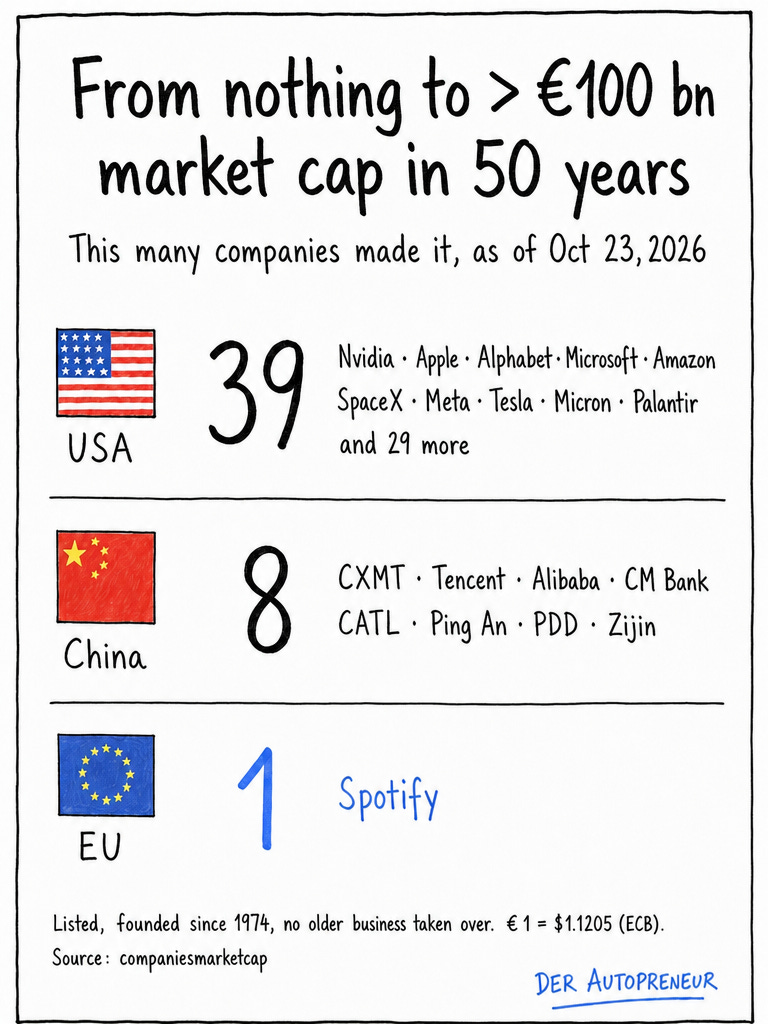
But it's an even bigger problem in the car industry.
Why Car Startups Need Money for So Long
Developing batteries, software and AI for cars means doing work nobody has done before. It can take decades of funding before anyone makes money:
Tesla took 17 years to make its first annual profit
Waymo still isn't profitable after 17 years
In the US, that money mainly comes from Big Tech and investors like Elon Musk. Sometimes the government helps too:
For over 10 years, Google funded Waymo on its own
Amazon gave Rivian money and ordered 100,000 delivery vans
When Tesla nearly ran out of money in 2008, Elon put in more of his own money. In 2010, the US government also gave Tesla a loan
In China, there's private money too. And when that's not enough, the government steps in:
Tencent, Baidu and Alibaba funded Nio and Xpeng early on
Many founders got rich in tech first and now invest their own money, like the founders of Xpeng and Li Auto
When Nio ran out of money in 2020, Hefei's city government and 2 state funds invested around $1 billion
There's been government funding in Europe too. But when startups ran into trouble, nobody stepped in:
Northvolt got around €1 billion from the EU and Germany. But when Northvolt ran out of money in 2024, nobody helped
Sono and e.Go each lost an investor
So Europe did have startups. But they didn't survive the years without profits. Because nobody was there to keep funding them.
And I think it's also because Europe's faith in the free market is a bit naive.
In China and the US, governments and Big Tech spend decades building key technologies, even when they don't pay off for a long time. China does this to become independent of the US. And the US does it to become independent of China.
In Europe, there are no big tech companies like Google or Amazon. So the free market doesn't provide that much money for that long. That really only leaves governments. They have to build up these technologies until the market can take over. And in Europe, they haven't.
That's why Europe now depends on China and the US for batteries, software and AI.
And that's exactly what's turning into a problem for Europe's old car industry.
Legacy Carmakers Can't Make the Shift Alone
So let's sum up: no new car industry has grown big in Europe.
And where does that leave VW, BMW and Mercedes?
They're part of the old car industry. And the new one is replacing it right now. Only those legacy carmakers that make the jump to the new car industry will survive.
But almost none of them can do it on their own:
VW was counting on its software subsidiary CARIAD. But CARIAD failed, even though a huge amount of money went into it
Ford and VW shut down their joint robotaxi company Argo AI in 2022
GM shut down its robotaxi company Cruise in 2024 after spending over $10 billion
And in 2025, Ford cancelled its own new software platform for cars
Here's what does work: partnerships with companies in the new car industry. These partners already know how to do what legacy carmakers still need to learn:
Mercedes gets its autonomous driving software from Nvidia
Stellantis bought a stake in Leapmotor and sells Leapmotor's EVs in Europe
BMW and Mercedes buy their driver assistance systems for China from Momenta
And here's something many people miss: China also has an old car industry.
These are mainly the big state-owned carmakers like SAIC, GAC and Dongfeng. They're struggling with the change just as much as European carmakers.
In China too, carmakers are using the same strategy: partnerships with companies from the new car industry. Often, the partner is Huawei:
Seres used to mainly build cheap minivans. With Huawei, Seres sold over 420,000 cars under its Aito brand in 2025
Changan, Chery and SAIC are also building their own brands with Huawei
VW has copied exactly this strategy, with Rivian in the US and Xpeng in China. The hope is that these partners will pull VW into the new car industry.
And that makes Europe's problem clear: VW's new partners aren't European. Because Europe never built a new car industry of its own. VW's biggest new partner in Europe was Northvolt. And Northvolt is bankrupt.
So legacy carmakers in Europe only have 2 options:
Stay in Europe, find no partners and probably not survive
Or move development to wherever they can find partners: the US and China
In other words: without a new car industry of its own, Europe will eventually lose the old one too.
My Take
So Europe's problem isn't China. It's that Europe never built a new car industry.
The winner is already clear: the new car industry. Many legacy carmakers will die. The big question is which of them will make the jump.
My impression: politicians in Europe mainly want to save legacy carmakers and their jobs. The plan: subsidies, so the carmakers can keep up again on their own.
But as we've just seen, they almost never manage that on their own. And they only find partners in the US and China.
That leaves Europe with a dilemma:
European taxpayers fund legacy carmakers
Those carmakers invest in partnerships abroad because there are no partners in Europe
Rivian alone is getting up to $5.8 billion from VW
In the end, taxpayer money flows to the US and China. And development, expertise and jobs go with it
People often ask me how to save Germany's car industry. And some say: All you ever do is describe the problems.
Fair enough. Here's my answer: not by giving the old carmakers more taxpayer money. But by making sure that startups in batteries, software and AI can grow big in Europe.
And VW, BMW and Mercedes would benefit too. They'd find their partners in Europe instead of moving abroad. They'd buy their technology from European startups. Those startups would grow, supply even more and become big tech companies themselves. And that would bring value chains, jobs and prosperity to Europe.
The catch: it'll take a lot of money over a very long time. In Europe, hardly anyone but the government can provide that.
So if you want to save Europe's car industry, you'll have to build a new one.
🔗 cmc | wy | row | el | dr | eib | cs | mb
PS: Reading this in Promotions or spam? Add autopreneur@substack.com to your contacts, or just hit reply. That tells your email provider to deliver it to your inbox.
PPS: Know someone in the car industry who wants to understand why Europe has no Tesla? Send them this issue.
A word from me
You could help Mercedes or Bosch. But they've never heard of you
The German car industry is a closed club. You're either inside or outside. And from abroad, you start outside.
Outside means paying over $20,000 for a trade fair booth. And you leave with 100 business cards and 3 real conversations.
I'm on the inside. I spent almost 10 years at Mercedes-Benz. Every week I reach over 100,000 people in the German car industry through my German newsletter, podcast, YouTube channel and LinkedIn. They trust me. So when I tell them about you, they listen.
An IT services company got 250 webinar signups this way. A consulting firm got 60 new contacts at decision-maker level.
My partnership page shows packages, prices and past campaigns with their results. You can also request a free 30-minute call there. By the end of it, we'll know if it's a fit.
Only 2 campaign dates are left this year: December 6 and December 20.
See you next Wednesday,
Philipp