


Ad
85% fewer defects, before the first car is even built
That number comes from a real EV development project.
With simulation software from IPG Automotive, you test the entire vehicle on the computer. Through every driving situation, long before the first real prototype exists.
Same project: 60% fewer prototypes and 40% less development time.
IPG Automotive is your partner for virtual vehicle development.
The whitepaper shows you how to get there:
Welcome to Issue #124 of The German Autopreneur.
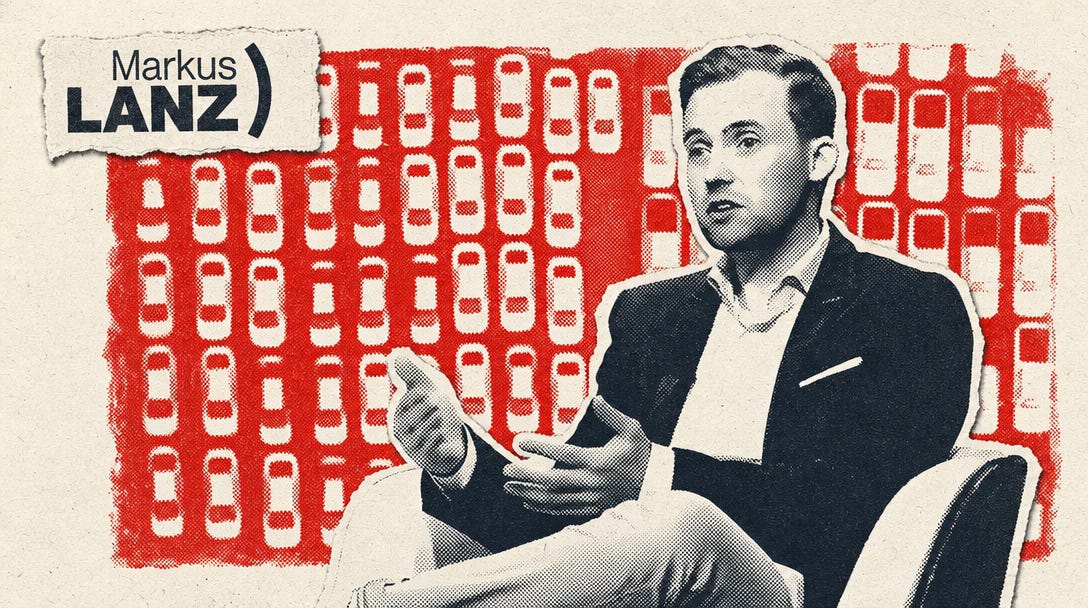
This week I was on Markus Lanz, one of Germany's biggest prime-time talk shows. We covered a lot. One topic was the EU's 2035 combustion engine ban. Again.
So I want to step back and look at the whole picture.
It's the same debate Europe has been having for years. 2035 or 2040. Soften the rule or hold it. Ban combustion or keep the door open. And the longer I listen, the more certain I am: Europe is fighting about the wrong thing.
Today I'll cover 3 things:
Why the 2035 date barely changes the outcome
Why up to 80% of a car's value will soon sit in battery, software, and AI, exactly where Germany is behind
Why German carmakers themselves are lobbying to soften the rule
Where the Debate Stands Right Now
The state of play:
2023: As part of the Green Deal, the EU agreed to ban the combustion engine. The rule says a new car in 2035 must emit on average 100% less CO2 than in 2021. In practice that means EVs only
December 2025: The European Commission proposed cutting the target from 100% to 90% less CO2. Roughly 10% of new cars in 2035 could still be combustion. Credits for e-fuels, biofuels, and green steel make that possible
Now: The debate is about softening the softening. After all the credits, a new car in 2035 would only have to emit about 73% less CO2 instead of the planned 100%
Nothing is decided yet. The EU's environment committee votes this fall. Then the full EU parliament. Then negotiations with the member states
The Ban Has Nothing to Do With the Crisis
Here's what we know. The car industry is in a crisis right now. Especially in Germany.
In the debate it often sounds like the ban is the cause and scrapping it is the cure. That's the wrong analysis. It links 2 things that have nothing to do with each other.
The ban takes effect in 2035. That's 9 years away. The crisis is happening now. One can't have caused the other. And by the same logic, scrapping or softening the ban can't fix the crisis either.
The crisis has 2 causes. Neither has anything to do with the 2035 date:
1. The technology shift. An electric powertrain is simpler to build than a combustion one. Fewer parts, less labor, fewer jobs
2. New competition from China. German carmakers are losing market share to new rivals, mostly from China and the US. So they sell fewer cars
Neither softening nor scrapping the rule fixes those causes. The crisis has a different root. So a later ban is not the cure.
That doesn't mean softening is pointless. It can help the industry. Just not the way most people think.
Are EVs Even Coming?
First a reality check. Say Europe scraps the ban completely. Does that stop EVs? No. They win even without a ban.
For a long time EVs had real drawbacks in daily use. Mostly range and charging time. At first, mainly early adopters bought them and accepted those drawbacks.
Today those drawbacks are basically gone. The current state of the technology:
Charging in 5 minutes
700 to 900 km of range
Even German models now charge in 10 minutes and reach 800 km.
That kills the practical argument against EVs. The competition shifts to price. And the mass car market always decides on price.
We just saw how fast that can happen. When the oil price jumped during the Iran crisis, demand for EVs rose sharply.
The mechanism behind it is simple. Picture two curves forming an X.
Combustion gets more expensive. The technology is fully developed, so there's little left to gain. And fuel keeps getting more expensive over the years
EVs get cheaper. The technology is still early and will get far more efficient. On top of that, huge economies of scale keep pushing prices down
Where the two curves cross, the market flips. And it flips fast.
In China it already happened. In 2025, more than half of all new cars there were electric or plug-in hybrids. One reason: on the total cost of ownership, an EV is already cheaper there than a combustion car. In Europe, price parity should arrive between 2026 and 2028, depending on the segment.
So the "if" is settled. Only the "when" is open.
The EU can influence how fast it happens here. But the market will flip anyway. And as an export industry, most of Germany's sales sit outside the EU in any case.
The Old Car vs the New Car
So the EV is coming. But there's one more thing to understand. An EV isn't just a car with an electric motor.
It's a new product category, invented mostly by Tesla. In China they call it the smart car. A computer on wheels.
You can see it in what makes up a car's value:
Before: mechanics. Engine, transmission, chassis, sheet metal
Now: battery, software, and AI
The battery alone already makes up 30% to 40% of a car's value. Add software and electronics. Their share rises to as much as 40% of the vehicle's value by 2030. Most of all, it's the AI that runs the car.
So battery, software, and AI together will soon make up as much as 80%. What classically defined a car is now only 20%. The mechanics become a commodity. And unfortunately, that's what Germany does best.
As the value shifts, so do the skills you need to build a car. And those are the skills Germany lacks.
So today there are 2 cars:
The old car. The combustion car we know
The new car. The software-defined EV, run by AI
On the old car, Germany leads. On technology too. On the new car, Germany is 1 to 2 product generations behind.
And that leads German carmakers to do something that looks backwards.
Why Carmakers Want to Delay the Ban
German carmakers sell in every major market in the world. And all of these markets are flipping from the old car to the new one. Just at different speeds.
If you want to hold your position everywhere, you have to do both everywhere. Build the old car and the new car at the same time. Run both tracks at once.
That's expensive.
On the new car, German carmakers are behind. So they have to do 2 things at once. Catch up, and keep the old business running. That double load eats into profits. It shows up every few months in the grim quarterly headlines.
So you'd expect carmakers to want this expensive phase to be as short as possible. They do the opposite. They want to sell combustion cars for longer. Why?
The reason is money. Catching up on battery, software, and AI costs enormous sums. And that money comes from the old business, where the margins still work. The profitable combustion car funds the future technology.
That's why they lobby in Brussels to scrap the ban.
The Dilemma for Policymakers
At first glance the answer seems obvious. If German industry is behind, and the old business funds the build-up of the new one, then policy should support exactly that.
Loosen the rules. Give the old business more time so carmakers can catch up globally. Sounds reasonable.
But there's a catch. The carmakers and the EU don't want the same thing:
A carmaker wants to make a profit, anywhere
The EU wants to keep high-value work and jobs at home
The problem is that this catching up doesn't happen in Europe. German carmakers build and buy their future technology mostly in China and the US. They're building their future there, not in the EU. So the high-value work and the jobs move abroad. And nothing guarantees they ever come back.
That flips an old arrangement. For decades, China was Germany's factory floor. Germany designed at home and let China build it. With the new car it's the other way around. Development now sits in China, not in Germany.
Volkswagen shows what this looks like in practice. There's no longer just 1 VW. There are 3:
The old VW in Germany builds the old car, the one we know
A VW in the US develops the new car for the West, together with Rivian
And a VW in China develops the new car for China, and probably for emerging markets too, together with Xpeng
The future is taking shape in the US and in China. Europe keeps the old business.
So Germany earns its money with the car of yesterday and develops the car of tomorrow somewhere else.
The EU can help carmakers run the old business longer. But that also helps push the high-value work abroad. That's the dilemma the EU has maneuvered itself into.
The Real Mistake Is Industrial Policy
The reason the EU ends up in this dilemma at all goes back to a deeper flaw in its industrial policy. The idea of staying open to every technology.
I went out on my own in 2020. The painful lesson I learned as an entrepreneur: only focus leads to success. Try 10 things at once and you'll be good at none.
For a market, staying open to all technologies is good. For a single company with a clear strategy, less so. For a country's industrial base, it's the opposite of strategy.
Because as Europe, we can't compete with China and the US in every sector. We have to decide what to bet on, and then be better than the rest at exactly that. That's what industrial policy is. Deciding what a country builds its prosperity on.
Staying open to everything means not deciding. Jack of all trades, master of none.
And whoever doesn't decide ends up average everywhere. Average isn't enough against China and the US. Then you fall behind across the board.
The best argument for this is China itself. China didn't win the car market by staying open to every technology. The opposite. They were ruthlessly focused.
And with one goal. To take high-value work and jobs away from competing economies. From economies like ours.
And it worked. VW, Bosch, and others are moving their most valuable engineering jobs to China right now.
The One Time Europe Actually Committed
This is exactly what the EU tried with the Green Deal. It was never just climate policy. From the start it was also an industrial bet. Build a homegrown industry around green technologies. Batteries, electric powertrains, charging infrastructure.
China made the exact same bet. Just packaged differently, and a good decade earlier. As part of its five-year plans.
To build an industry like that, you first need a market trigger:
The EU set the CO2 limit
China used targeted subsidies
The effect is the same. Give the market a clear direction. The Chinese route uses subsidies instead of bans. That's easier to swallow, because it creates less resistance.
But after that first step, China took a second one. Because building an industry means 2 things:
1. Set the direction
2. Go in with real money, long before it pays off
The difference is in the second step:
China set the goal and then built the road to it. Over 15 years it pumped more than $230 billion into the market, until it had a whole industry. Carmakers, suppliers, and real competition
Europe set the goal and trusted the market to sort it out and build the road itself
The result: China built this green industry faster and bigger than Europe did. Now China is pushing into Europe's market with exactly that industry.
And it benefits from the rules Europe set for its own industry. So China threatens to choke that industry before it can even take off.
And Europe? Caught in the squeeze. Hold the target or loosen it? Protect its industry or its climate goals? Europe doesn't know either, and it reacts in contradictory ways:
On one side it pays up to $6,500 in subsidies per EV
On the other it softens the rule so that people buy fewer EVs
Europe hits the gas and the brake at the same time.
That's no way to build an industry. And that's exactly what staying open to every technology looks like.
My Take
What bothers me most about this debate: in Germany we turned a sober economic question into a culture war.
One side ties the combustion engine to the good old days and sees the EV as some left-green climate cult. The other side is firmly pro-EV. But they focus so narrowly on the environment that they miss the real point. China has overtaken Germany on technology.
And while both sides fight each other, someone else wins. That someone is China.
I take a deliberately neutral view, from the perspective of Germany as a place to do business. And from that angle, the real point is something completely different from the date.
The future of the car comes down to 3 things. Battery, software, and AI. Whoever doesn't master them will soon barely matter in this market. And that's exactly where Germany is behind.
Softening the ban can buy us time. But only if we use it to build exactly that. Otherwise bought time becomes lost time.
The exact date is secondary. Whether 2035 or a few years later, most markets will flip on their own by then anyway. On price, not on a ban.
What really worries me is the pattern behind it. German industrial policy is almost always reactive. We catch up on what others have already decided, instead of thinking ahead about what comes next.
You can see it in the battery. 15 years ago China started locking up the battery supply chain. Today it controls up to 90% of it. We're now paying a high price to break free of that dependence.
And while we do, the battery moment is repeating. This time it's about the AI that runs the car. The cards are being dealt right now. Nobody here has it on their radar yet. In the US and in China they do.
We're circling the engine ban date yet again.
What we should learn: the market won't sort this out anymore. Not against China and the US. There, policy decides, not the market.
We have to decide. What's our bet for the future? And then stick with it, even when it gets uncomfortable.
Today we manage the status quo. If we really want to save our car industry, we have to do the opposite. Build the future. And the future is battery, software, and AI.
🔗 ec | re | ea | iea | csis | cnbc
That’s all for today.
I’m Philipp. 10 years at Mercedes-Benz, independent since 2020. Now I cover the transformation of the auto industry from its epicenter: Germany.


P.S. If this was useful, forward it to one person in the industry who should read it. That's the kindest thing you could do for this newsletter. And a Restack helps more people find it.
Not subscribed yet? Subscribe here.
Everything else I’m working on.
A word from me
Your shortcut into European automotive
Selling to BMW, Bosch, or Continental from outside Germany? Good luck.
German automotive is a closed club. Built on trust, relationships, and decades of doing business face to face. Cold outreach doesn’t work. Trade fairs cost $20,000 for maybe 3 real conversations. And nobody takes meetings with companies they’ve never heard of.
I spent 10 years inside Mercedes-Benz. Today, 80,000 European automotive decision-makers follow me. From team leads to board level. They trust me. Because I speak their language. Literally.
One partner generated 250 webinar signups. Another got 60 qualified leads at OEMs.
I’m your bridge into the German auto industry.
The crisis is entirely manufactured by the EU bureaucracy with their bans (who is going to develop a next generation ICE engine, integrate it with software and other gadgets, etc with a ban in front of him!?) and mandates and financial penalties. Japanese manufacturers are facing the same Chinese competition but are not mass-firing their workforce neither bleeding losses (apart from the unfortunate EV pioneer Nissan). The EU bureaucrats should let their citizens buy the cars they want - be it German, Chinese or gas-guzzling American beasts
Where do the elements to build batteries come from? Where does the steel come from? The Rare Earth materials? The carbon composits?
No need to answer that.
China's green manufacturing is built on coal and gas. The green products produced by hydrocarbons.
So, it is not the choice between going green and hydrocarbons. China is the proof it does both.
Europe wants to go Green in an absolutist way. That will always fail. Time to wake up..