


Ad
See you in Stuttgart in 3 weeks at Vehicle Tech Week?
Vehicle Tech Week brings 3 worlds under one roof:
Automotive Testing
Autonomous Vehicles
Automotive Interiors
June 23–25 at Messe Stuttgart.
10,000+ attendees from the industry. Mercedes, BMW, Ford, Volvo, NVIDIA, Waymo and BYD will be there.
Welcome to Issue #120 of The German Autopreneur.
By 2035, 1 in 4 jobs in Germany’s car industry will be gone.
The VDA (Germany’s auto industry association) says 100,000 have already disappeared since 2019. Another 125,000 are set to follow.
And it’s not just the car sector. Across German industry, more than 10,000 jobs have disappeared every month for the past 2 years.
Audi CEO Gernot Döllner put it bluntly to his own people:
“This is no longer about a single model or market share here and there. It’s about the survival of the German auto industry.”
That’s a lot at once. And it sounds like the end.
Still, every week I get messages like this: why don’t you write something positive about the German car industry for once? Usually with a link to some shiny new model. I get it.
But here’s how I see it. Plenty of outlets celebrate those wins already. My job is to zoom out.
To ask where the industry is heading as a whole. To connect the scattered headlines into one picture. And to give decision-makers the signals that matter.
And when I zoom out, it doesn’t look good.
Germany’s time as a car nation is over.
Today we’ll look at:
Why Germany’s car business model is broken
Why the fight against China is a fight between systems, one we can’t win the way we’re playing it
Why we showed up late to 3 car technologies
And how we get out of this
Why Germany’s Car Business Model Is Broken
The “Made in Germany” success model always stood on 4 pillars:
Complexity. A combustion engine is one of the most complicated mechanical devices ever built. Thousands of parts, tolerances down to the micrometer. We did this better than anyone. That was our moat
An industrial ecosystem. Carmakers, suppliers, and research institutes next door to each other. Stuttgart, Munich, Wolfsburg, Ingolstadt. Entire cities built around the car, with hundreds of players packed close together, pushing each other to peak performance
Cheap energy from Russia
Profits from China. Our biggest growth market since the 1990s. We developed in Germany and sold in China. More every year. For decades the money just came in. Cash was never the problem
From these 4 pillars came a story that worked worldwide. A German car stands for quality and high tech. That’s why Mercedes, BMW, and Audi could charge a premium everywhere. More expensive, but better. That was the story.
Today all 4 pillars are crumbling at once:
The combustion engine matters less and less
The ecosystem is moving abroad
The Russian gas is gone
And China is buying fewer and fewer German cars
Volkswagen, Mercedes, and BMW now sell nearly a third fewer cars in China than in 2018. And that’s even though the overall market grew by about 25% in the same period. The market is booming, just without us. The money machine has stopped.
And the “Germany equals high tech” story doesn’t hold anymore. Because German cars no longer lead where high tech gets defined today. In the electric powertrain. In software. In AI.
And most of it leads back to China. So that’s where we look next.
Why the Fight Against China Is a Fight Between Systems
China built its own car industry in just a few years. One that has already overtaken us. For a long time, nobody in Germany took it seriously.
They did it by leapfrogging. They skipped an entire stage of development.
China realized early that it would never catch us in the traditional car market. We spent 100 years perfecting the combustion engine. No one gets close to that.
So the Chinese skipped the combustion engine. And asked themselves what comes next.
The electric, software-defined car.
They didn’t invent it. They copied it from Tesla.
They just understood earlier that this was where the future lay. And whoever controls the world’s biggest car market gets to shape that future.
This is even built into China’s industrial policy: first adopt, then understand, then do it better yourself. That’s how it went with high-speed trains, with solar, with AI. And now with the car.
And all of it was possible for one reason. China competes as an entire system.
Picture 2 soccer teams.
One has a coach. He sets the tactics, picks the lineup, and subs out anyone who doesn’t deliver. All 11 play toward the same goal.
The other has no coach. 11 individual players on the field. Each with their own strategy. And each one wants to score for himself.
That’s China versus us. A collective against individual players.
What does that mean? Here every company fights for itself. Each one runs its own strategy.
China works differently. There, an entire economy pulls toward one goal. Hundreds of companies, 1.4 billion people.
And above all those individual strategies sits a government master plan. A national industrial strategy that sets the direction.
The companies still compete with each other, of course. They’re meant to. But in the end they all pull in the same direction.
And it’s planned from the start that most of them will go under. That’s exactly the point. The goal is to produce global champions.
Here’s how the Chinese playbook runs in 5 steps:
The state sets the stage. Capital, subsidies, market access, talent, infrastructure
Hundreds of startups jump in. A whole ecosystem forms
Oversupply is allowed on purpose. More supply than demand
Whoever isn’t efficient and innovative dies. Brutal competition does the rest
The survivors are unbeatable. That’s how BYD and CATL were born. Today the biggest EV maker and the biggest battery maker in the world
VW CEO Oliver Blume said recently: “Our business model doesn’t work anymore. Not at Volkswagen. Not for Germany as a whole.”
He means more than a business model. He means a whole system that belongs to another era. Our system. Everyone fights for himself. Against an opponent that competes as a collective. With plans that run for decades.
And it gets worse. Because the car itself is becoming something entirely new.
Software Is Eating the Car
In 2011, tech investor Marc Andreessen wrote a line that became the most important thesis of the decade: “Software is eating the world.”
In Germany, that line never really clicked for us. We only understood what it meant once it had already happened:
2007, the phone. Nokia was the world leader. Then came the iPhone. Today Nokia doesn’t build phones anymore
2015, music. Once the CD on the shelf. Then came Spotify. Today nobody owns music
2020, banking. Once the branch with a counter and an advisor. Then came banking apps like N26 and Revolut. Today the bank is an app
Same pattern every time. An industry, stable for decades. Then software comes in and rewrites the rules. And the old leaders disappear.
And that’s exactly what’s happening to the car now. Except here the wave didn’t come once, but 3 times. First the powertrain went electric. Then the car became software. Now AI takes the wheel. Each wave built on the one before. And each came faster. We were late to every one. The third is rolling right now.
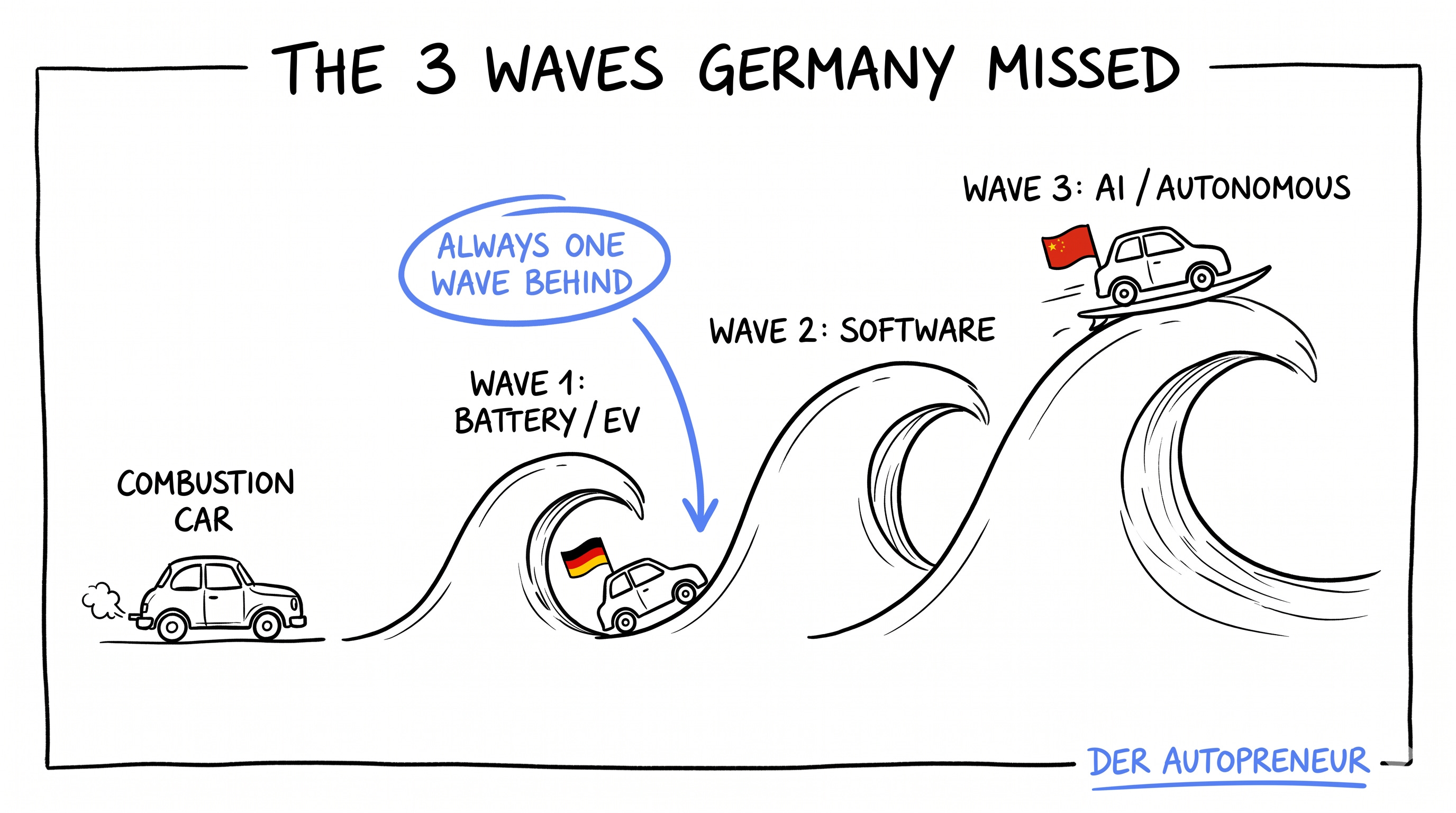
The car today is no longer the car we knew. It’s a computer on wheels. A robot that drives itself. The heart is a software platform. Everything runs on it: driving, assistance, AI. The metal around it becomes an afterthought.
That’s why the new generation of carmakers builds completely differently. Software first, then the car. They think like a tech company, not a carmaker.
And this is exactly where it gets dangerous for us. When the product changes this fundamentally, you need a completely different organization to build it. A different culture. Different processes. Different people. You have to turn your entire company inside out.
Almost no one manages it. German carmakers have been trying to pull off this exact rebuild for over 10 years. And still haven’t cracked it.
But why is that?
These companies were trained for over 100 years on a single task. Squeezing more and more out of a mature technology. 3% cost out, 5% efficiency in.
The system rewarded the optimizers and weeded out the inventors. For decades that was exactly right.
Today the game has changed. Now what counts is inventing something brand new. And that’s exactly what’s catching up with them. Perfecting something that exists and inventing something new are a whole different ballgame. A single company can almost never do both.
Volkswagen tried it with its software unit CARIAD. 6,000 developers, over $13 billion. In the end, the old organization smothered the new one.
And I want to make one thing clear. Inside these companies are plenty of people who want to break it open. They’re just fighting a system that doesn’t want to change. The problem isn’t the people. It’s the machinery they’re stuck in.
That’s the one reason German carmakers can’t move forward at home.
There’s a second. The most uncomfortable one.
The German customer doesn’t even want the car of the future. He wants a solid car, the way he knows it. He doesn’t need all the digital extras.
With the combustion engine it was different. Germany was the test lab. German carmakers could develop here and test the newest technology directly with customers. What worked here was then sold to the whole world. That was our success model.
Today that doesn’t work anymore. Nobody here wants the car of tomorrow. In China they do.
Together, those two forces push German carmakers out of the country. At home they lack the organization that can build the new car. And the market that wants it. So they go where both exist.
That’s why VW and supplier Bosch are moving their development to China. And why Mercedes CEO Ola Källenius says: “I am Chinese.”
And sadly it’s not the factories that are leaving. It’s the R&D. The know-how. The most valuable thing we have. They’re now developing the car of the future 8,000 kilometers away. The car nobody wants here.
It comes down to one thing. These companies have to reinvent themselves. As software firms. And in history that has almost never worked. Nokia, music, the banks. When the software wave hits an industry, the newcomers always win in the end. Not the old market leaders.
German carmakers want to be the exception. But inside the old structures that’s barely possible. So they look for a place where they can start from scratch again. Far from the old machine. With new people who don’t have the old thinking baked in.
My Take
I’m not saying this as an outsider. I’ve been in this industry since 2011. My livelihood depends on it. If it goes down, it hits me too.
Before we look ahead, we still have to be honest with ourselves. In the car industry, we no longer set the pace. We’re running behind. For Germany, the car business probably won’t ever be what it once was. Too much has happened.
The car was never just a product for us. It was always part of our identity too. Tell someone abroad you’re from Germany. Almost always the same thing comes back: soccer, beer, and cars. That’s exactly why it hurts when this slips away. And that’s exactly why I do this. Because it’s not only about cars. It’s about us.
The end of the car is not the end of Germany.
So the question isn’t how we get the car back. It’s how we secure our prosperity when the car no longer carries it.
And that’s exactly where our problem lies. When an industry stumbles here, everything revolves around preserving it. The tax money, the lobbying, the whole debate. Everything goes into keeping the old alive. Almost nothing into building the new.
This time we should do it differently.
1) Protect your own market
We’re always told politics should stay out and the market will sort itself out. Open borders, fair competition, may the best one win. That made us rich. But today that belief is mostly one thing. Naive.
Because the free market doesn’t work against an opponent that plays as a system and doesn’t follow the rules. You only beat a system as a system. That includes shielding your own market. Uncomfortable. But it’s exactly what China and the US do too.
But a wall only protects whoever builds something behind it. This isn’t about closing ourselves off. It’s about a deal. Whoever wants to sell here should also leave something behind. Produce here, share technology, create good jobs. Market access for real value. That’s exactly what China demanded from us for years.
Former ECB chief Mario Draghi described this in his 2024 EU competitiveness report. Europe has to stop playing nice. Everyone else plays industrial policy hard. Europe has to act as one player and work on a strategy for years. When we say “together,” we usually mean just 27 EU foreign ministers trying to speak with one voice. That’s not enough. We need industry and politics working on the same plan for decades. Airbus proved it can be done. Several countries joined forces and invested billions together. Today Airbus and Boeing split the global market between them.
2) Build the new
That was the defense. But it won’t secure our prosperity. Because in the future, prosperity won’t come from the car anymore. It’ll come from industries that don’t even exist yet.
And here China is worth a look. They were once exactly where we stand today. Left behind, with no chance of ever closing the gap. Their answer was to leapfrog. Don’t fight where the game is already decided. Step in where it’s just beginning. Get ahead of the wave. That’s exactly what we have to do now.
We have to find the markets where we can build a lead that lasts for decades.
And then we have to stick with it. For the long haul. That’s exactly where we failed once before. About 15 years ago, Germany was the world leader in solar. We were ahead of the wave. Then we cut the subsidies. The Chinese kept subsidizing and took over the market. Our industry didn’t survive it. Today almost every solar cell comes from China.
We still live off the industries of the last century. But they have an expiration date. And if nothing new is ready by then, we’ll have nothing left.
In the end it all comes down to a single question. Do we keep putting our money and energy into preserving yesterday? Or into building tomorrow?
Germany’s time as a car nation is over. But what comes next is up to us.
🔗 vda | jobs | audi | china | solar | draghi
That’s all for today.
Until next week,
Philipp
PS: If you find value here, share it with someone who should read it too.
Want to work with me?
I help global B2B companies connect with 100,000+ automotive decision makers in Germany.
‘… the free market doesn’t work against an opponent that plays as a system and doesn’t follow the rules.’. I dare say that’s the voice of an insider . The opponent couldn’t compete with a rulebook created by the old players with intrinsic historic advantage. They had to challenge the rulebook to survive and that’s what they’re doing. I guess it’s for old dogs to learn new tricks now. Like you rightly outlined, let’s see if they can. Selling complexity isn’t profitable anymore.