


Sponsored
When This Software Fails, the Plant Stops
Plant managers, logistics leads, and IT directors know the problem: Every model change, every new supplier, every plant ramp-up makes just-in-sequence delivery more complex. That’s what nemetris solves.
Software built in Germany. Powered by open-source technology. Used by Tier-1 suppliers for German and international automakers. 60+ plants. 16 countries. Around 30,000 vehicles per day. For over 25 years. 24/6 support with 20-minute response time.
One system from goods receipt to shipping. Customizable per plant. Stable for over 10 years.
nemetris is the specialist for JIS IT in the automotive industry. If this is your world: you should know nemetris.
Welcome to Issue #118 of The German Autopreneur.
A few things happening right now:
BYD starts production in Hungary
Chery produces cars in a former Nissan plant in Barcelona
Stellantis builds Leapmotor cars in Spain
Geely takes over part of a Ford plant in Spain
Xpeng wants to acquire a VW factory
Xiaomi is aggressively hiring BMW, Porsche, and Mercedes talent in Munich
And BYD wants to take over VW’s Transparent Factory in Dresden
Chinese automakers are no longer coming to Europe as importers. They’re coming as manufacturers, technology suppliers, partners, and employers.
The question: Will Europe be a partner? Or China’s assembly line?
Today we’ll look at:
Why the first wave of Chinese automakers in Europe failed
The 4 strategies they’re using now
What this really means for the European auto industry
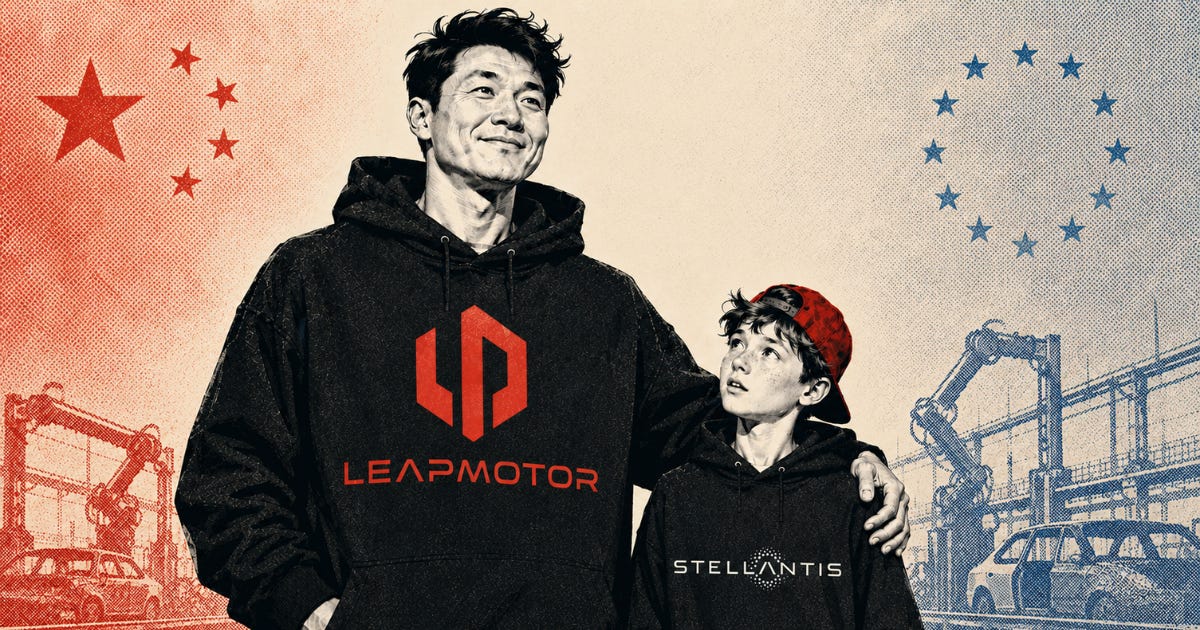
How Chinese Automakers First Tried to Crack Europe
2-3 years ago, the fear in Europe was clear. A Chinese tsunami of cheap EVs would flood the market. European manufacturers would be wiped out.
That’s not what happened.
But let’s go back to the beginning.
In 2007, SAIC bought British heritage brand MG. In 2010, Geely acquired Volvo.
The idea: Building a brand from scratch in Europe takes years. Faster to buy one that already has trust.
The real push came later:
NIO launched in Norway in 2021
BYD brought its first models to Europe in 2022
MG sold 233,000 units in Europe in 2024. 5x more than in 2021
Things seemed to be going really well.
JPMorgan predicted 20% market share for Chinese manufacturers in Europe by 2028. Brussels started openly discussing protective measures for the first time.
By late 2024, the EU introduced tariffs on Chinese EV imports. Direct imports became much more expensive overnight.
The result? MG’s EV sales dropped 58%. Their electric share fell from 47% to 30%.
And beyond tariffs, Chinese brands struggled. NIO bet on its own stores and direct sales in Germany. No traditional dealers. That model works in China. In Germany, it didn’t. In Q1 2026, NIO registered 8 new cars in Germany. Down 87.5%. NIO abandoned its direct sales model.
What works in China doesn’t automatically work in Europe. Chinese automakers had to learn that the hard way. Just like German automakers had to learn the same lesson in China.
Chinese brands’ market share in Europe by the end of 2024: about 4%. In 2025: 6%.
So the Chinese didn’t steamroll Europe. But nobody gave up either. Quite the opposite. They completely rebuilt their strategy.
The 4 Strategies They’re Using Now
1) They’re producing in Europe
The EU tariffs worked. Direct imports are less profitable. Producing in Europe is cheaper than importing with tariffs.
The answer: Assemble the cars directly in Europe. Either build new factories. Or take over existing ones.
BYD built plants in Hungary and Turkey. Now they’re negotiating with Stellantis and other EU manufacturers to take over underutilized factories
Geely is taking over part of a Ford plant in Spain
Chery assembles cars in a former Nissan plant in Barcelona
MG plans its own factory in Spain
Xpeng has Magna Steyr in Graz build its cars and is negotiating with VW for a German plant
Stellantis is openly considering selling 4 European factories to Chinese partners
What European carmakers no longer need, the Chinese do.
Where the Chinese invest isn’t random. The money flows into countries that didn’t vote for the tariffs. Poland voted in favor. Stellantis then moved Leapmotor production to Spain. Spain had abstained.
For the Chinese, local production has a positive side effect. It bypasses tariffs. And creates local jobs. That reduces political resistance and builds acceptance with customers.
2) They’re selling their technology to European brands
In China, European manufacturers already use Chinese partners’ technology to catch up. VW builds on Xpeng’s platform. Audi on SAIC’s. Mercedes and BMW use technology from Momenta.
Until recently, the rule was: What happens in China stays in China.
That’s changing. Chinese technology is now inside cars sold in Europe:
The Volvo EX30 runs on Geely’s platform
The Smart #1 and #3 also run on Geely’s platform
The Dacia Spring is essentially a Dongfeng. Just with a Dacia badge
Most buyers probably think these are European cars.
European manufacturers are buying Chinese technology instead of developing their own. That has never happened before.
For 40 years, the direction was clear. Cars were developed in Europe and assembled in China. China was the manufacturing base. Now that’s reversing.
VW CEO Oliver Blume is now considering offering China-developed models in Europe too. Until now, those only went to Southeast Asia, the Middle East, and South America. He’s also looking at opening European factories for Chinese partners
And the next Opel electric SUV will run entirely on a Leapmotor platform. More on that in a moment
3) They’re hiring European talent
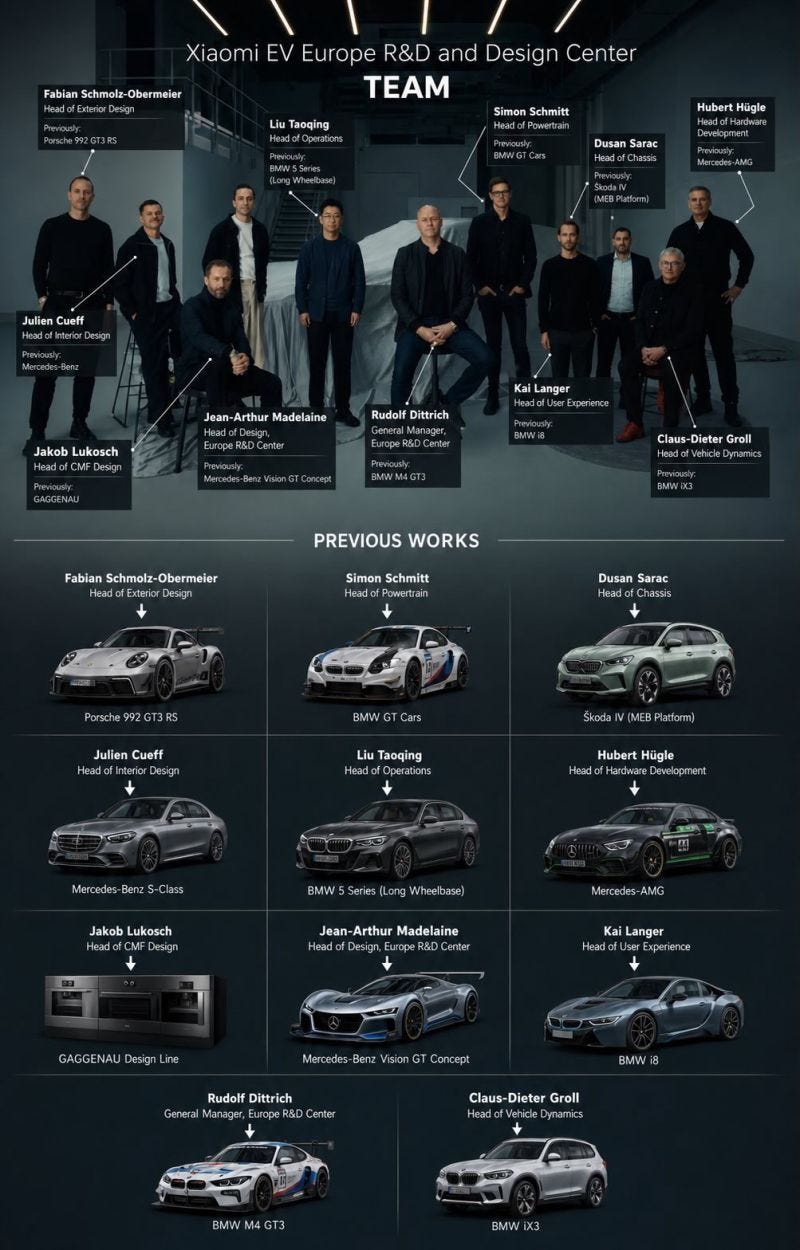
Xiaomi hasn’t sold a single car in Europe. But they’re already here. In 2025, they opened a research center in Munich.
Xiaomi watched other Chinese automakers fail in Europe. Their answer: Get the people first. Then bring the cars. They’re actively recruiting BMW, Porsche, and Mercedes employees. The packages are well above what their previous employers offered. Everyone who switches isn’t building German cars anymore. They’re building Xiaomis for the European expansion.
What Xiaomi does well: publicity. Their first car was a Porsche clone with seriously good software. Everyone laughed at first. Then the entire world started talking about Xiaomi as a carmaker. Marketing: A+.
In China, the concept worked. Last year they sold over 400,000 cars. After 16 months, the car division was profitable. Now they want to bring that to Europe. Launch is planned for 2027.
4) They’re starting joint ventures with European manufacturers
Selling cars the Chinese way doesn’t work in Europe. NIO proved that. And building a brand from scratch takes years. BYD hasn’t had its big breakthrough despite its Euro championship sponsorship. So what do you do? You find a partner who already has everything you need.
This model is familiar. In China, the deal was clear for decades: If you wanted market access, you had to enter a joint venture with a local partner. Market access in exchange for technology transfer.
In Europe, the exact same thing is now happening. Just in reverse. And voluntarily. The first example: Stellantis and Leapmotor.
A Chinese automaker partners with a European group. They share factories, distribution, and service networks.
Let’s take a closer look.
Stellantis Is the Junior Partner of a Chinese Startup
October 2023. Then-Stellantis CEO Carlos Tavares signed a deal with Chinese automaker Leapmotor. Stellantis bought 21% of the company. They also created a joint venture for production and distribution of Leapmotor cars outside China. Stellantis holds 51%. Leapmotor 49%.
June 2024: The first Leapmotor cars rolled off the line in Poland. 2024: 1,300 units sold in Europe. In 2025, Stellantis opened its sales network. Over 800 retail locations across more than 10 countries. Result: 40,000 units sold. 30x in 12 months. In Q1 2026: another +706%.
A Chinese automaker that almost no one in Europe knew 2 years ago is taking off. Thanks to European infrastructure.
May 2026: Stellantis wants to build the next Opel electric model on a Leapmotor platform. At the same time, Stellantis is cutting 650 engineering jobs in Rüsselsheim, Opel’s development headquarters near Frankfurt. That expertise isn’t coming back. Development now happens in China. What stays at Opel: body design and chassis tuning. Platform, powertrain, and software come from China.
On paper, it looks like the perfect deal. Stellantis gets technology. Leapmotor gets market access.
In China, the formula was clear for decades: market access in exchange for technology transfer. This time, the Chinese want market access. And Stellantis opens the door. But Leapmotor isn’t sharing technology. Stellantis assembles and sells. Development stays entirely in China.
Carlos Tavares himself brokered the deal. After leaving Stellantis, he said about Leapmotor: “They want to swallow us eventually. I’m aware of that.”
What does he mean? Geely founder Li Shufu once put it bluntly: “You can’t buy core technology. The more you rely on someone else’s technology, the more dependent you become.”
My Take
On the surface, things actually look pretty good. The Chinese tsunami never arrived. The tariffs worked. Chinese brands aren’t flooding Europe with cheap imports. They’re building factories. Creating jobs. Investing in Europe. There’s even a first joint venture modeled on the Chinese approach.
The catch: The technology doesn’t come with it.
What the Chinese are bringing to Europe is production. What stays in China? Everything that actually makes a car valuable today.
And that’s the irony. 2 years ago, the EU wanted to protect European industry from Chinese competition with tariffs. Today, it’s European industry itself that’s voluntarily inviting the Chinese in through partnerships.
On paper, Stellantis holds 51%. In reality, Stellantis is the junior partner. Leapmotor has been building cars for 7 years. Stellantis for over 100. And still: Leapmotor develops the product. Stellantis helps with assembly and sales.
The Stellantis-Leapmotor joint venture is the prototype for Europe as China’s extended assembly line.
The European auto industry is cutting tens of thousands of jobs right now. And yes, Chinese companies are building factories in Europe. And yes, that creates jobs. But most of them are basic production jobs. Not engineering. Not development. And if we’re honest: these are exactly the jobs that will be automated away within 10 years. We already know that.
But it doesn’t have to go this way.
Because right now, Europe has the strongest negotiating position in years. China has over 100 automakers. Far too many. Only a fraction will survive. They all need to expand abroad. The pressure to break into Europe is enormous.
Europe has something they desperately need: market access.
The conditions for a good deal have never been better.
And China spent 40 years teaching us how that deal works: market access in exchange for technology transfer.
Europe could use the same lever today. But it’s not.
Instead, Europe is entering joint ventures where it handles distribution. And China keeps the technology.
Don’t get me wrong. Joint ventures with Chinese automakers are exactly the right path. I’m all for it. But only on terms that build real technological competence in Europe.
Without that, Europe isn’t a partner. It’s just China’s assembly line.
🔗 re | re2 | car | scmp | bl | eco | ace
That’s all for today.
Until next week,
Philipp
PS: If you find value here, share it with someone who should read it too.
Want to work with me?
I help global B2B companies connect with 80,000+ automotive decision makers in Germany.