


Ad
This issue is supported by Berylls by AlixPartners
For today's newsletter I spoke to Dr. Andreas Collet. He co-authored the Battery Electric Truck series at Berylls by AlixPartners. His analysis and his numbers went into this issue.
Berylls by AlixPartners had no influence on the content of this newsletter.
Welcome to Issue #128 of The German Autopreneur.
We talk about China and electric cars a lot. But it's almost always about passenger cars.
Not today. Today it's about trucks.
And this is a completely unemotional market. Nobody drives down the highway thinking: what a beautiful Mercedes Actros. A truck is a tool.
But that tool carries 3/4 of everything moved on land in Europe. Your parcel, the shelf in the supermarket, all of it.
And right now this invisible market is going through the same 3 shifts as the car market: electric, software, autonomous driving. With the same challenger: China.
We've seen this film before. With cars, we're watching the ending play out right now.
So the question today: does the same thing happen with trucks?
To find out, I spoke to Dr. Andreas Collet. He's a commercial vehicle expert at Berylls by AlixPartners.
Today we'll look at:
Why buying a truck comes down to the numbers and nothing else
Why the electric truck gets cheaper than diesel before 2030
And whether the Chinese are about to take over the European truck market too
A Market Without a Champion
So who is the Volkswagen or Toyota of the truck market?
The answer: there isn't one. What you get instead are 2 truths, and both of them hold:
1) By revenue, Europe leads:
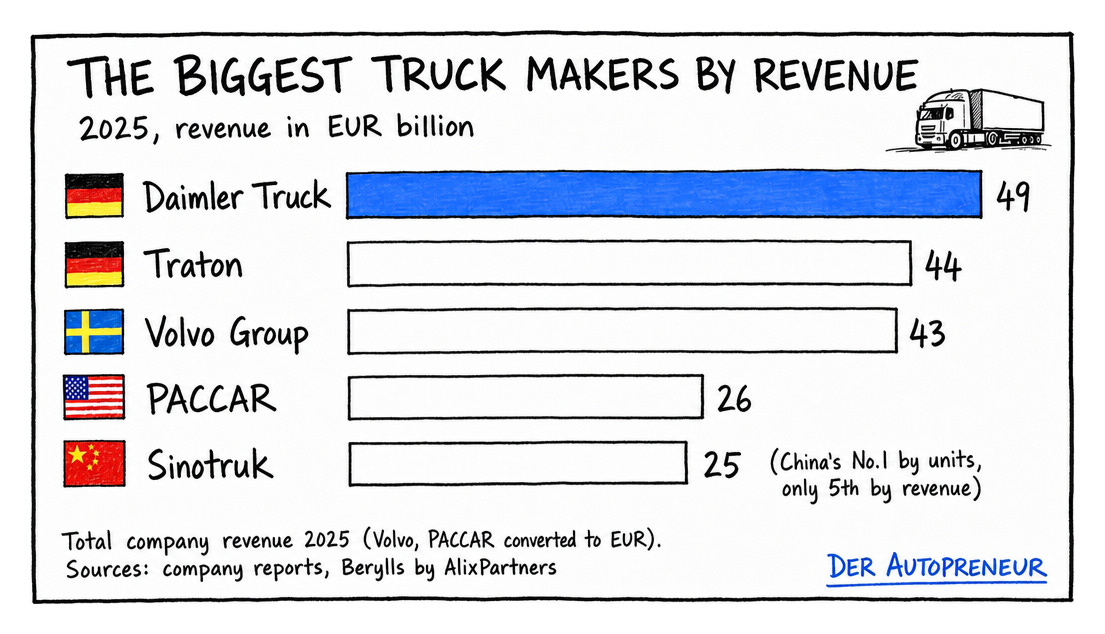
The biggest truck group in the world is Daimler Truck: around €49 billion in revenue and 420,000 vehicles sold in 2025. Mercedes still owns 1/3 of it
Behind it: Traton (Volkswagen's truck arm, with MAN and Scania), the Volvo Group (the truck company, not the car brand) and the US group PACCAR
2) By units, China leads:
Chinese manufacturers sell more than 1.1 million heavy trucks a year, around 70% of them at home
Market leader Sinotruk alone accounts for around 300,000 of them
There is no global champion: the 7 biggest groups together hold less than 30% of the world market by revenue.
The market splits into separate worlds:
Europe: Daimler Truck, Traton and the Volvo Group together hold around 2/3 of the market, and the Volvo brand leads with around 19%
China: a world of its own. More heavy trucks are sold in China every year than the biggest Western manufacturer sells worldwide
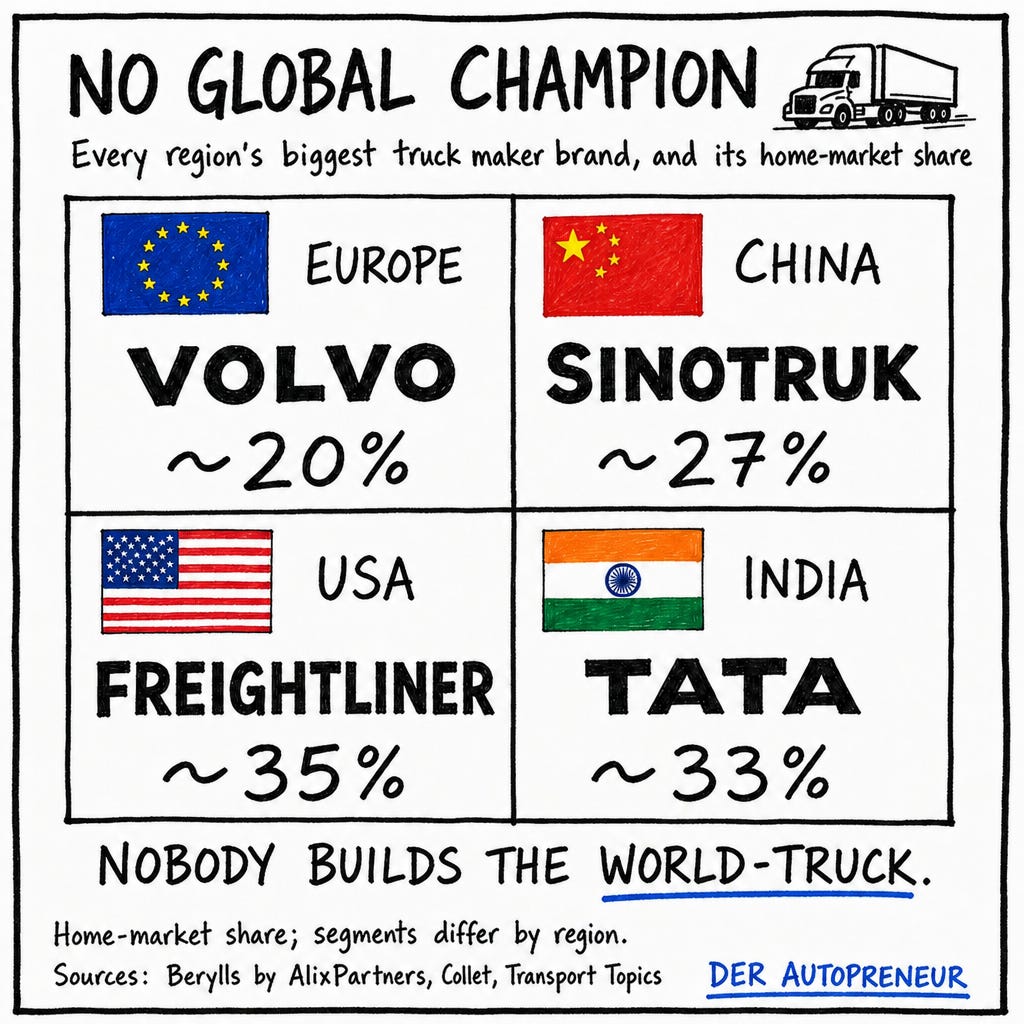
Nobody builds a world truck. And the reason is simple: a truck for European highways is a completely different vehicle from one built for Indian roads.
That's the structure. But the part that really matters comes next.
Who Actually Buys a Truck?
We buy a car with our gut: brand, design, status. With a truck, none of that counts.
And the person who buys it isn't even the one who drives it: the trucking company orders, the driver drives. And the trucking company wants exactly one thing: for the truck to make money.
The calculation behind that is called TCO (total cost of ownership): the full cost over the truck's lifetime, usually around 10 years. And it splits roughly into 3 blocks:
1/4 purchase price
1/4 driver
1/2 operating costs: diesel or electricity, maintenance, tolls
These days the biggest block is operating costs. The purchase price is only 1/4 of the truth. Andreas puts it like this: whether a truck costs €50,000 more "doesn't really matter in the end." What matters is what it earns over 10 years.
And a truck only makes money when it's moving. One that stands still costs money. Which is why something else hangs on this calculation: trust.
The trucking company has to trust that its manufacturer keeps that truck running for 10 years. A workshop nearby, spare parts, someone who turns up when something breaks.
Nobody pays extra for the logo on a truck. But everybody pays for that trust. It's the real moat in this market.
But that whole calculation is about to change. In 3 places at once.
Trucks Face the Same 3 Shifts as Cars
With cars, we always talk about 3 big technology shifts:
from combustion to electric
from hardware to software
from driving yourself to autonomous driving
So let's apply the same 3 to trucks.
1. Electric
For trucks, electric is a done deal too. And the reasons are the same as for cars: regulation and cost.
The regulation: trucks are only 2-3% of the vehicles in Europe, but they cause around 25% of road emissions. Which is why the EU set fleet targets for trucks as well: -45% CO2 by 2030, -90% by 2040.
The cost: Berylls by AlixPartners worked it out per kilometer for European long-haul:
2025: diesel €1.35/km, electric €1.42/km
2030: diesel €1.42/km, electric €1.28/km
2035: diesel €1.49/km, electric €1.13/km
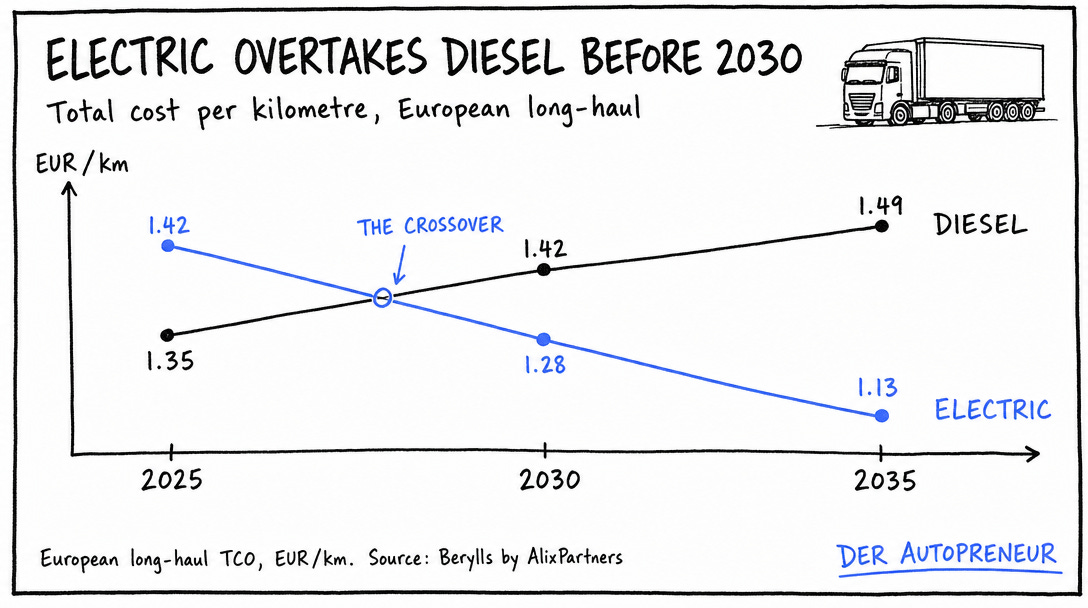
So before 2030 the electric truck becomes cheaper than diesel in long-haul. And as we know: this market runs the numbers ruthlessly.
But what about range? That's exactly what I asked Andreas.
His answer: a modern electric truck does 400 to 500 km in real conditions. The top models manage 700 to 800. A driver hardly ever needs more: after 4.5 hours at the wheel, EU rules force a break. Andreas: "Usually I don't need the 800 kilometers of range, because I'm not allowed to drive them."
And the truck charges during that break anyway. So the real bottleneck is the charging infrastructure, not the range.
2. Software
With cars, the car itself becomes a software product. We know the game: updates over the air, and the car gets better after you buy it.
With trucks, software counts where it saves money: fleet management and remote maintenance. Both keep the truck on the road. And software is the ticket into the biggest shift of all:
3. Autonomous driving
1/4 of the cost is the driver, and autonomous driving wipes out that quarter.
And then there's the driver shortage. Europe and the US are already short of drivers today. And by now it's gotten so bad that good drivers pick their trucking company. Not the other way around.
Autonomous driving solves both at once: the cost and the missing drivers. Which is why for trucks it's a business model from day 1.
And it's already happening. The 2 most important players are in the US: Aurora and Kodiak. Both run real freight with nobody in the cab. Aurora on public highways, between Dallas and Houston. Kodiak off the public road network, in the oil fields of Texas. In other words, where the conditions are easier.
So with trucks we're at the same point as with cars: the technology is right at the edge of scaling.
China is testing at scale too, but mostly still with a safety driver on board. In Europe there are only a handful of pilot projects.
Is China Taking Europe's Truck Market Too?
With cars, China is the disruptor. In just a few years the Chinese built an entire car industry from scratch. They overtook the established players on cost and technology. And now they're pushing out into the world market.
With trucks, they're running the same playbook.
So let's start by looking at the Chinese truck market:
29% of new heavy trucks in China run on electric or plug-in hybrid (most of them fully electric). In December 2025 it was even 53.9%, just before a subsidy ran out
More than 400,000 electric trucks were sold in China in 2025, across all size classes. That's more than 90% of the global volume
But you don't see much of it on the road yet: only around 4% of all trucks in China run on electric. And the switch is only just starting
By 2030, 40% of new heavy trucks are meant to be electric. That's what China's current plan says
What drives all of this is the battery: the biggest cost block in an electric truck. And no country controls it the way China does. Around 80% of the global battery supply chain is in Chinese hands.
And you can see it in the price: a Chinese electric truck comes in around 30% below a comparable European model. At an average of around €320,000, that's roughly €100,000 less.
My first reaction: but they can't match the quality of a European truck. Right?
Andreas on that: "That's a bit of the old arrogance talking."
The Actros was the benchmark for decades. Andreas says that gap is basically gone today: "One to one, just like in passenger cars."
We can see how that plays out with buses. Technically a bus is almost a truck. And Chinese electric buses have been running through Europe for more than 10 years, including in German cities. But they still haven't taken over the market.
And the next step is already under way. The Chinese are building in Europe:
BYD is massively expanding its commercial vehicle plant in Hungary
At the former MAN plant in Steyr (Austria), Steyr Automotive now assembles trucks for Chinese manufacturers. One of them looks almost exactly like a MAN. Deliberately, of course
None of this is about dodging tariffs, by the way. The EU tariffs on Chinese electric cars only apply to passenger cars. On trucks there's just the normal import duty of around 10%.
So why build in Europe if they don't have to?
Because they're building the one thing you can't export: trust. The service network, being close to the customer. Someone who's there when the truck breaks down.
With cars they learned one thing: the best price is worth nothing if the customer doesn't trust you.
So with trucks they're turning it around: trust first, volume second.
And you can see it in 2 numbers:
So far the Chinese have sold almost nothing in Europe: Steyr Automotive assembles around 800 trucks a year, MAN builds more than 60,000
But the service network is already there: through partnerships they have around 700 service points. Daimler Truck has around 3,000
And if they want it to go faster, they might simply buy that trust. With cars it went exactly the same way: Geely bought Volvo Cars, SAIC bought MG.
And Andreas says the Chinese attack on Europe doesn't even show up in the big market forecasts. Not yet.
But everyone knows by now that they're coming. Daimler Truck CEO Karin Rådström says: "I expect an offensive in trucks as well." And: "It's up to us to be prepared."
At the end I asked Andreas one last thing. The Chinese build the cheaper product, at the same technology and the same quality. So won't they simply run Europe over?
My Take
So: with trucks, the same thing is happening as with cars. Only faster. Probably much faster. You barely notice it yet. But that's most likely just the calm before the storm.
Why faster?
With cars, the brand was a shield. Even when the Chinese had the better technology AND the lower price, customers stayed with the brands they knew. The reason was the brand. The status. The habit. The trust.
That shield bought the carmakers time to catch up on price and technology.
With trucks, that shield doesn't exist. Here only the numbers decide. Whoever makes the better offer gets the order. Which is why the truck market is probably far more open to attack than the car market.
And there's something much bigger behind all of this. Talking to Andreas really drove that home for me.
More than 15 years ago, China started building the complete battery supply chain. From the mine to the finished cell. With enormous amounts of money, years without profit. But with a goal that was bigger than the car.
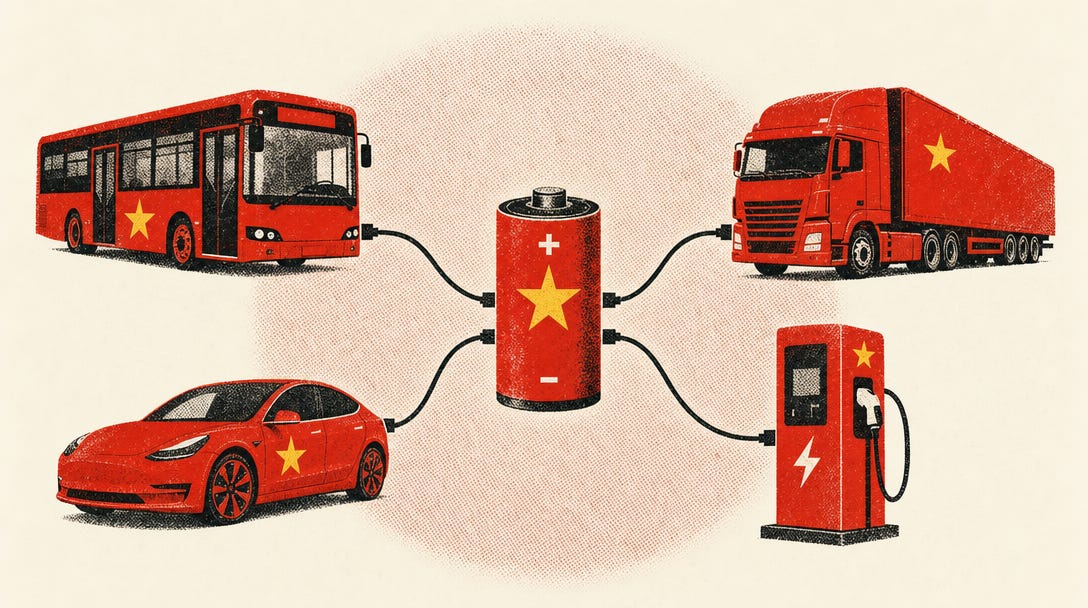
Because the battery reaches far beyond the car. It's the basis for almost everything that's going electric right now. Cars need batteries. Buses need batteries. Trucks need batteries. And the charging hubs that are supposed to charge all of it? They need huge energy storage. Which again means batteries.
In the end it all comes down to the same thing: everything needs batteries. And the batteries come from China.
And that was the brilliant move. China was never only after the car market. It was after everything that hangs off the battery. And that plan is working out right now.
And yet Andreas ends up surprisingly optimistic.
His argument: this time we know the script. With cars, we didn't take China seriously. With trucks, we know exactly how it runs. Through price. Through local production. Through bought trust.
And we know where our lead is. In trust. The service network, being close to the customer, 10 years of reliability. Exactly what China still has to build up or buy.
And there's one more thing: a Chinese truck still has to prove it's worth something after 10 years. As long as that residual value is unclear, it stays a risk in the TCO calculation.
That gives Europe a lead. But of course only for a while. We had one with cars too. And we didn't make the most of it.
This time we know better. We've seen this film before. Now it's running again. Only now we know the ending. And we can prepare.
PS: This is the last issue before the summer break. See you in September 🏝️
🔗 be | iea | ic | eu | he | el | ma | au | cv
A word from me
Your shortcut into European automotive
Selling to BMW, Bosch, or Continental from outside Germany? Good luck.
German automotive is a closed club. Built on trust, relationships, and decades of doing business face to face. Cold outreach doesn't work. Trade fairs cost €20,000 for maybe 3 real conversations. And nobody takes meetings with companies they've never heard of.
I spent 10 years inside Mercedes-Benz. Today, 80,000 European automotive decision-makers follow me. From team leads to board level. They trust me. Because I speak their language. Literally.
One partner generated 250 webinar signups. Another got 60 qualified leads at OEMs.
I'm your bridge into German automotive.
That’s all for today.
Until next week,
Philipp
And as always: If you find value here, share it with someone who should read it too. That helps me a lot.
China’s electric heavy-truck market has crossed a genuine commercial tipping point.
In China, a standard-load electric heavy truck costs roughly RMB1 per kilometre in electricity, compared with RMB2.5–3 for a diesel equivalent. Electric trucks already enjoy a clear total-cost-of-ownership advantage in ports, steel mills, mines, short-haul operations and fixed-route transport. Regional haulage is approaching broad cost parity, while the economics of long-distance trunk routes still depend heavily on annual mileage, charging efficiency, payload and electricity prices.
The rise in diesel prices in 2026 has widened that advantage further. At current fuel prices, GL Consulting estimates that, over one million kilometres, the combined purchase, energy and operating costs of an electric heavy truck could be only half those of an equivalent diesel vehicle. That figure is based on a high-oil-price scenario, but the direction is increasingly clear: electric trucks are beginning to sell on their economics, rather than relying primarily on subsidies.
Truck buyers may place little value on brand image, but they will pay for attractive financing, dependable residual values, shorter repair times, reliable spare-parts supply, compatibility with fleet-management software and a ten-year record of operational reliability. Market share will ultimately be determined by after-sales networks, leasing and financing, residual-value management and local operating capabilities.
This is why BYD is expanding its commercial-vehicle plant in Komárom, Hungary, tripling its local capacity for electric buses and trucks.
No mention at all of Tesla's Semi -- what ignorance and arrogance. Get your head out!