


Welcome to Issue #112 of The German Autopreneur.
Last year, everyone here in Germany felt it: BYD is just taking over.
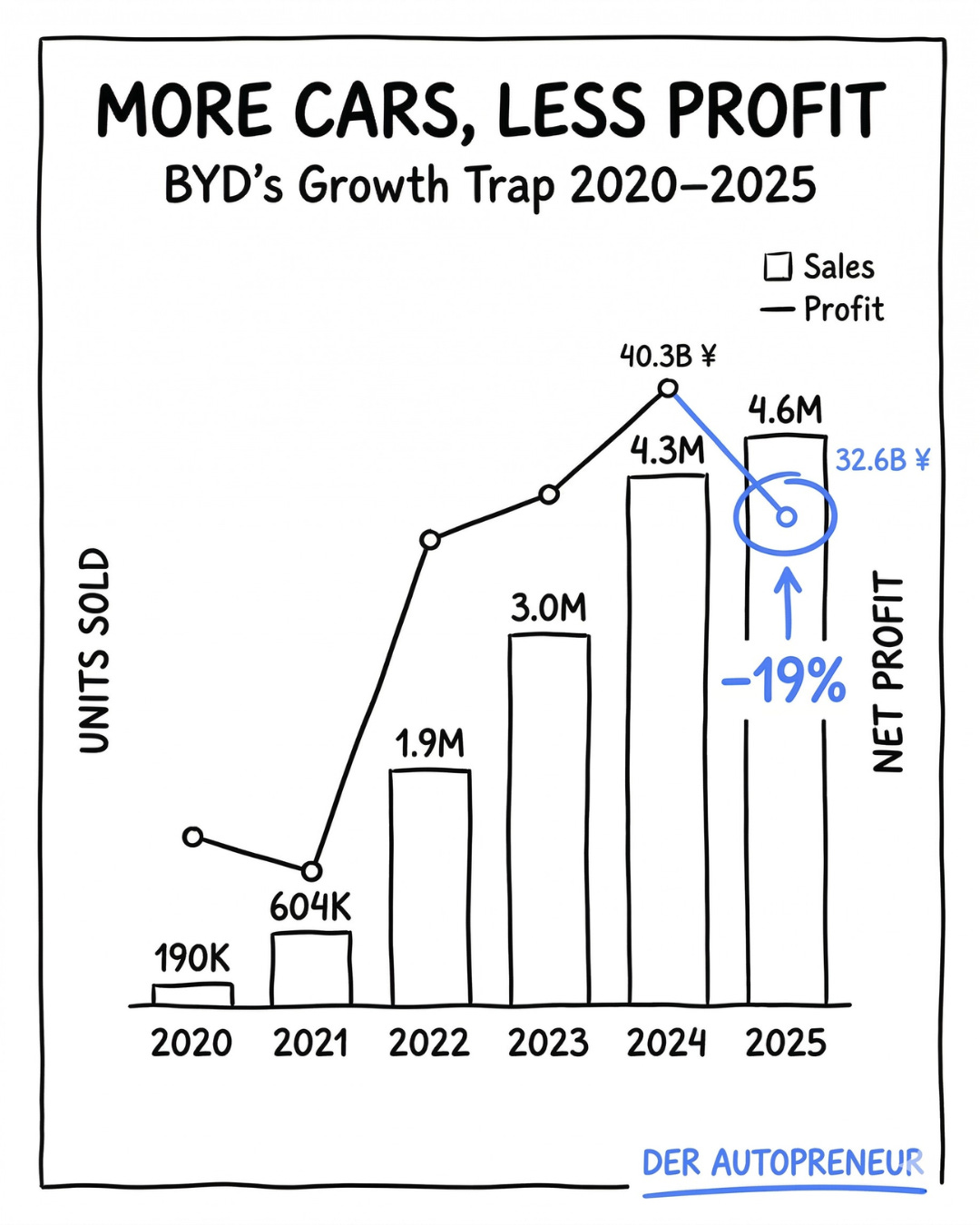
4.6 million cars sold. More than BMW and Mercedes combined. Tesla overtaken. It felt like they were steamrolling every market at once.
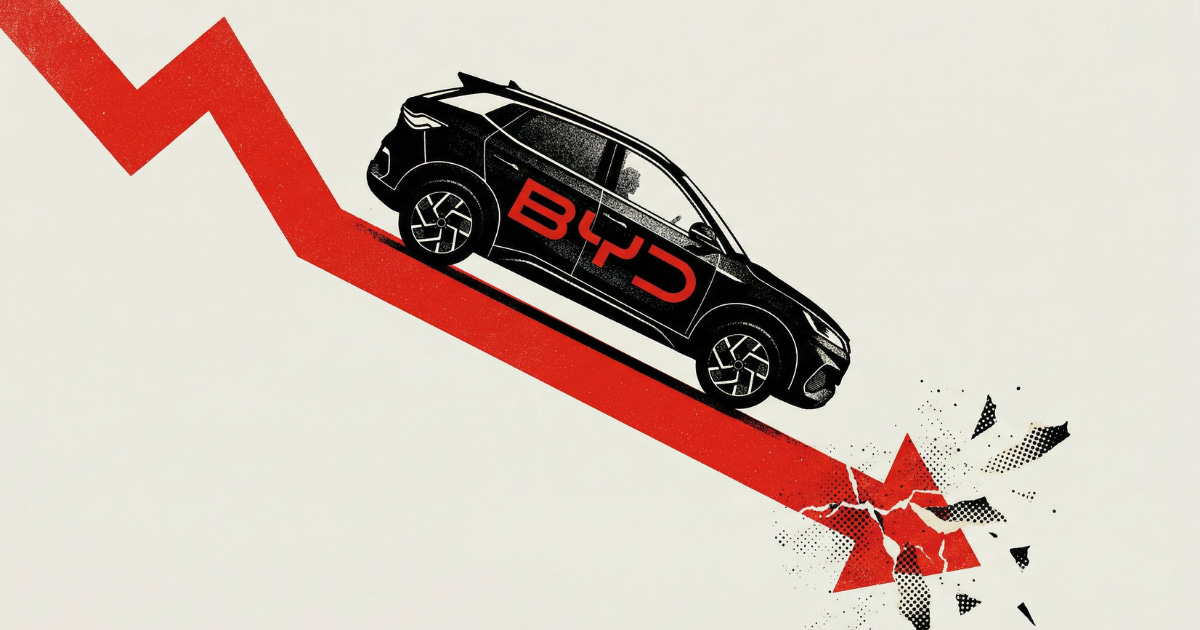
Now the 2025 numbers are in. And the first data for 2026. They tell a different story. Profit down 19%. Strip out subsidies and it’s closer to 50%. In China, BYD has dropped from first to fourth.
So which is it? Is BYD still on the rise? Or is the shooting star crashing?
The answer is neither. And what’s actually happening affects European automakers more directly than most people realize.
What the Numbers Actually Say
Sales: 4.6 million vehicles (+7.7%)
Revenue: +3.5% (weakest growth in 6 years)
Net profit: 32.6 billion yuan (approx. $4.5 billion), -19%
Q4 profit: -38%
Auto gross margin: 20.5% (down from 22.3%)
Net margin: 4.1% (down from 5.2%)
State subsidies: 12.47 billion yuan (approx. $1.7 billion) = 38.2% of net profit (2024: 25.9%)
Profit without subsidies: approx. 20.1 billion yuan / $2.8 billion (-50%)
+7.7% more cars, but only +3.5% more revenue. BYD is selling more vehicles at lower prices.
The profit decline accelerated through 2025. In Q1, profit nearly doubled. By Q3: -33%. By Q4: -38%.
BYD founder Wang Chuanfu says competition has peaked. China is in a “brutal elimination phase.”
Why BYD Dropped to Fourth in China
In early 2026, BYD sits behind VW, Geely, and Toyota. Sales have been declining for 7 months. In Q1 2026 alone: -30% year over year. Market share has collapsed from 33% to 24.6% in a single year.
Three factors are hitting BYD at the same time:
1) The price war:
Since mid-2025, all major manufacturers have been cutting prices at once. BYD’s margins have fallen faster than its competitors’. The reason: BYD is most exposed in the volume segment. That’s exactly where the price war is fiercest. This triggered the profit collapse in the second half of 2025.
2) New competitors:
This is the biggest irony of the whole story. BYD spent years as the newcomer rolling over incumbents. Now they are the incumbent. And the next wave is rolling over them.
Smartphone maker Xiaomi collected nearly 290,000 pre-orders for the YU7 in a single hour in June 2025. Huawei’s automotive alliance HIMA is rapidly gaining EV market share. These competitors come from the tech sector. They bring their own ecosystems, software mindset, and brand loyalty.
BYD comes from the battery business. Software was never their home turf. But software is where China’s market war is being won right now.
3) The policy reset starting in 2026:
This is probably the most important factor. China changed the rules for EV buyers. Two changes at once.
First, the trade-in bonus. Until now, the government paid anyone who scrapped an old car and bought a new EV a flat rate of roughly $2,800. No matter whether the new car cost $10,000 or $45,000. This meant cheap cars benefited the most. That’s BYD’s core business.
Now, the bonus is 12% of the car’s price. For BYD’s entry model, the Seagull (around $10,000), that means roughly $1,350 instead of $2,800. More expensive models now benefit more than before.
Second, the purchase tax. In China, car buyers pay a 10% tax on the purchase price. EV buyers were fully exempt for over 10 years. Since 2026, they pay 5%. Still half of what combustion buyers pay. But after a decade at zero, it’s a real increase.
Both changes hit BYD from two sides at once. BYD only makes EVs and plug-in hybrids. Every subsidy cut and every new tax hits the entire business. Geely, by contrast, still sells around 146,000 combustion cars per month that are unaffected. And BYD is most exposed in the affordable volume segment. Exactly where the trade-in bonus change hurts most.
BYD’s Subsidies Help in China. And Hurt in Europe
BYD is trapped.
In China, BYD needs state subsidies to compete on price. In 2025 alone, BYD received around $1.7 billion in subsidies. Nearly 40% of profit. Without that support, profit wouldn’t have fallen 19%. It would have fallen around 50%.
In Europe, the EU uses exactly these subsidies to justify tariffs. BYD pays 17% in penalty tariffs on every imported car, plus 10% standard import duty. 27% total. The justification: unfair state support. The $1.7 billion in BYD’s annual report is all the proof the EU needs.
The irony: the subsidies help BYD survive in China’s price war. And make its exports to Europe more expensive at the same time. The more subsidies, the stronger the argument for European tariffs.
Wang Chuanfu’s response: BYD paid around $7.5 billion in taxes in China in 2025. Net, they contributed $5.7 billion more than they received back in subsidies.
Fair point. But it doesn’t change the fact that nearly 40% of profit came from state support. And that’s the basis for EU tariffs.
Under this pressure, what does BYD do? Flee China.
The Flight to Europe
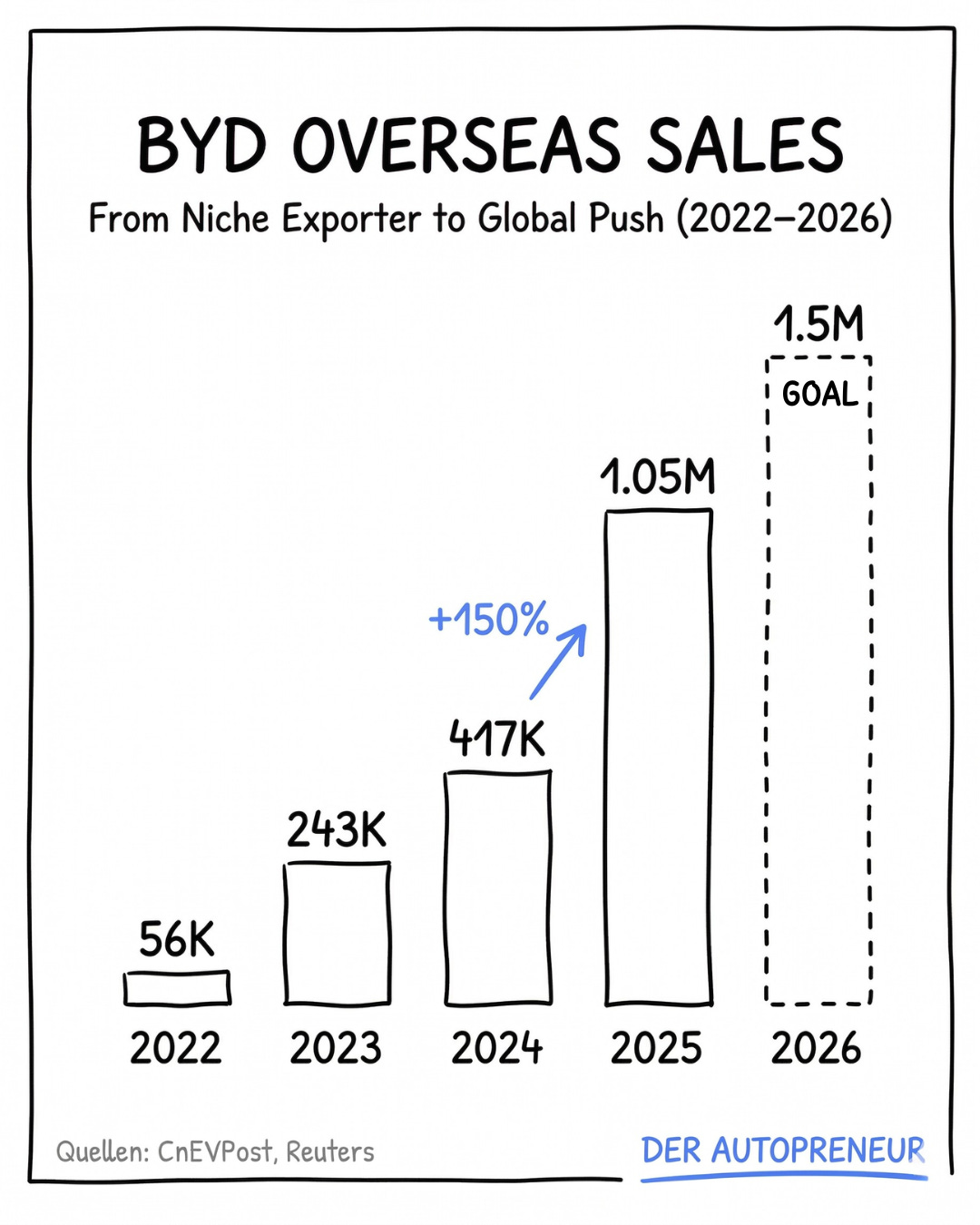
1.05 million exports in 2025. Up 150% year over year. In Europe, BYD overtook Tesla on new registrations in early 2026.
The math is straightforward. BYD earns around $700 per car in China. In export markets, it’s around $2,800. One export car generates as much margin as 4 domestic cars.
That’s why BYD raised its 2026 export target from 1.3 to 1.5 million vehicles. In February, over 50% of BYD’s sales came from exports for the first time.
The logic is simple: BYD goes where the money is.
And they’re not stopping at exports. BYD is building a global production network at speed. Thailand and Uzbekistan are already producing. Plants are under construction in Brazil, Indonesia, and Turkey. And then there’s Europe.
The plant in Szeged, Hungary, has already started pilot production. Full-scale production begins in Q2 2026. Capacity: up to 300,000 vehicles per year. Built in the EU. The 27% tariffs? Gone.
The pattern isn’t new. In the 1980s, Toyota did exactly this. The Japanese home market was under pressure. Toyota flooded the US with affordable exports. Then built local factories. And never left. The exporter became the world’s largest automaker.
BYD is running the same playbook. Just faster. China Speed. Toyota needed over 10 years. BYD is building a global production network in 18 months.
My Take
Both narratives about BYD are wrong.
“BYD is unstoppable” ignores: profit -19%, stripped of subsidies -50%, crashed to fourth in China, growing dependence on state support.
“BYD is crashing” ignores: +150% exports, world’s largest EV manufacturer, factories on 3 continents, market leader in Thailand, Singapore, and Brazil.
To understand what’s actually happening, you need to know China’s industrial playbook. China ran the same strategy in solar. In batteries. In steel.
Today, over 80% of solar panels sold in Europe come from China. The European solar industry has practically disappeared. That took less than 10 years. With EVs, China is running the same playbook:
Pour money into an industry. Hundreds of companies emerge
Brutal domestic competition. Too many players, too little margin. A price war to the death
Pull back subsidies. Survival of the fittest. The weak die
The survivors are globally unbeatable. Because they survived the world’s toughest competition. With the lowest costs. The most efficient processes
That’s what we’re watching with EVs right now. Around 50 EV manufacturers are fighting for market share in China. Only a handful are profitable. Now subsidies are being cut. And the price war is escalating.
BYD isn’t crashing. BYD is doing exactly what China’s system designed it to do.
Soon, the first BYDs will roll off the line in Hungary. No tariffs. European production. BYD is no longer an import problem. It’s a local competitor.
So is BYD rising or crashing? Wrong question. BYD is transforming. From local champion to global powerhouse. The rise was never the real threat to European automakers. What’s about to hit world markets is.
🔗 bl | re | wsj | ev | cnp | el
That’s all for today.
Feel free to reply to this email with your thoughts.
Until next week,
Philipp
PS: If you find value here, share it with someone who should read it too.
Want to reach European automotive decision makers?
I help global B2B companies connect with 80,000+ automotive decision makers in Germany.
Very informative, thank you. I live in Brazil and it’s impressive how many BYDs you see on the street. They absolutely took over and it’s pretty obvious their low price strategy. If you compare the tech, visuals, motor and price, they are unbeatable.
One big issue would be the winner of the cut throat race may not profit that much from winning. If you invest in Jinko Solar, a big winner of the solar price war, you are likely underperforming.