


Ad
Europe’s biggest Automotive Tech Event. Late June, Stuttgart, Germany. Free.
The Vehicle Tech Week Europe brings 3 worlds under one roof: Testing, Autonomous Driving, and Interior. From June 23 to 25.
3 events, 1 ticket. 10,000+ attendees. 400+ exhibitors. Companies like Mercedes, BMW, Ford, and Volvo will be there.
If you work in the auto industry, Vehicle Tech Week is a no-brainer.
Welcome to Issue #115 of The German Autopreneur.
Bosch is the world’s largest automotive supplier. Number 1 for over a decade. €91 billion in revenue. 412,000 employees.
And yet Bosch flies under the radar. The reason: no stock listing, no quarterly earnings, no investor calls. Bosch is enormous. And almost invisible.
Bosch released its 2025 annual results. For the first time since 2009, the company slipped into the red.
And CEO Stefan Hartung calls 2026 the “year of progress.”
Bosch posts its first loss in 16 years. The CEO talks about progress. How does that add up?
Today we’ll look at:
Why Bosch is now losing money
How Bosch is using the crisis to restructure
And what China has to do with it
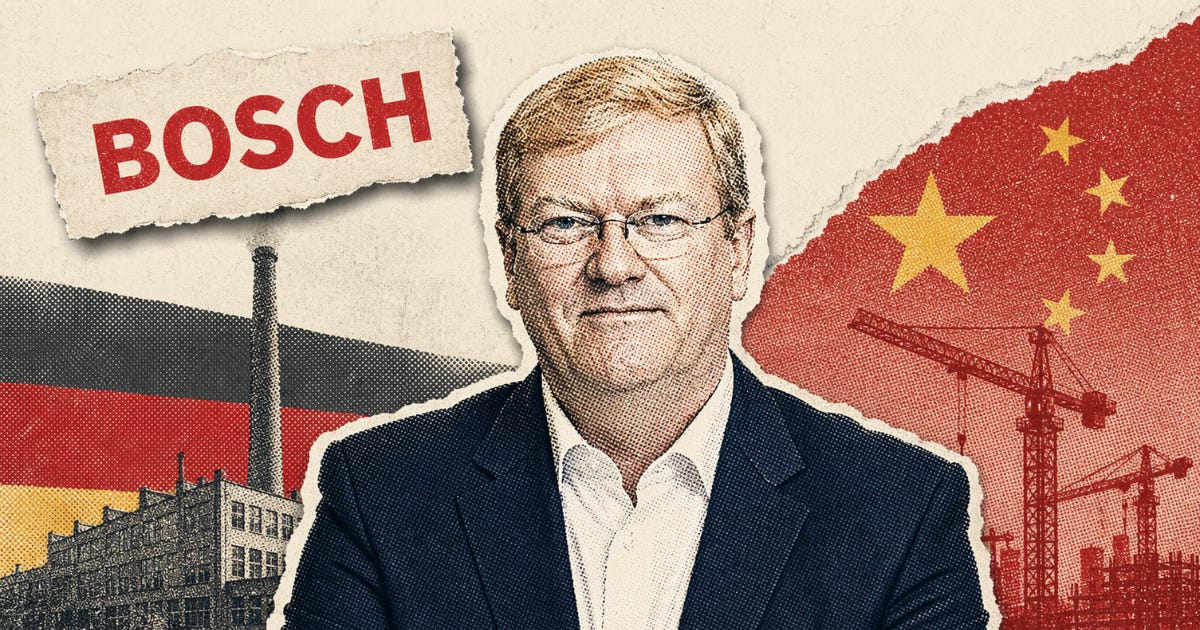
Suppliers Are Getting Hit Harder Than Carmakers
We talk a lot here about the crisis at VW, Mercedes, and BMW. Less about the suppliers. But they’re getting hit harder:
Mahle closed 6 plants in Europe and North America in 2024. 4 more are on the way.
According to EY, around 73,000 jobs have disappeared at German suppliers since 2019. Nearly 1 in 4.
Bosch is the biggest of them. And Bosch isn’t immune.
Here are the 2025 numbers:
−€400 million net loss (first loss since 2009)
€1.8 billion operating profit
€300 million cash flow (a third of the prior year)
22,000 jobs cut in the Mobility division in Germany
€2.7 billion set aside for workforce reductions
€15 billion China revenue in Mobility (more than 50% from Chinese manufacturers)
In 2023, operating profit was €4.8 billion. In 2024, €3.1 billion. Today, €1.8 billion. Down 62% in two years. For every euro of revenue, 2 cents remain. Bosch pushed its 7% return target from 2026 to 2027.
Why Are the Numbers This Bad?
The CFO’s official explanation: “One-off effects, separate from the underlying business performance.” Translation: everything under control, the core business is fine.
The numbers tell a different story.
Bosch’s core business is the powertrain. Injection systems, sensors, control units. A combustion engine has over 1,200 mechanical parts. Bosch supplies a large share of them. That’s how Bosch became the world’s largest automotive supplier.
Electric mobility is shrinking this business. An electric powertrain needs far fewer parts.
Inside Bosch, they’ve turned this into a rule of thumb. Where diesel manufacturing needed 10 people, gasoline engines need 3. Electric powertrains need 1.
That’s the math behind the 22,000 jobs.
So: the core business is shrinking. Bosch needs something to replace it.
The obvious answer would have been battery cells. The most expensive component in an EV.
But Bosch decided against it. And the reasons go back further than you’d think.
In the mid-2000s, Bosch made a big bet on solar energy. The bet: photovoltaics would be the next billion-dollar market. They bought companies, built plants, and launched a dedicated Solar Energy division.
Then Chinese manufacturers entered the market at far lower prices. Solar cell prices collapsed between 2008 and 2012. Bosch couldn’t compete. The final tab: €3.7 billion in losses. In 2014, Bosch exited the solar business entirely.
That left a mark. Since then, one simple rule has taken hold in the boardroom: never again compete against China in mass manufacturing.
In 2018, Bosch made the decision that locked everything in. It exited battery cell production before it had even properly started.
The official reason: it would take €20 billion just to be a meaningful player. Too expensive. Too risky. Unofficially? After the solar disaster, nobody on the board wanted to go up against the Chinese again.
Today, CATL, BYD, and LG control the global battery market.
Bosch supplies components. But not cells.
German automotive analyst Stefan Bratzel sums it up: “Suppliers fundamentally misjudged the industry’s direction.”
Bosch has full exposure in a shrinking combustion market. And insufficient exposure in the markets growing to replace it. That gap is now visible in the balance sheet.
Restructuring Has a Price
The result: 22,000 jobs cut in Bosch’s Mobility division in Germany. €2.7 billion set aside to cover it.
At the same time, Bosch is looking for new ground beyond the auto business. In 2025, they acquired Johnson Controls’ climate-control business for around €7.4 billion. The largest acquisition in company history. A visible step away from Mobility dependence.
Bosch is financing the restructuring through bonds. €8.5 billion over 2.5 years. That’s unusual. Historically, the company has avoided debt. The bonds fund the acquisition. And the job cuts.
How Can Bosch Pull All This Off Simultaneously?
Bosch has no shareholders. No quarterly reports. No capital market pressure.
94% of shares belong to the Robert Bosch Foundation. A nonprofit foundation has no owners. Profits don’t flow to investors but to projects in health, education, and science.
93% of voting rights sit with the Robert Bosch Industrial Trust. A small body made up of family members of founder Robert Bosch and long-serving Bosch managers. They make the strategic decisions and appoint their own successors.
The common criticism of German corporations: they only think as far as the next quarter. Bosch doesn’t have that problem. They can plan their transformation over 5 or 10 years.
And they’re using that. €7.9 billion is going into R&D in 2025, in new fields like sensors, AI, and robotics.
Just not where most people are looking.
The Future Is Being Built in China
The logical assumption would be: new technologies emerge where the old ones fade. Same plants. Same people. Different product.
That’s not how it works.
The next wave of automotive technology isn’t coming from Europe. It’s coming from China. The world’s largest car market. That’s where new systems get developed, go into production, and reach customers. Europe gets them later.
One example: The XPeng GX has been in production since March 2026. With Bosch’s latest steer-by-wire system. That’s steering with no mechanical connection between the steering wheel and the wheels. A prerequisite for autonomous driving. Mercedes is also bringing steer-by-wire. But later. After the Chinese.
A Chinese car is running Bosch’s newest technology before it arrives in a German one.
And this is not a one-off.
In February 2026, during German Chancellor Merz’s state visit to Beijing, Bosch signed a major contract with Nio. Chassis, steering, drivetrain, battery management, sensors.
With Nio, Bosch moves from component supplier to system partner. Across all 3 of Nio’s brands: Nio, Onvo, and Firefly.
More than 50% of Bosch’s China revenue already comes from Chinese manufacturers. Rising.
The reason is straightforward: Chinese manufacturers decide faster, integrate faster, and bring new technology to production earlier. Bosch keeps moving more of its value chain to China. Its own development, its own production. In China, for China.
What shrinks in Germany grows in China. Not necessarily because Bosch wants it that way. But because that’s where the markets of the future are forming.
The fear of China didn’t keep Bosch away from China. It pushed Bosch toward it.
My Take
I’m from a small town called Leonberg, just outside Stuttgart. Bosch had plans to build a tech campus there for 2,500 people. The foundation pit had already been dug. Then Bosch scaled back the plan. The result: half a campus. And a foundation pit that got filled in again.
The jobs are going somewhere else now.
A few kilometers away is Feuerbach. Bosch’s historic home base. For over 100 years. Generations of engineers walked in every morning and walked out every evening feeling like they were part of something big. Bosch developed and built injection systems here for decades. Now 2,500 jobs are disappearing from that site alone.
The losses give Bosch the justification. Without a crisis, Bosch probably couldn’t push this through.
But this restructuring has a price that Bosch isn’t paying. The southwest of Germany is.
Where I’m from, there’s a local saying: “I schaff beim Bosch und halt mei Gosch.” I work at Bosch and keep my mouth shut. Swabians (the people from this region) love to complain. But at Bosch, there was nothing to complain about. Secure job, good money, pride in the product. That was the deal.
Around Stuttgart, a unique ecosystem grew over decades. Bosch in Feuerbach. Mercedes in Sindelfingen. Porsche in Zuffenhausen. Mahle in Stuttgart. A large part of Germany’s automotive success story was written here. This is where Made in Germany was forged. Suppliers and manufacturers side by side. When Mercedes needed a new component, the Bosch engineer was sitting in the meeting an hour later. Short distances, shared knowledge, fast iteration. That was the secret behind the technological lead.
The problem: this ecosystem depended on one technology. The combustion engine. And it was never reinvented for what came after. It never got an update. The model still works. Just not here anymore.
Today, the most advanced automotive ecosystem in the world is in China. Essentially the same playbook as the southwest of Germany. Just 8,000 kilometers further east. And the companies from Stuttgart are helping build it.
Around 235,000 jobs across Germany depend directly on the combustion engine. 55,000 of them in this region alone.
CEO Stefan Hartung calls it the “year of progress.” For this part of Germany, it feels more like a farewell. The region lived off the combustion engine for decades. It’s losing more than jobs. It’s losing a piece of its identity.
If Bosch’s transformation works, what emerges is a global tech company. But one that has left its home behind.
Bosch isn’t officially giving up on Germany. But structurally, it is.
The foundation pit in Leonberg is filled in. The foundation pits in Beijing are being dug right now. Bosch will survive this. Just somewhere else.
🔗 hb1 | hb2 | wiwo1 | wiwo2 | faz
That’s all for today.
Until next week,
Philipp
PS: If you find value here, share it with someone who should read it too.
Want to reach European automotive decision makers?
I help global B2B companies connect with 80,000+ automotive decision makers in Germany.