


A quick word
You know your product. But do you know your buyers?
You sell software, consulting, or technology to German and European OEMs and suppliers. You know how hard it is to get real insights. What keeps decision-makers in Europe’s largest automotive market up at night? What are they planning internally?
Last week, hundreds of automotive professionals took part in my AI survey. From team leads to board members. Real data. Straight from your target audience.
I do this for partners too. You choose the topic. I ask the questions. Directly to 80,000 German automotive professionals.
Welcome to Issue #111 of The German Autopreneur.
Over the past few weeks, I’ve looked at the annual results from Mercedes and VW. Today it’s BMW’s turn. And upfront: this is by far the most boring story.
No drama. No radical pivots. No shocking numbers.
But that’s exactly what makes it interesting.
2025 was the worst year for German automakers since 2020. Net profits collapsed across the board:
Mercedes: -49%
VW: -44%
And then there’s BMW at -3%.
That looks like BMW won. But they didn’t.
BMW just got through 2025 better than the others. And the more interesting question is: why?
Today I’ll look at why BMW’s numbers look better than they actually are. What really helped BMW in 2025. And why BMW is taking on more risk in 2026.
BMW’s Key Numbers for 2025
Revenue: $153.9 billion (-6.3%)
Net profit: $8.6 billion (-3%)
EBIT margin, automotive segment: 5.3%
Sales volume: 2.46 million vehicles (+0.5%)
EVs: 642,000 units (+8.3%), of which 442,000 fully electric
Sales by region:
Europe: +7.3%
US: +5.0%
China: -12.5%
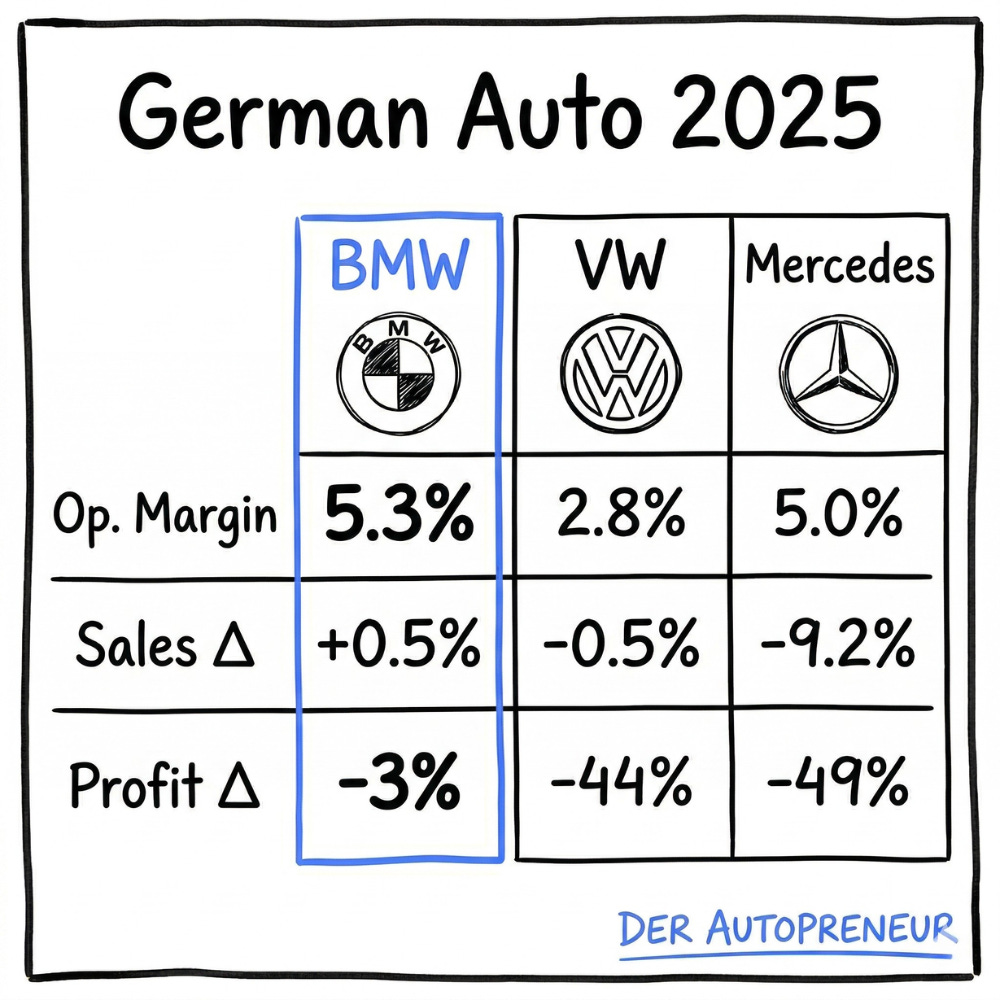
Unlike VW and Mercedes, BMW cut costs in 2025. And sold more cars.
What the Numbers Don’t Show
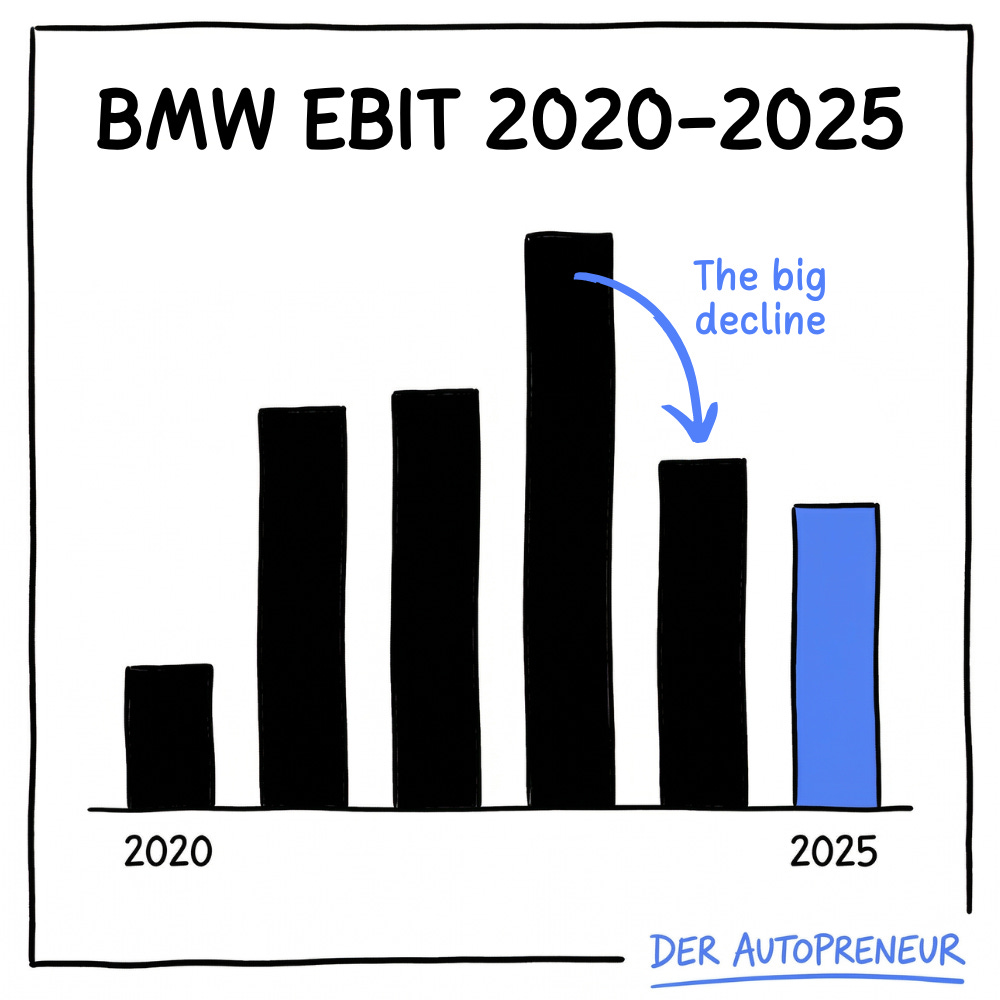
2025 looks better than it is. The reason is 2024.
Net profits had already collapsed in 2024:
Mercedes: -28%
VW: -31%
BMW: -37%
BMW fell hardest in 2024. The reason: a faulty braking system from Continental forced BMW to recall 1.5 million vehicles. In Q3 alone, that cost around $1.15 billion.
That skews the comparison. BMW’s 2025 looks good because 2024 was already bad.
So is BMW structurally in better shape? Yes. But not for the reasons most people assume.
BMW’s 3 Structural Advantages
All three kicked in at the same time in 2025.
1. Platform flexibility
BMW builds combustion, hybrid, and electric cars on the same production line. That sounds like a footnote. It isn’t.
VW and Mercedes went a different way. They produce separately. Put simply: one plant for combustion, one for EVs. That’s more efficient, but only if you can keep the lines running at capacity. And that requires you to predict almost exactly how many EVs will sell in which region. Then ramp production in sync.
And in today’s market, that’s nearly impossible to time.
And in 2025, that got even harder. Trump changed the rules overnight, and billions in automaker investments became worthless.
BMW could work around it. When fewer EVs are ordered, they simply build more combustion cars on the same line.
2. BMW was America-first before Trump
BMW is the largest automotive exporter from the US, ahead of Ford. The BMW plant in Spartanburg employs 11,000 people. It produces 1,500 cars a day. The plant has been running since 1994. That’s where the SUV lineup is built, from the X3 to the X7.
BMW was America-first decades before Donald Trump. When high import tariffs hit in 2025, Trump’s message was clear: build in America. BMW had already been doing that for 30 years.
3. Cost management
BMW cut $2.9 billion in costs in 2025. Without the headlines. Without mass layoffs or plant closure debates.
Lower development costs, reduced material costs, leaner administration. That’s where the $2.9 billion came from. The most boring number in this story. And the most important one.
These 3 advantages protected BMW in 2025. All at once, at the right time.
But was this a deliberate strategy?
Every automaker faces the same question right now: go all-in on EVs, or keep building combustion cars alongside? BMW’s answer is flexibility. CEO Oliver Zipse made “Power of Choice” his mantra: all powertrains, all markets.
It sounds bold. Even principled. But BMW had no better read on the market than anyone else. They just sold the story better.
And BMW isn’t as committed to keeping all options open as it sounds. Their future strategy is a clear bet on EVs. And it has a name.
The Neue Klasse
In 1959, BMW was on the verge of bankruptcy. Daimler wanted to acquire it. A guy named Herbert Quandt rescued the company with a private investment. His family still controls BMW today.
Two years later, BMW unveiled the 1500 at the IAA. Germany’s flagship auto show. It was the first model of the Neue Klasse. That car became the foundation for everything BMW is today.
65 years later, the answer is Neue Klasse again. This time, fully electric.
Mercedes tried going all-in on EVs and walked it back. BMW chose a different path. The Neue Klasse runs alongside the existing combustion platform, not instead of it.
The old flexible combustion architecture continues for another 8-10 years. But by 2030, more than 50% of all BMWs sold should be fully electric.
The first models on the new platform: the iX3 and a new i3.
Here’s the catch. BMW’s advantage in 2025 was that everything ran on one line: all powertrains, maximum flexibility. That’s over now. The Neue Klasse plants build EVs only. BMW is moving toward the same situation as VW and Mercedes: two parallel worlds, double the infrastructure.
And BMW is tying its future to this platform. If the Neue Klasse doesn’t work, BMW has a serious problem. No matter how well the combustion cars still sell.
Where BMW Actually Stands
The disruption reshaping the auto industry hits BMW just as hard as everyone else. Software, AI, autonomous driving, cost pressure from new competitors. BMW has no structural advantage over Mercedes or VW on any of these.
In Q4 2025, the EBIT margin was just 3.7%. BMW’s own forecast for 2026: 4-6%.
In China, BMW faces the same problems as the rest. In the last 2 years, BMW has lost nearly 200,000 units of annual volume. The trend is still pointing down.
And the US advantage? More than half of the cars produced in Spartanburg are exported. If the trade war escalates, that advantage becomes a liability.
In May, Milan Nedeljkovic takes over as the new CEO. 33 years at the company. He won’t reinvent BMW. His job is to deliver what his predecessor promised.
My Take
Mercedes has changed course 4 times in 18 months. VW is fighting for its survival. And BMW? Just keeps going like nothing happened.
That’s boring. But it describes BMW as a company pretty well.
But did BMW actually have the better strategy? No.
This wasn’t foresight. It was a bet. A more risk-averse one. VW and Mercedes bet on 2 platforms: one for combustion, one for EVs. BMW bet on one platform for everything.
Not necessarily the smarter bet. But in a year where everything changed, keeping your options open paid off.
Flexibility is a crisis strategy. It works as long as the world stays volatile. As long as no one knows which technology wins where and when. As long as political decisions can change everything overnight. In that world, optionality isn’t a weakness. It’s a capability.
BMW’s approach wasn’t necessarily cheaper. A single platform that has to handle combustion engines, hybrids, and EVs at the same time means enormous complexity. And with it, cost.
Why could BMW pull it off? At VW, the German state of Lower Saxony holds 20% of shares. Politics literally has a seat at the table. At Mercedes, major shareholders from China and Kuwait shape the agenda. BMW is backed by the Quandt family. They’ve held half the shares for over 60 years. Of the German automakers, BMW can plan furthest ahead. In generations, not quarters. That is BMW’s real structural advantage.
2025 was a year where the best plan was having no plan. BMW benefited from that. The Neue Klasse is the opposite: a clear bet. And clear bets can be lost.
🔗 bmw-pr | el1 | hb-oem | re1 | hb1 | cio1
That’s all for today.
Until next week,
Philipp
PS: If you find value here, share it with someone who should read it too.
Want to reach European automotive decision makers?
I help global B2B companies connect with 80,000+ automotive decision makers in Germany.