


AI Is Coming for the Auto Industry. Just Not How They Expect
Welcome to Issue #114 of The German Autopreneur.
“Real AI adoption will reduce management layers. And that’s exactly what no one inside these companies actually wants.”
That’s what an insider at a German automaker told me. One of many.
It started with a newsletter where I made a case: AI will replace the highest-paid jobs in the auto industry first. I ended it with a survey. 293 people responded. Since then, I’ve had dozens of background conversations with insiders.
I wanted to understand: where does the German auto industry actually stand on AI?
Officially, everything looks fine. Budgets approved. Copilot rolled out. Strategy on the slides.
The reality inside these companies is something else.
Today we’ll look at:
What 293 insiders said anonymously about AI
Why, once again, the problem isn’t the technology. It’s the system
Why the pressure is coming from China and the US
The Data
Who responded?
48% from OEMs and suppliers
37% decision-makers from executive management, boards, and division leadership
Plus individual conversations with insiders from OEMs, suppliers, and tech companies
The key findings:
85% use AI regularly or daily
91% have already introduced AI or have concrete plans to do so
57% say: this needs to happen this year
And yet: 45% say they don’t know where to start
Why the System Is the Problem
91% want to adopt AI. Yet almost half don’t know where to start. How?
Once again, the answer isn’t the technology. It’s the system.
Many want to use AI. But the system doesn’t give them what they need:
No time to learn
No budget for tools or training
No approval for what actually works
No environment where experimentation is allowed
No guidance on which use cases are worth the effort
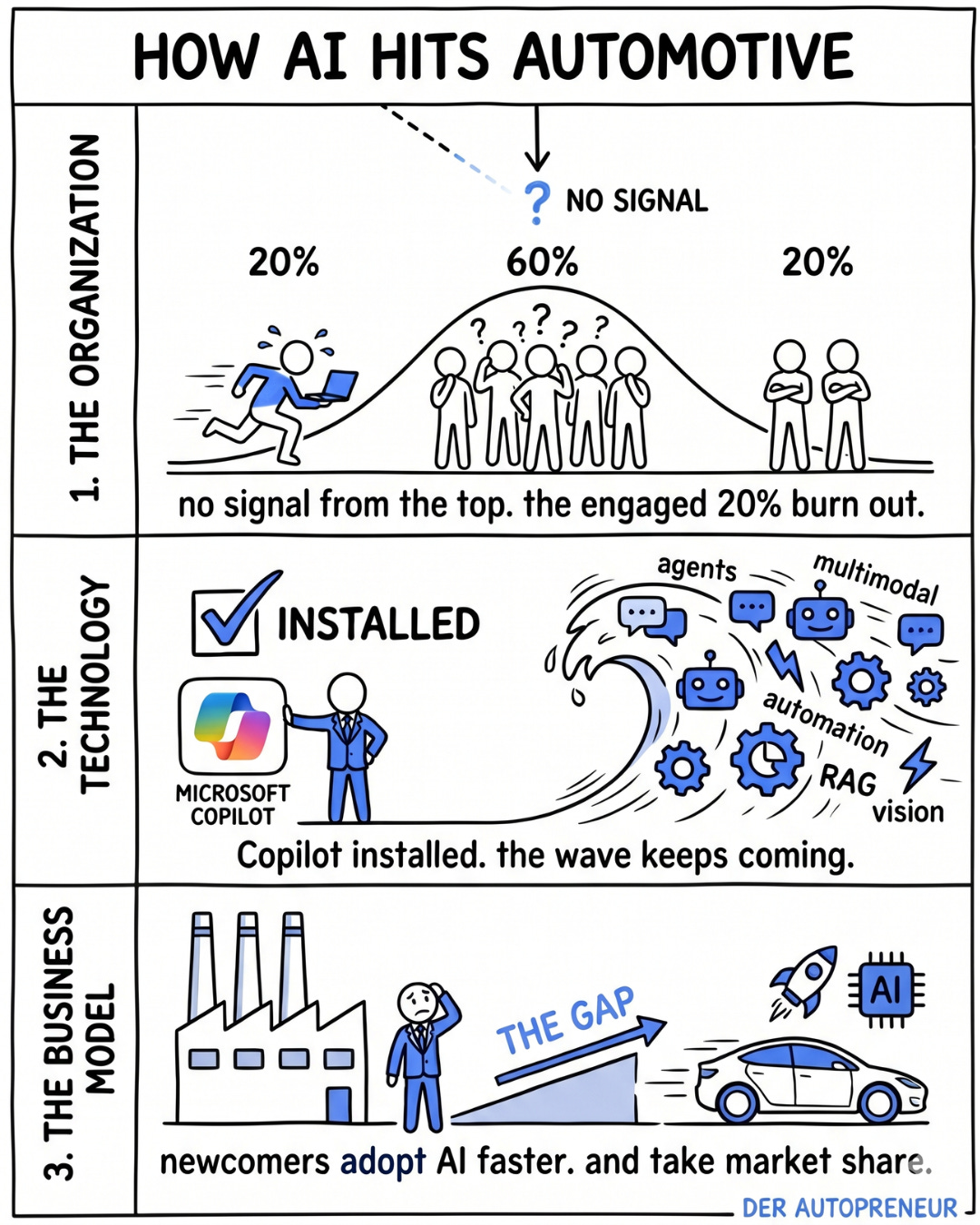
Then there’s a second dynamic. People inside organizations adopt new technology at very different speeds:
20% are the frontrunners. They try tools, build workflows, bring others along
60% wait. They need a clear signal from above before they start
20% are the resisters. They reject AI entirely
One executive told me: “More than half our team needs active persuasion. That only works top-down.” The main fear: losing their job.
And that’s exactly why two things happen:
1) People use their own tools.
50% of respondents introduced AI tools on their own in the last 12 months. Often bypassing IT entirely. Personal accounts with company data. Unapproved models. Internal documents in external tools.
There’s even a word for it: shadow AI.
The irony: many companies ban AI tools for data protection reasons. And in doing so, create exactly the risk they were trying to avoid.
2) The organization turns AI into an Office feature.
Where AI is officially permitted, organizations try to shrink it down until it fits existing processes and mental models. Until it feels like a new Office feature.
Instead of rethinking processes, AI gets layered on top.
“We’re papering AI over old, entrenched processes. Without taking the chance to rethink them from scratch with AI.”
Why doesn’t anyone do it differently?
1) Nobody likes sawing off the branch they’re sitting on.
Who willingly introduces a tool that makes them redundant? Or cuts their own management scope?
2) AI isn’t even on the agenda.
No budget, no plan, no priority. Among suppliers, 12% say their company blocks AI entirely.
Nobody Wants Microsoft Copilot
When companies respond to AI, they almost always roll out Microsoft Copilot. That came up in nearly every conversation. Usually with frustrated undertones.
What most people get: a chatbot with no access to company data, no context for their actual work. The Pro license with company data access costs around $30 per user per month. But most companies don’t roll that out broadly. Everything else gets blocked.
Privately, those same people use Claude, ChatGPT, or Gemini. And they all say the same thing: Copilot delivers far worse results.
Even those with the Pro license are frustrated:
“We have the Pro license. And Copilot can’t even handle a simple Excel table comparing 4 quotes. $380 a year. I’d be twice as fast without it.”
Here’s what happens next. Copilot gets rolled out, tried for a few weeks. Many are disappointed. Usage drops off. And the topic is now radioactive internally. For the 60% in the middle, this is the confirmation they were waiting for: “AI just isn’t there yet.”
Some frontrunners keep pushing. Others give up. Others quit. They know what’s possible. They just don’t get the chance to act on it.
And in management? AI is now checked off. Tool introduced. Done.
That’s the real misconception. Rolling out Copilot doesn’t mean introducing AI. It means providing a stripped-down version of ChatGPT. While believing that’s a sufficient response.
Putting a chatbot in Office is a feature update. Not a new way of working.
The Pressure Is Coming from Outside
In every conversation, I asked the same question: what happens if your company doesn’t keep up with AI?
The answers:
“Revenue in our core business will fall off a cliff.”
“In 2 years we won’t have market-viable prices anymore.”
“Without AI, we’re out of business in a few years.”
Almost everyone agrees.
The good news: There’s no awareness problem.
Even better: There’s probably still time. Organizations are slow by nature. Technological change always moves faster than adoption in large companies. That was true for the internet, mobile, and cloud.
If AI follows the same pattern, there’s still time to adapt.
The bad news: AI might not follow that pattern.
The pressure is coming from 2 directions:
1) The barriers to entry for new competitors are falling.
With AI, it’s suddenly much cheaper to:
bring a product to market
copy an existing business model
attack an entire industry from the outside
AI-native startups don’t need to transform. They build with AI from day one. What takes 100+ people in an established organization, they do with a handful of people and AI agents.
2) Early movers build a lead that’s nearly impossible to make up.
AI users achieve the same results with a fraction of the resources. Start early, develop faster, sell cheaper. That gap is almost impossible to close later.
This is where competitors from China and the US have a potential advantage. Their organizations are younger. More digitally native. And if you can’t keep up, you’re out. That pressure forces faster change. And that’s how the lead gets built.
My Take
What’s forming right now is a disconnect. Between what’s possible with AI on the outside. And what’s actually happening inside these organizations. And it keeps widening.
The established players get hit hardest. Their size makes them slow. We know this.
One example: German OEMs are currently offshoring large parts of software development to India. Mercedes is in the middle of it. The decision came from a time when software developers were scarce and expensive.
But that world is shifting. AI is changing exactly this kind of work.
Code is becoming a commodity. AI handles it. What companies actually need are veterans who understand both product and code. A small number of highly skilled people working close to the core organization. Not offshore.
Yet the offshoring continues. Because organizations today are acting on decisions from a world that no longer exists. And the larger the organization, the longer it takes to correct course.
Where is this heading? Toward companies that run with a fraction of today’s knowledge workers. The successful companies of the future will likely consist almost entirely of frontrunners.
But what shocked me most in these conversations: there are companies in Germany that still haven’t prioritized AI. No budget. No signal from the top.
To me, that’s leadership failure.
AI isn’t the next tool. AI changes the operating system of a company.
If you don’t treat this as a leadership priority, you’re driving your company off a cliff.
So back to the original question: where does the German auto industry stand on AI?
The honest answer from these conversations: behind.
Some companies won’t survive this.
But it doesn’t have to end that way.
Companies can course-correct. Just not with the standard playbook.
And here’s the good news:
The answer is already inside the company.
It’s the 20%. The frontrunners.
They’ve already started. With their own tools. Their own projects. At their own expense.
These are the most valuable people a company can have right now. Don’t slow them down. Give them everything they need to move fast.
That’s the bet. Not on the technology. On the people already using it.
That’s all for today.
Feel free to reply to this email with your thoughts.
Until next week,
Philipp
PS: If you find value here, share it with someone who should read it too.
Want to reach European automotive decision makers?
I help global B2B companies connect with 80,000+ automotive decision makers in Germany.
The shadow AI number is telling. Half of respondents introduced their own tools in the last year, bypassing IT entirely. Companies are so slow to approve what works that people just go around them. That is not a technology problem. It is a trust problem.