


Ad
Modernize your SCADA systems without stopping production
In many plants, control systems have run unchanged for decades. Replacing them has always seemed expensive and risky. But the longer you wait, the more dependent you become on your vendor. If you work in plant engineering or production IT, you know the feeling.
OneSCADA® by GADV migrates and modernizes your SCADA environment while production keeps running. It's vendor-neutral, fully automated, and TISAX-compliant. No downtime, no vendor lock-in.
The result: shorter project timelines and clean, structured data, ready from day one for predictive maintenance and automation.
Get a free initial assessment of your migration:
Welcome to Issue #125 of The German Autopreneur.
What a week for VW:
Up to 100,000 jobs could go
4 plants are at risk
VW is ending its self-driving alliance with Bosch
And it's selling off entire parts of the group
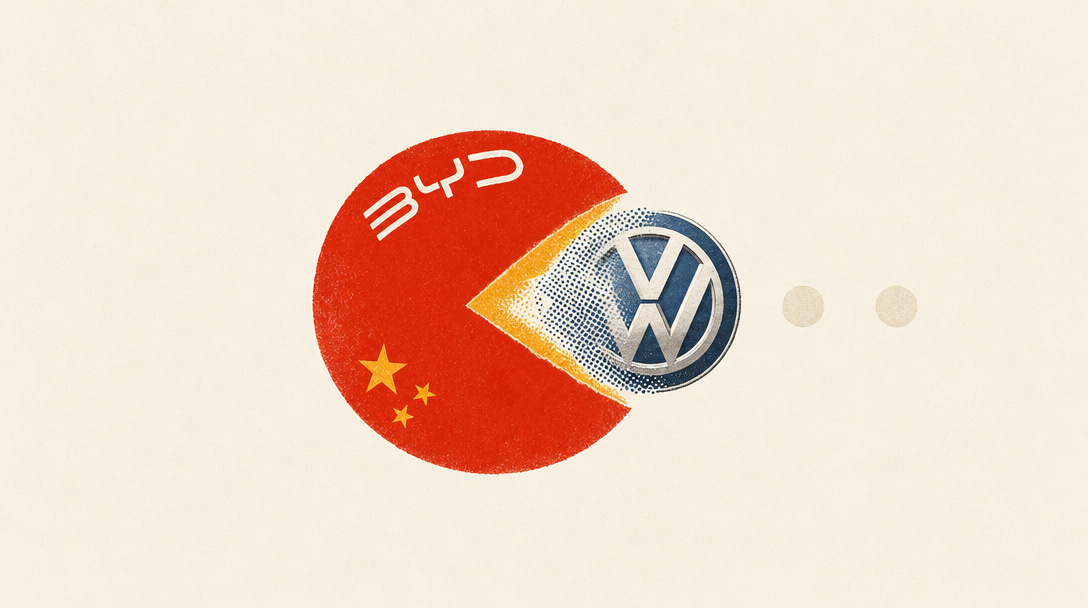
In the middle of all this, one sentence. Moritz Schularick is one of Germany's most respected economists. His prediction: "VW will probably be bought up by a Chinese carmaker. BYD, for example."
Sounds like the end of VW. Today I'll look at whether there's anything to it:
Why VW has to buy its future technologies instead of building them
Why the rescue plan from China could backfire
And the 3 scenarios for how this could end for VW
What's Actually Happening at VW
One step at a time:
1. Up to 100,000 jobs could go:
VW employs 657,000 people worldwide. That would hit almost 1 in 6 jobs. It's not confirmed yet. The supervisory board meets on July 9.
2. 4 German plants could close:
The same leak names Hannover, Zwickau, Emden, and the Audi plant in Neckarsulm.
3. VW is buying its self-driving technology instead of developing it:
In 2022, VW started an alliance with Bosch. Around $1.7 billion reportedly went into it. Now the alliance is over. VW plans to buy the technology from partners instead of developing it in-house. At least for Level 3 and up, where the car takes over the driving.
4. VW is selling off parts of the group:
VW is selling whatever can be sold: engine maker Everllence (majority stake to a financial investor), design subsidiary Italdesign (to a US company), IT consultancy MHP (buyer wanted). Even stakes in battery subsidiary PowerCo and robotaxi subsidiary MOIA are up for debate.
5. VW wants to bring cars developed in China to Europe:
Until now, the rule was: developed for China, sold in China. Reports say the board is now considering the opposite.
6. VW is restructuring into a holding company:
The Volkswagen brand is set to become its own legal entity.
That's a lot for one week. From the outside, it looks like chaos. What's behind it? And how does it all connect?
Why VW Has to Buy Its Future
As with most problems in the German auto industry, the story starts in China.
For decades, China's car market was firmly in foreign hands. Mostly German ones: VW was the number 1 there for almost 40 years.
Then China built its own auto industry and took the market back:
In 2019, VW still delivered 4.23 million cars in China
In 2025, it was 2.69 million. A drop of more than 1/3
And the curve keeps pointing down
China is the epicenter of the VW crisis. There's just one problem: it doesn't stay in China. China's new auto industry is pushing into almost every market in the world. The real danger for VW: what happened in China could now repeat everywhere. Market by market.
But why are Chinese brands winning market share everywhere? Because they've overtaken the established carmakers in the technologies that will define the car.
And there's a reason for that. The product itself has changed:
Engine, transmission, and chassis used to make up a car's value
In the new car, it's battery, software, and AI: soon up to 80% of the value
That's what the Chinese have mastered. And where VW is behind.
Catching up on its own didn't work. That was CARIAD: VW's in-house software subsidiary swallowed billions and still didn't deliver a competitive product.
The change in strategy came 2 to 3 years ago. Stop developing. Start buying. From partners who already know how:
In the US, VW bought into Rivian: Rivian has exactly the software architecture for the new car that VW wanted to build itself with CARIAD. VW is investing up to $5.8 billion and is now Rivian's largest shareholder with almost 16%
In China, the partner is Xpeng: same principle as with Rivian. VW holds almost 5% and is building a platform for the Chinese market with Xpeng. The technology comes from Xpeng
Which leaves one question: why is VW buying the same technology twice? Once in the US, once in China.
The answer: VW would probably love to buy everything in China. It's cheaper. The problem: the US is locking Chinese vehicle technology out. From model year 2027, connected software from China is banned. From 2030, the hardware too.
Polestar shows how serious this is. The brand belongs to China's Geely Group. At the end of June, the US government decided: from model year 2027, Polestar can't sell new cars there anymore. Chinese technology in the car now means no US market.
So VW pays for both: 2 partners, 2 separate platforms. The industry calls them tech stacks. One for China, one for the US. So far, so smart.
The plan has one catch. A carmaker that buys its core technologies has no edge of its own anymore.
For comparison: BYD builds around 80% of its cars itself. VW has always built more like 1/3 in-house, with suppliers delivering the rest. And that share keeps shrinking, because the new core technologies now come from outside too. VW contributes less and less to its own car.
VW is becoming interchangeable.
And still, VW is going one step further: it now wants to bring that Chinese technology to Europe.
The Rescue Plan From China
Some even see this as the rescue. Olaf Lies is the premier of Lower Saxony. The state co-owns VW, and Lies sits on its supervisory board. His hope: affordable models with technology from China keep the German plants busy. And save jobs and sites.
At first glance, that sounds logical. In China, VW is already developing cars with Xpeng. They're technologically ahead of anything VW builds in Europe, and cheaper. So why not sell them here too?
Because there's a Trojan horse in this rescue plan: Chinese technology with a German logo.
Audi shows how that plays out. Audi lost massive market share in China. So it tried something new: a separate brand built on the technology of its Chinese partner SAIC. Design and logo come from Audi.
But customers quickly noticed there's a Chinese car underneath. The models are selling poorly. So far, the plan hasn't worked.
And that's the move VW now seems to be planning. Only bigger. And this time in Europe.
The timing makes it even riskier. The China business is breaking away. That makes its home market more important than ever. For VW, that market is Europe. But Chinese carmakers are expanding aggressively into Europe right now.
And with a move like this, VW would make Chinese technology mass-market overnight. Customers don't know Xpeng. But they know VW. And they trust VW.
The danger: Xpeng already sells its cars in Germany today. Once customers realize the same technology sits in both the VW and the Xpeng, at some point they'll buy the original. Just like Audi in China. VW would be opening the door for its own competitor.
And it's not just VW. Stellantis already sells cars from Chinese carmaker Leapmotor in Europe. And Leapmotor's technology is even set to appear under the Opel brand in the future.
The tragic joke: Europe's carmakers are afraid the Chinese will overtake them in Europe. So they climb into bed with "the enemy."
That's why this plan is a tightrope walk. It can keep plants busy and save sites. Or it lets Chinese technology flood into Europe and makes VW interchangeable for good.
Either way: a carmaker that buys its technology instead of developing it needs fewer people. By that logic, VW should be shrinking.
Why VW Isn't Allowed to Shrink
VW's plants can build around 12 million cars a year. VW builds around 9 million. And according to CEO Oliver Blume, that's not going to change.
Add a problem VW has been dragging around for a long time. With the profits from China, the group built up a huge, bloated organization in Germany over decades.
Too much administration, too many overlapping structures, too many people. For a long time, nobody noticed. The profits from China covered it. Now the profits are gone. That bloated organization is still there.
So VW would have to shrink. But VW isn't allowed to.
Because VW is not a normal company. Honestly, VW is partly the very thing the West likes to accuse China of: a half state-owned carmaker.
The German state of Lower Saxony holds around 20% of the votes. And since 1960, there's been the Volkswagen Act. A law written for this one company. It lets Lower Saxony block any major decision about its plants and sites.
Then there's German co-determination: the works council and the IG Metall union hold half the seats on the supervisory board. Closing a plant against your own workforce is impossible.
So VW's mandate was always bigger than pure profitability: protect jobs, even when they no longer pay for themselves.
One VW CEO already failed at this: Herbert Diess. He wanted radical cuts and lost the power struggle against these structures. In 2022, he had to go.
His successor Oliver Blume is now trying the same thing. And this time, the pain is big enough that it might work.
Because by now, everyone gets it: without hard cuts, VW won't make it out of this. But nobody can say yes openly. Their own people would tear them apart.
That's what the restructuring solves: VW is turning the Volkswagen brand and the components division into standalone companies. What's left is a holding company that just owns the shares.
Officially, this is about competitiveness and market value. But there's another hope behind it: the old protections from the Volkswagen Act and co-determination apply to the group as a whole.
Pull the brand out as its own company, and those protections lose much of their grip. The hard cuts then get decided by the new company. More independent of politics and the works council.
And because the works council and the state no longer have to approve the cuts directly, they can still back the restructuring. Only then can plants close and jobs go at scale.
And the restructuring has a 2nd effect. Remember Moritz Schularick's prediction: VW gets bought by a Chinese carmaker. A restructuring like this is what makes that possible in the first place. Because a company in pieces is a company you can buy.
And VW is showing right now that it's willing to sell: Everllence, Italdesign, MHP. Why not an entire brand at some point?
Which raises the question: will Volkswagen even exist in 5 years?
How This Can End for VW
Let's play it out: where can VW go from here? I see 3 scenarios:
Scenario 1: VW makes the comeback
VW uses the partnerships with Rivian and Xpeng to learn. It studies everything: the technology, how they work, the speed. With one goal: build these skills in-house and eventually get better than the partners.
That's the playbook China used to get big. First, they learned through joint ventures with Western companies. Then they tried it themselves. And in the end, they overtook the West technologically.
One thing is critical: the dependence on the partners can't become permanent. It has to stay a transition phase. And VW has to use it to stand on its own feet again.
Scenario 2: China buys VW
That's Moritz Schularick's scenario. A Chinese group takes over the VW brand completely. And it fits the moment: BYD wants to overtake Toyota by 2030 and become the world's largest carmaker. Buying VW would be the perfect shortcut: a global brand, the China business, South America, access to Europe.
But part of the package would instantly be worthless: the US business. A carmaker in Chinese hands has no future in the US. We saw that with Polestar.
And that's why there's a 3rd scenario.
Scenario 3: VW splits up
Nobody buys VW as a whole. Instead, the brand breaks apart along its 2 tech stacks:
A China VW on Xpeng's technology: eventually owned by a Chinese group, running the China business
A US VW on Rivian's technology: stays Western, takes over the US business, and maybe one day merges with Rivian completely
And the rest of the world? Either the 2 VWs split the markets between them. Or we get the absurd situation of the China VW competing against the US VW in the same market. That's what could happen in Europe.
Sounds crazy at first.
But VW built the fault line itself, with its 2 tech stacks. And the holding restructuring could be the first step in that direction.
My Take
Let's zoom out. From a German perspective, only Scenario 1 is worth rooting for. The other 2 mean losing Europe's largest car group.
And if you ask me: a complete takeover by China is unlikely. The US problem is too big for that. If VW doesn't make the comeback, a breakup is the more likely ending.
But let's hope it comes to neither.
Which leaves the question: how does VW make the comeback?
Start at the core. The car of the future needs completely different skills than the old one. Not mechanical engineers, but software developers and AI researchers.
Different skills also need a different organization. And that leaves VW with a brutal task: turning itself around 180 degrees. From an industrial manufacturer to a software company. It has to become a completely different group.
And this is where it gets uncomfortable. Some people can be retrained. But only up to a point. You can't turn every mechanical engineer into an AI researcher. And not everyone wants to change. Many just want to keep doing what they've always done.
What VW needs is a generational reset. At every level. That's one reason behind the 100,000 jobs.
Don't get me wrong. There are real people behind that number. But artificially keeping alive jobs that have no future helps no one in the end. It just kicks the problem down the road.
And here's the truly bitter part. Germany's own rules make exactly this rebuild nearly impossible.
Our employment protections. Our labor rights. They shielded German workers for decades. A real achievement, and one we Germans are rightly proud of.
But these rules were built for a stable world. And that world is gone. In a disruption, a company has to act more like a startup. Decide fast. Take risks. Try things.
That's what our rules barely allow.
What's left are expensive severance programs. And with those, the people who leave voluntarily are often exactly the ones you want to keep.
It gets worse. Hire someone in Germany, and you can't easily part ways again. For something completely new, that's too risky. So VW builds its new teams somewhere else from the start.
And that's my real fear. Our rules protect the jobs of yesterday. The jobs of tomorrow are being created in the US and in China.
The comfortable way out is familiar by now: buy someone else's technology and put your own logo on it. But that's not a future.
That leaves the hard way. Stay humble. Learn from the partners without getting played. Copy everything. And reinvent yourself along the way. Damn hard. But it's the only real chance.
In the end, VW's choice is pretty simple. Either VW reinvents itself. Or VW gets sold. In one piece, or in parts.
🔗 sz | mm | dw | hb1 | hb2 | hb3 | re | ek | ev1 | ev2 | cnn | ts | moia | pc
A word from me
Your shortcut into European automotive
Selling to BMW, Bosch, or Continental from outside Germany? Good luck.
German automotive is a closed club. Built on trust, relationships, and decades of doing business face to face. Cold outreach doesn't work. Trade fairs cost $20,000 for maybe 3 real conversations. And nobody takes meetings with companies they've never heard of.
I spent 10 years inside Mercedes-Benz. Today, 100,000 European automotive decision-makers follow me. From team leads to board level. They trust me. Because I speak their language. Literally.
One partner generated 250 webinar signups. Another got 60 qualified leads at OEMs.
I'm your bridge into the German auto industry.
Interesting comparison to the US where Chinese ownership has become a major barrier to market access. See how Polestar was blocked, and how it decided to refocus on Europe.
It's easy to pick on VW for past mistakes, lousy investments, and inertia. The real question is how to overcome the inertia and the friction of current German laws to reinvent the business. It really comes down to the value of the finished product. I for one do not trust VW quality after years of anecdotal evidence from friends. It's better for Europe that they survive, but not at the company's current size. "Hey, let's make a smaller, cheaper, functional People's Car!"