


Ad
Homologation: who on your team pulls the current legal texts together?
Anyone who wants a vehicle on European roads has to go through this, whether you build here or import.
The rules keep changing, and they're spread across a lot of different legal sources. So somebody keeps a list of their own and hopes nothing was missed. That's one reason approval work in Europe takes longer than it should.
That's what ATEEL built ALICe for. The software breaks the legal texts down to the level of the individual paragraph and marks every change. For autonomous driving as much as for the rest of type approval.
ATEEL is your partner for homologation and technical compliance in the automotive industry.
Welcome to Issue #129 of The German Autopreneur.
I'm back from the summer break. And we start with the story all of Germany has been talking about for weeks: Volkswagen.
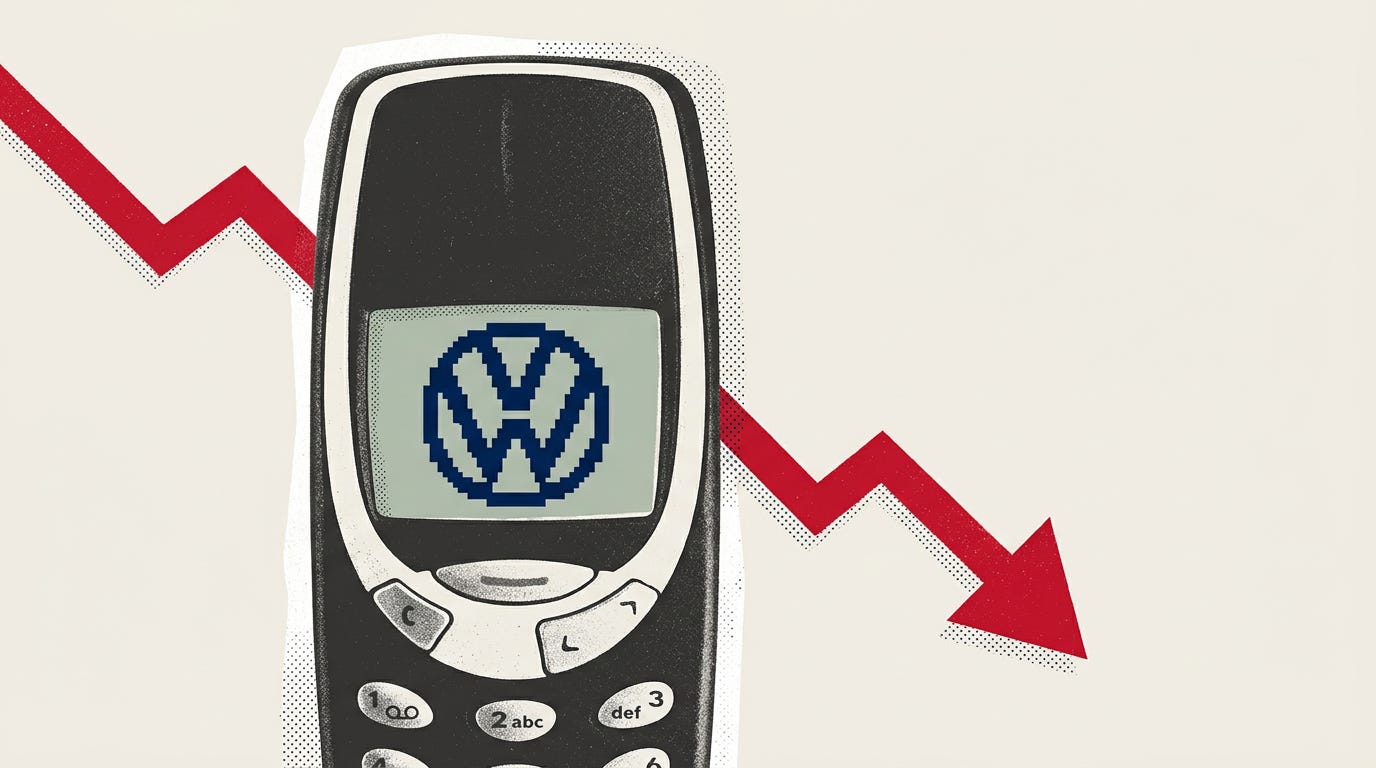
Plant closures, job cuts, and since last Thursday a cost-cutting plan the supervisory board has approved. In 2 weeks VW also drops out of the Euro Stoxx 50, the index of the 50 biggest listed companies in the eurozone. And ironically, it's Nokia that's taking its place.
VW has become the face of the crisis in the German car industry. And a little bit the face of the whole country.
So everyone has an opinion on it. And I think most of that debate misses the point.
So today we'll look at:
What's actually happening at Volkswagen right now
The biggest myth in the current debate
What it means for Germany, and whether VW survives it
What the fight at VW is about
First, who wants what. At Volkswagen, 2 sides are up against each other.
One thing about German companies before that, because the whole fight runs on it. A company this size has 2 boards. A management board runs the business. And a separate supervisory board has to approve the big decisions. Half the seats on that supervisory board belong to the workers.
1) The management board wants the biggest restructuring in the company's history. Its plan leaked this week. It wants to:
Wind down car production at 4 German plants: Emden and Zwickau in 2031, Hanover in 2032, the Audi plant in Neckarsulm in 2034
Move that production to the Czech Republic, Slovakia and Poland
Cut 50,000 jobs worldwide (together with the 50,000 agreed since 2024, that's almost 1 in 6 jobs)
Kill half of the group's models, from around 150 down to 75
Shut down the SEAT brand
Spin off the core VW brand and the components division, so they sit legally outside the parent group. That would give the workers and the state less say over them
Sell, close or merge 700 of the group's more than 2,000 companies
Target: €30.9 billion in operating profit in 2030. More than 3x what VW made in 2025 (€8.9 billion)
2) The workforce and the state of Lower Saxony are against it. What they want:
The workforce wants to keep its jobs. When CEO Oliver Blume pitched the plan at the headquarters in Wolfsburg, he got booed
Lower Saxony owns 20% of VW and wants to save every site. One detail stands out: state premier Olaf Lies no longer talks about cars. He talks about industrial jobs. The plants have to stay, and what gets built in them matters less
So in the end the supervisory board had to decide. And for a long time it couldn't:
The supervisory board has 20 seats. 10 belong to the workers, 2 to the state of Lower Saxony. And the state almost always votes with the workers
Moving production out of a VW plant needs a 2/3 majority. That's written into the Volkswagen Act, a law made for this one company
So the management board can't get its plan through without the workers. It tried in July and failed
The short version: the management board wants out of Germany. That's how it wants to save VW. The workforce and the state want to keep Volkswagen in Germany at any price. That's the conflict. And there's something absurd about it.
Then came the deal. Not one vote against it.
What was actually decided
What they agreed on is the plan from the leak. And now both sides are celebrating:
The management board got it in writing: car production in those 4 plants ends between 2031 and 2034
The works council and IG Metall (Germany's metalworkers' union) got it in writing that no plant will be closed. And that the spin-off is cancelled
Both of those are true:
Winding a plant down isn't a closure. And the management board doesn't need anyone's approval for that
And the spin-off is only postponed. The supervisory board and the shareholder meeting decide in 2027 at the earliest
This is how the restructuring at VW has worked for years. Never one big move. Always one more piece of it.
Back in 2021, then-CEO Herbert Diess already wanted to make deep job cuts. Shortly after, he was gone. At the end of 2024 came the first big deal. Now the next piece. And in 2027 there will be more.
So everybody is arguing about the German plants. The real problem is somewhere else.
The mother of all VW problems
For decades the German car industry ran on a simple model:
Develop high-tech cars at home
Sell them all over the world
The core of it was Germany's technological lead. German cars were better. So customers around the world paid extra for them. And that extra paid for expensive factories at home.
The most important market was China. For every German carmaker it was the biggest and the most profitable, and for VW most of all.
This is what 2019 looked like:
Almost 4 of 10 VW cars were sold in China, 4.23 million of them
€4.4 billion in profit came out of China alone. No other market delivered that much
And this is 2025:
2.69 million cars sold in China, down by more than 1/3
Profit from China fell to just under €1 billion, down by almost 4/5
So between 2019 and 2025 the China business collapsed. In the rest of the world, sales fell by only around 7% over the same period.
Think of VW's business model as a house of cards. China was the card holding it up. It got pulled out over the last 5 years, and now the whole thing is coming down.
Which means VW's problems started in China. Without China there would be no crisis today. And yet Germany tells itself a different story.
The myth that Germany is too expensive
Germany has settled on one answer. The country is too expensive. Wages too high, energy too expensive. Get those down, and the car industry is saved.
That's the mistake.
Because sales collapsed in China, not in Europe. And VW builds its Chinese cars in China. At Chinese wages and with Chinese energy prices.
Don't get me wrong: Germany does have high costs. They just have nothing to do with the collapse in China.
So German plants can cut wages and energy costs as much as they like. It won't make the products any more competitive in China.
The problem is the product. Products come out of engineering, and VW's engineering sat in Germany. It stopped delivering what the market wants.
So there are 2 different fights, and they keep getting mixed up.
1) The fight over production
In production, Germany is not competing with China. It is competing with Slovakia, Hungary and the rest of the EU.
Industrial labor costs in 2025:
Germany: €49.50 per hour
Slovakia: €19.30 per hour
That's a fight Germany can't win. It's one of the richest countries in Europe, and the wages come with that.
And it shouldn't want to win it either. A race with the poorest EU countries over who builds cars cheapest can't be the goal. Germany was never competitive in production. It could only afford production because it had the engineering.
2) The fight over engineering
That was the business model. That's what made German carmakers strong. In engineering, Germany does compete with China and the US. But the playing field has moved:
It used to be about engines and mechanics. Mechanical engineering, the German core skill
Today the most valuable technology in a car sits in the battery, in software and in AI. And that's exactly where Germany is weak
So Germany is losing more than production jobs. It's losing the engineering. That work moves to where the new technology is built, and that's China and the US.
But the debate is about production costs. About the part Germany was never strong in.
And there's a reason for that. Until the end of 2030, VW can't lay anyone off in Germany at all. That's the deal with the union.
So if VW wants to cut jobs anyway, people have to leave on their own. And people leave more easily when the mood is bad. Which gives VW its own reason to keep the too-expensive story running.
But none of that changes the real problem: the product. So how does VW plan to fix it?
This is Volkswagen's rescue plan
Cut out the noise and the plan does 3 things.
1. Shrink production and move it
In China production really is shrinking. VW simply sells far fewer cars there than it used to. It has already taken out capacity for more than 1 million vehicles.
In Europe VW wants to take out capacity for around 500,000 vehicles.
At the same time, production moves to cheaper sites. That's the part Germany argues about.
And this is the part that always gets mixed up. The assumption is that the German plants are sitting half empty. In fact they run at 81% capacity. That's a good number. They're just more expensive than the plants abroad:
€6,490 in factory cost per car in Germany
€2,832 elsewhere in Europe
That gap is too wide to close. The fight is lost before it starts, so production moves to where it's cheaper.
2. Sell off the side businesses
VW is more than a carmaker. The group also includes brands, plants, a finance arm, trucks, motorcycles, consultancies and stakes in football clubs. Around 700 of those companies are supposed to go.
Already sold: the consultancy MHP went to Tata. The majority of Italdesign went to UST, and the majority of Everllence to Bain Capital.
Also on the list: Ducati, Moia, Europcar, part of Traton, the football stakes. And IAV (which develops cars for other manufacturers) is set to go to Accenture.
The goal is a smaller group that focuses on its core business: building cars.
3. Buy the engineering instead of doing it in-house
This is the most important part of the plan. Vehicle engineering is the heart of a carmaker. At VW it sat in Wolfsburg, Ingolstadt and Weissach (the towns where the group develops its cars). And a large part of it now goes to partners.
According to the leak, VW is cutting technical development by 35-50%. Investment and research drop by €50 billion over 5 years.
What VW still does itself: body, chassis, interior, design and final assembly.
What VW buys in:
Software and electronics: from Rivian in the West, from XPENG in China
Autonomous driving (the AI in the car): from XPENG in China, and in the West likely from Nvidia, Wayve or Mobileye
Battery: the cells come mostly from suppliers
So VW is giving away the one thing the German model was built on. Its engineering. The question is why.
Why VW is outsourcing its engineering
The usual explanation: VW slept through the shift. That's only half true. Yes, VW should have reacted earlier. But by 2020 at the latest it did react. With a lot of money.
Almost no company in the world spends more on research than VW. €21 billion in 2024 alone. That's 8th place worldwide, across all industries. More than Mercedes and Tesla together.
So the money was never the problem. The problem is what came out of it:
Software: VW's own software unit CARIAD lost more than €10 billion in 5 years. The software came late and was never competitive
Autonomous driving: first Argo AI with Ford, shut down in 2022. Then the alliance with Bosch, ended this year
Battery: VW bet on Northvolt and was its biggest shareholder. Northvolt went bankrupt. The stakes in QuantumScape and Gotion are up for sale. And PowerCo (VW's own battery company) is supposed to find outside investors
So VW spent a lot of money. It just never turned that money into results. It burned it.
And at some point VW made up its mind: we give up. What we can't build ourselves, we buy.
My Take
I think we in Germany are talking about the wrong thing. We argue about plants and jobs. About the part we're going to lose anyway. And we look past the engineering. That's what made those plants and those jobs possible in the first place.
I understand both sides.
For the management board, the only way out is leaving Germany. And honestly, from where it sits there's no logical reason left to stay.
Germany was a great place to build cars around the combustion engine. Everything that went with it sat here: the suppliers, and the deep knowledge of the powertrain. That's what made it work.
The car has moved on since then. What matters now is batteries, software and AI. And for those Germany has nothing to build on.
What's left is the highest labor costs in the European car industry. The only thing still keeping VW here is its own history. Nothing else.
The workforce and the state want to keep their jobs and their share of the value chain. That makes complete sense too. The 2 things just don't fit together.
Which leaves 2 questions. What does all this mean for Germany? And will VW survive it?
The German model was simple: our cars are better, so they cost more. That's exactly what's gone now. Because if VW buys its technology, a Volkswagen is no longer better than the competition. At best it's level with it. Rivian and XPENG sell that same technology to other carmakers too. Or build it into their own cars.
So VW can't afford to be more expensive than the competition anymore. Then the price gets set by whichever company sells the same technology cheapest. And that's the Chinese carmakers. That means: VW has to come down to their price level, or it has no chance.
And that decides the future of the German plants. We could only afford them because customers paid extra for German technology. But nobody pays that extra anymore. Which means we can't afford them.
And that brings us back to Nokia.
15 years ago Nokia was the biggest phone maker in the world. The phones were well built. Nokia lost anyway, because Apple and Google had the better software.
Then Nokia bought its software from Microsoft. But it wasn't enough. Eventually Nokia stopped building phones.
Today Nokia builds network technology: mobile networks, fiber, the connections between data centers. That business is growing because of AI. And on the stock market Nokia is now worth more than VW again.
Volkswagen is where Nokia was 15 years ago. The cars are well built. Just not with VW's own technology.
Buying the software didn't save Nokia. VW thinks it can pull off what Nokia couldn't. That's the bet. It could work, or it might not.
The sad part: for Germany it doesn't matter how it ends. We lose the engineering. And sooner or later, production too.
Which is exactly why I want to end on something positive.
20 years ago China was where Germany feels it is today. Behind on the technologies that would matter. No market leaders of its own.
Then they made a plan. And they stuck to it for 20 years.
What I'm saying is this: we in Germany can do the same. It's in our own hands. And I'm sure it will get better again.
PS: I spoke to CNBC about these job cuts back in July. Here is the clip
🔗 wiwo1 | wiwo2 | hb | ai | eu | mm | bl | vw | jrc | riv | sp
A word from me
Your shortcut into European automotive
Selling to BMW, Bosch, or Continental from outside Germany? Good luck.
German automotive is a closed club. Built on trust, relationships, and decades of doing business face to face. Cold outreach doesn't work. Trade fairs cost €20,000 for maybe 3 real conversations. And nobody takes meetings with companies they've never heard of.
I spent 10 years inside Mercedes-Benz. Today, 100,000 European automotive decision-makers follow me. From team leads to board level. They trust me. Because I speak their language. Literally.
One partner generated 250 webinar signups. Another got 60 qualified leads at OEMs.
I'm your bridge into German automotive.
That’s all for today.
Until next week,
Philipp
And as always: If you find value here, share it with someone who should read it too. That helps me a lot.
Thank you for the excellent article, but why no mention of energy costs in Germany? Isn't this a major factor?
And something different from economic prespective. Whats more important to German people. A Volkswagen to be built in Germany. Or sending it to Slovakia and keep the "company" alive. And at what point its to be called a German Car Company itself. Just to keep it alive, keep sending its parts to everywhere else. When eventually it would have nothing to do with Germany, as cost will always go on increasing,it will sell and send itself away totally. Why would it be important to keep it alive that way.
And i have to say,Your article is nothing but excellent in pointing the issues of vw.