


Ad
Do you work in logistics? Then you should know this company
Meet Neovia Logistics. Customers call Neovia a hidden champion. 5 of the top 10 carmakers work with them. And the 10 biggest customers have been with Neovia for an average of 24 years.
One example: a German premium carmaker has Neovia run its spare parts warehouse near Warsaw. When a dealer orders a part, it's in the workshop the next day.
Whether you're a carmaker or a supplier, Neovia takes care of everything that happens in your warehouse.
Welcome to Issue #134 of The German Autopreneur.
Last week Porsche unveiled its new strategy: Sportwagenschmiede '35 (German for "sports car forge").
The direction: back to its roots. More sports cars and combustion engines again.
In 2022 the goal was different: more than 80% of all new Porsches would be fully electric by 2030.
In between came a crash: profit dropped 93% in 2025. And then a new boss arrived.
So Porsche is going back to what they do best. That sounds reasonable at first.
But will that save Porsche? Can they recover this way?
Today we'll look at:
How Porsche once nearly went bankrupt, then grew by doing something very different
Why the bet on EVs didn't pay off
And how much of the new strategy actually takes Porsche back to its roots
Porsche nearly went bankrupt in 1993
To understand the new strategy, we need to go back a bit.
Most people think of the 911 first when they hear Porsche. Porsche has been building it since 1963.
Well into the 1980s, Porsche was still a small company that only built sports cars. And business was good: 1986 was the 5th record year in a row. Porsche sold more than 53,000 cars that year.
But that success depended on a single market. Back then, more than 1 in 2 Porsches went to the US.
And that's where things went wrong. The stock market crashed in 1987, and US sales collapsed.
The success had covered up Porsche's problems. Now they became visible: in the good years, Porsche had developed hardly any new models. And production was far too expensive.
That's why Porsche didn't recover for years. In the early 1990s, a recession made things worse. By 1993, Porsche was selling only around 12,000 cars a year.
Most experts expected Porsche to be sold soon: to Mercedes or VW.
In the middle of the crisis, Porsche appointed a little-known executive as CEO: Wendelin Wiedeking. Almost nobody thought he could save Porsche.
But he rebuilt the company. In the end, Porsche could build a 911 in half the time.
And in 1996, Wiedeking launched the Boxster: a cheaper sports car meant to bring new customers to Porsche.
The plan worked. By the early 2000s, Porsche was back to selling as many cars as in the 1980s.
And Wiedeking went further: Porsche built an SUV together with VW. The Cayenne arrived in late 2002.
For the sports car company, that was the start of a new era. In the years that followed, all the growth came from the Cayenne. Later, Porsche added a smaller SUV: the Macan.
And the SUVs had another effect: they turned China into a huge market for Porsche. In 2020, 1 in 3 Porsches went to China.
Wiedeking had saved Porsche. And he'd reinvented the company along the way.
The small sports car company had become a major carmaker. For over 10 years now, more than 1 in 2 Porsches sold has been an SUV.
Then came the EV.
Porsche went all in on EVs in 2022
By the late 2010s, the whole auto industry was facing a major shift. Tesla showed that expensive EVs could sell, while governments kept tightening the rules for combustion engines. Almost everyone expected EVs to take over quickly.
So did Porsche. The Taycan arrived in 2019: the 1st electric Porsche. Oliver Blume was CEO at the time, and he called it the “beginning of a new era.”
At first, it looked like a success, with around 30,000 reservations before the car's debut. In 2021, Porsche sold over 41,000 Taycans. The Taycan outsold the 911.
A year later, Porsche made EVs its strategy. The target announced in March 2022: more than 80% EVs by 2030.
Back then, that made sense.
To understand why, let's take a quick look at a concept called the “messy middle”:
It describes the painful transition from combustion cars to EVs. During this phase, carmakers have to do everything twice.
They have to keep developing combustion cars, because those are the cars that make the money. And they have to develop EVs, which make hardly any money yet. Often they even have to run 2 production lines side by side.
That means double the costs. And carmakers have to keep up with the best in combustion cars and the best in EVs. On the EV side, that means competing with companies like Tesla, which build nothing but EVs.
For a single company, that's almost too much to handle.
So almost every carmaker wanted to get through this phase as quickly as possible. As early as 2021, Volvo, Mercedes and Audi announced plans to build only EVs.
Porsche did the same. Switch fast, and you skip the messy middle. That was the bet.
And at first, everything went well. In September 2022, Porsche's shares started trading on the stock market. A few days later, Porsche was worth more than its parent company VW.
A record year followed in 2023: more than 320,000 cars sold. Porsche kept €18 in profit for every €100 in revenue.
Porsche was at its peak. Then things went wrong.
By 2025, profit had almost disappeared
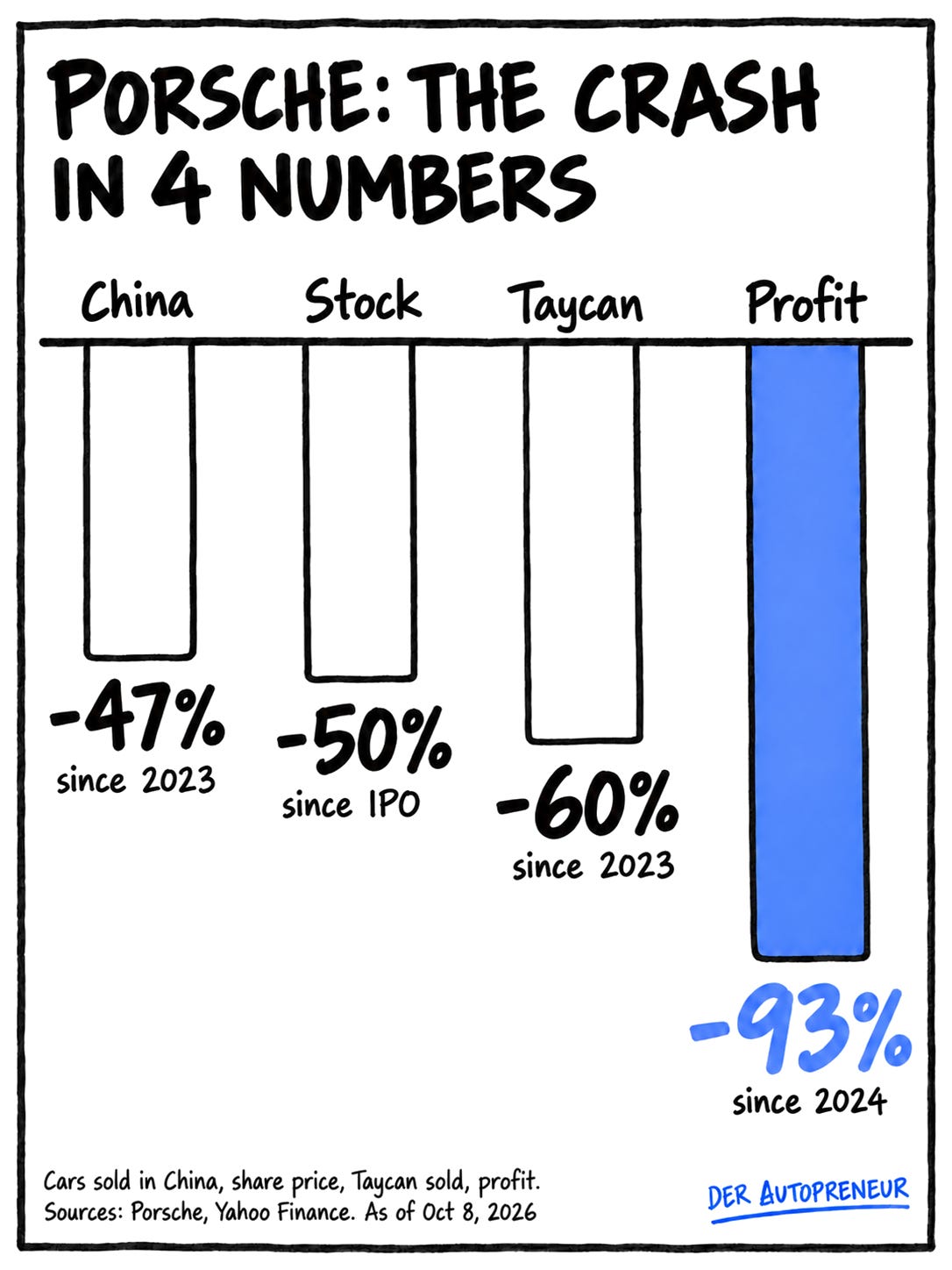
It all started in China. In 2023, Porsche still sold around 79,000 cars there. In 2025, the number was down to around 42,000. Sales in China had fallen by almost half.
All German carmakers are losing sales in China. But none of them has been hit as hard as Porsche.
In 2024, Taycan sales collapsed too. Porsche had built its future around this car, but global sales halved to around 21,000 in just 1 year. By 2025, they were down to around 16,000.
That hit profit, which fell by almost 1/4 in 2024.
In 2025, Porsche had to cut its forecast 3 times.
CEO Oliver Blume wrote to all employees: “Our business model, which has served us well for many decades, no longer works in its current form.”
Then Porsche changed course:
The 80% EV target: scrapped
New EVs: delayed
Its own battery production: abandoned
The total cost for Porsche: more than €3 billion.
By the end of the year, profit had almost disappeared: -93%.
Porsche kept just €1.10 of every €100 in revenue. Only 2 years earlier, Porsche had kept €18.
Then Porsche did exactly what had saved the company back in 1993: they brought in a new boss.
Oliver Blume stepped down, and Michael Leiters took over in January 2026. Before that, he was CEO of McLaren. And before McLaren, he spent over 8 years as Ferrari's chief technology officer.
So Porsche went from a record year to a crisis in 2 years. How did that happen?
An electric Porsche is just another car
Let's look at the reasons:
Reason 1: Porsche is losing China
In 2025, Porsche sold over 40,000 fewer cars worldwide than in its record year of 2023. Almost the entire drop came from China.
China's car market went electric in just a few years. But the engine isn't the only thing that changed. These EVs are a new kind of car. People in China call them “smart cars”: the famous smartphone on wheels.
People choose smart cars for different reasons than combustion cars. For combustion cars, the brand is the most important reason to buy. For smart cars, it ranks only 5th.
But the brand is Porsche's most valuable asset. In this new market, it barely matters anymore.
What matters instead are things like range and charging time. And for expensive EVs, it's mostly autonomous driving and the cockpit. This is exactly where Chinese carmakers are often better. That's why many people in China would rather buy a Chinese brand.
This hurts Porsche more than most. The reason: what makes a Porsche feel like a Porsche comes from the combustion engine and its sound. In an EV, both are gone. And Porsche can't stand out on performance anymore either, because almost every EV is fast anyway.
Take the phone maker Xiaomi. In 2025, a Xiaomi EV was faster around the Nürburgring Nordschleife than the fastest Taycan. And in China, that Xiaomi cost only around 1/4 as much.
That's why Porsche has such a hard time in China. With a combustion engine, a Porsche is an icon. As a smart car, a Porsche is just another car, only much more expensive.
Reason 2: Everywhere else, the bet on EVs came too early
In Europe and the US, most people who buy a very expensive car still choose a combustion engine.
But Porsche had committed to 80% EVs by 2030.
Even Porsche's new boss Michael Leiters now says: for a long time, Porsche invested almost nothing in combustion engines.
So Porsche doesn't have the right cars for either market. In China, Porsche doesn't have the EVs customers want. And everywhere else, Porsche lacks new combustion cars.
Reason 3: Porsche has grown too big
This reason follows from the first 2. In recent years, Porsche had built up the capacity for 350,000 cars a year. They expanded the plants. And since 2016, the workforce has grown by around 14,000 people. But in 2025, Porsche sold only 280,000 cars.
That's a gap of 70,000 cars. But the costs stay the same.
The new boss now has to fix all of this.
Porsche's new plan is to go back to its roots
Last week, Michael Leiters presented his strategy. It's meant to get Porsche out of this crisis:
1) Higher-priced sports cars
Porsche wants its 10,000 most expensive cars to cost even more: from €270,000 on average to €330,000. Porsche also plans an even more expensive sports car above the 911.
2) Combustion engines stay
Michael Leiters says: “The 911 will never be electric.” Porsche will also add a new combustion-powered SUV. The target: 2/3 combustion cars and 1/3 EVs.
3) Less China
Porsche expects things in China to get even worse. In 2025, 15% of all Porsches went to China. In the future, Porsche is planning for less than 10%.
4) Lower costs
Porsche wants to stay profitable even if they sell only 200,000 cars a year. In 2025, Porsche sold around 280,000. To be profitable at 200,000 cars, Porsche plans to cut 25% of jobs in administration and in the plants. In management, the cut is even bigger: 40%.
The big goal:
Sell fewer cars and still bring in more revenue
Revenue: €41-45 billion (2025: €36 billion)
Profit: keep €10-15 of every €100 in revenue again (2025: €1.10)
When: reach both targets by 2030 or 2031
In the 1st half of 2026, Porsche was already back to keeping €7.80 of every €100 in revenue. But profit won't simply keep going up from here. First, things will get worse again: at the current pace, Porsche will sell around 240,000 cars in 2026. And for 2027, Porsche expects even fewer cars and less profit.
So that's the plan.
An insider described it to me like this: the EV plan didn't work out. Now it's back to what Porsche is good at: sports cars and combustion engines.
But it's less of a return to Porsche's roots than it sounds.
Will Porsche become the next Ferrari?
A real return to Porsche's roots would mean going back to 2002. That was Porsche before the Cayenne: a small company that only built sports cars. Back then, Porsche sold around 54,000 cars and had around 10,000 employees.
Porsche is a long way from that today. In 2025, Porsche sold around 280,000 cars and had almost 42,000 employees. And 6 in 10 Porsches are SUVs rather than sports cars.
Still, the direction is clear: fewer cars at higher prices.
And there's a company that works exactly like that. Porsche's new boss spent over 8 years there: Ferrari.
Let's think this through. What if Porsche followed Ferrari's path all the way? That would mean only expensive sports cars with combustion engines.
The 1st question: will there still be a market for very expensive combustion cars?
Today, 6 luxury brands compete in this market: Ferrari, Lamborghini, Bentley, Rolls-Royce, Aston Martin and McLaren. Their cars start at around €200,000, and many cost much more.
Anyone who buys a car like this doesn't need a car. A Lamborghini customer already owns 5 cars on average. For these buyers, cars are a hobby. And they don't mind if a liter of gasoline costs €5.
That's why the combustion engine will survive in this niche. And that protects the niche from Chinese competitors: their way into the car market is the EV.
So yes, this niche would be the perfect place for Porsche to retreat to.
The 2nd question: does Porsche even fit into this market?
This is where it gets tricky: the market is tiny. All 6 luxury brands together sell fewer than 50,000 cars a year. Ferrari sells 13,640.
Porsche sells 20x as many cars as Ferrari. The 911 alone reached around 52,000 sales in 2025. That's more than all 6 luxury brands combined.
Even after shrinking to 200,000 cars, Porsche would still be 4x the size of this entire market.

So Porsche will never be Ferrari. They're far too big for that.
Porsche can't go all the way back to its roots. And they can't go all the way up to Ferrari either.
So what is the new strategy, really?
Where Porsche actually wants to go
The new strategy only goes halfway back to Porsche's roots. On every point, Porsche stays in the middle:
Powertrains: still combustion engines and EVs. Porsche even wants the EV share to grow from around 1/5 today to 1/3
Volume: fewer cars than before, but still far more than Ferrari
Price: more expensive than BMW and Mercedes, cheaper than Ferrari. Porsche calls this its sweet spot
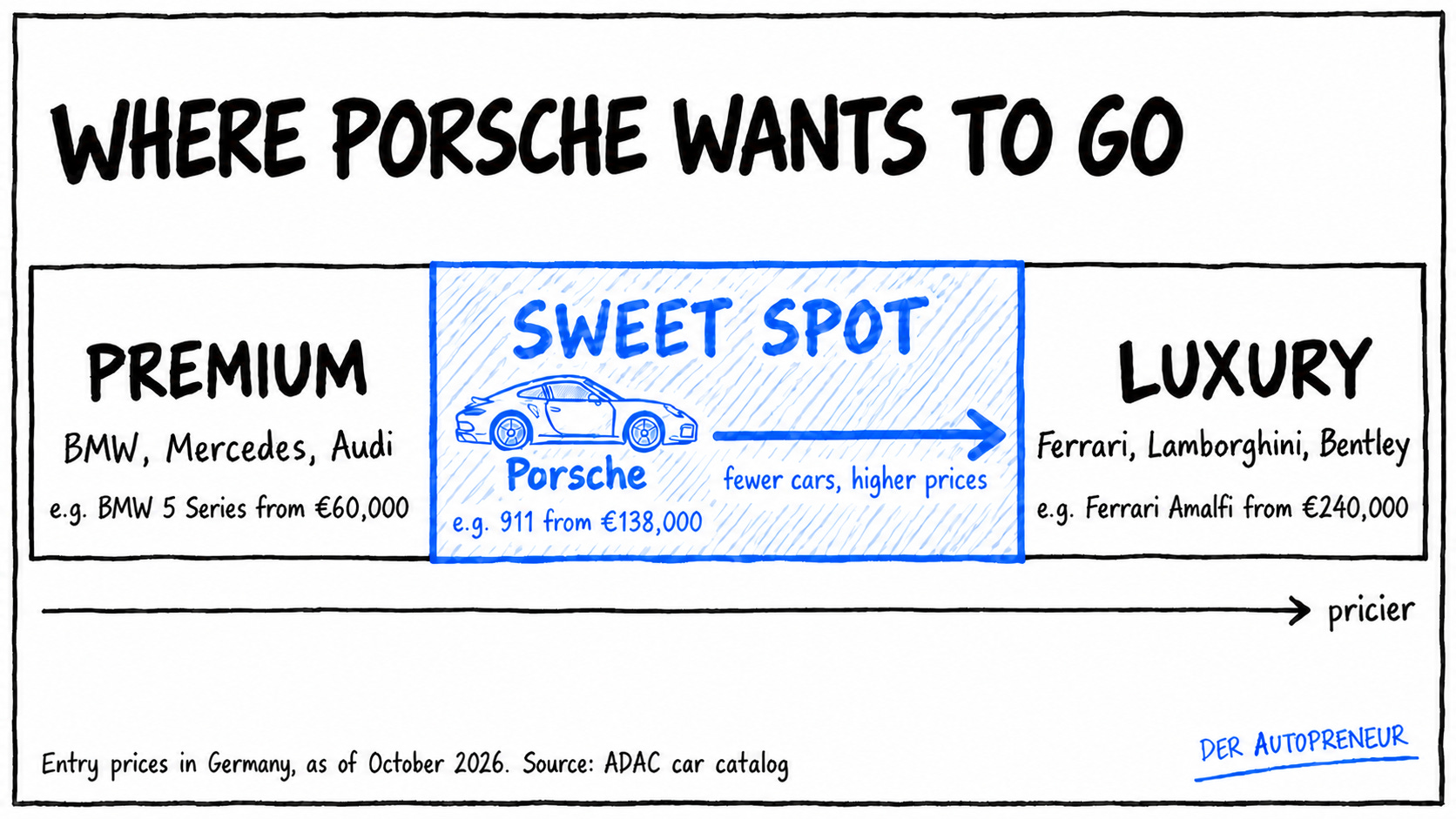
For powertrains, that's exactly the messy middle Porsche wanted to skip in 2022. Now Porsche is stuck right in it. And that will last well into the 2030s.
The only way this can work is through higher prices.
Here's the rough math:
Today: across all models, a Porsche costs around €130,000 on average
The target: at least €41 billion in revenue
The assumption: around 240,000 cars a year, roughly as many as in 2026
The result: a Porsche would need to cost around €170,000 on average. That's about €40,000 more
If the number of cars keeps falling, the price will have to go even higher.
So now the bet is that Porsche customers will pay these prices.
My Take
To be honest, this strategy is no masterpiece. Porsche simply has no other choice.
In 2022, Porsche went all in and committed to EVs. That didn't work.
But going all the way back to combustion engines won't work either. The market for combustion cars is slowly shrinking. What's left is the niche for very expensive combustion cars. And that niche is far too small.
So Porsche is moving back to the middle and doing both.
For China, that won't be enough anymore, and Porsche knows it. But for the rest of the world, it's enough for now: customers there still want combustion cars.
But China shows what comes next. People there buy a car the way they'd buy a phone. What made the old brands valuable barely matters there anymore: the name, the engine, the sound.
So the real task is to make these brands just as valuable in the new market. Because they have something no new brand from China can buy: a history. In Germany, we're so focused on the crisis that we sometimes forget this.
Customers still pay a lot extra for that history when they buy a combustion car. And nobody can copy it.
The problem: in the new market, the brands can't just keep telling their story the same way. They have to translate it for the new market. So far, nobody has managed that.
But Porsche has reinvented itself before. In 1993, a new boss came in and completely rebuilt the company.
Now Porsche is in the same situation again. A new boss has to reinvent the company.
This time, the task is even bigger. It's not about a new car.
It all comes down to 1 question: what makes a Porsche a Porsche when the combustion engine is gone?
The new strategy doesn't answer that.
But it gives Porsche a bit more time to find an answer.
🔗 por | re | nzz | mk | nr | sp | ov
PS: Know someone who works at Porsche or another legacy car brand? Send this issue to them.
A word from me
You could help Mercedes or Bosch. But they've never heard of you
The German car industry is a closed club. You're either inside or outside. And from abroad, you start outside.
Outside means paying over $20,000 for a trade fair booth. And you leave with 100 business cards and 3 real conversations.
I'm on the inside. I spent almost 10 years at Mercedes-Benz. Every week I reach over 100,000 people in the German car industry through my German newsletter, podcast, YouTube channel and LinkedIn. They trust me. So when I tell them about you, they listen.
An IT services company got 250 webinar signups this way. A consulting firm got 60 new contacts at decision-maker level.
My partnership page shows packages, prices and past campaigns with their results. You can also request a free 30-minute call there. By the end of it, we'll know if it's a fit.
The last open campaign date this year is December 20.
See you next Wednesday,
Philipp
The problem is that all these bets are based on the assumption that gasoline is ONLY going to become somewhat more expensive in the next 10 years.
But in the next 5, even the US is going to be facing so many climate disasters that there's going to be a concerted move to ELIMINATE fossil fuels from the public and the insurance industry and the farm lobby and others.
And remember the Obama 'buyback' that had people trading in their old vehicles? That's likely to come back, except the new vehicles will have to be EVs.
The luxury IC cars are headed the way of the elite horses at best, and could become the stolen Rembrandts (yes, you own one and display it to others with similar pieces for reputation games, but that's about it, you don't try and block legislation making it illegal to buy one)
There is no structural reason as to why Porsche should not be able to compete against Chinese EVs. It's way too simplistic to assume that premium EVs are all about self driving and software while Porsche was all about sound (?) and the combustion engine.
Porsche has always been about pleasure of driving and handling a racy car on public roads.
The simple fact is that they were unable to transmit that with the Taycan. That car had an over engineered but under delivering battery and they didn't get the balance right in a way that this car could feel like a Porsche.
They should have waited, as Ferrari did, to spend more time to understand the unique performance curve of eDrives and batteries before launching electric models.
Now they will muddle through in some stuck in the middle strategy between powertrains, price points, and brand positioning. Shame, really