


Paid partnership
This issue is supported by NVIDIA
NVIDIA invited me to their GTC conference in Berlin. While I was there, I got to test their AI driver assistance system Alpamayo in a Mercedes CLA. I also spoke to Philippe van den Berge. He leads NVIDIA's car business in Europe.
NVIDIA had no influence on my story: what comes next is my own view. And not necessarily NVIDIA's.
Welcome to Issue #137 of The German Autopreneur.
October 2026. I'm sitting in a concert hall in Berlin called the Tempodrom. It's packed. Everyone's waiting for one man.
Then he walks onstage: Jensen Huang. In the black leather jacket he's known for. The crowd cheers like he's a rock star.
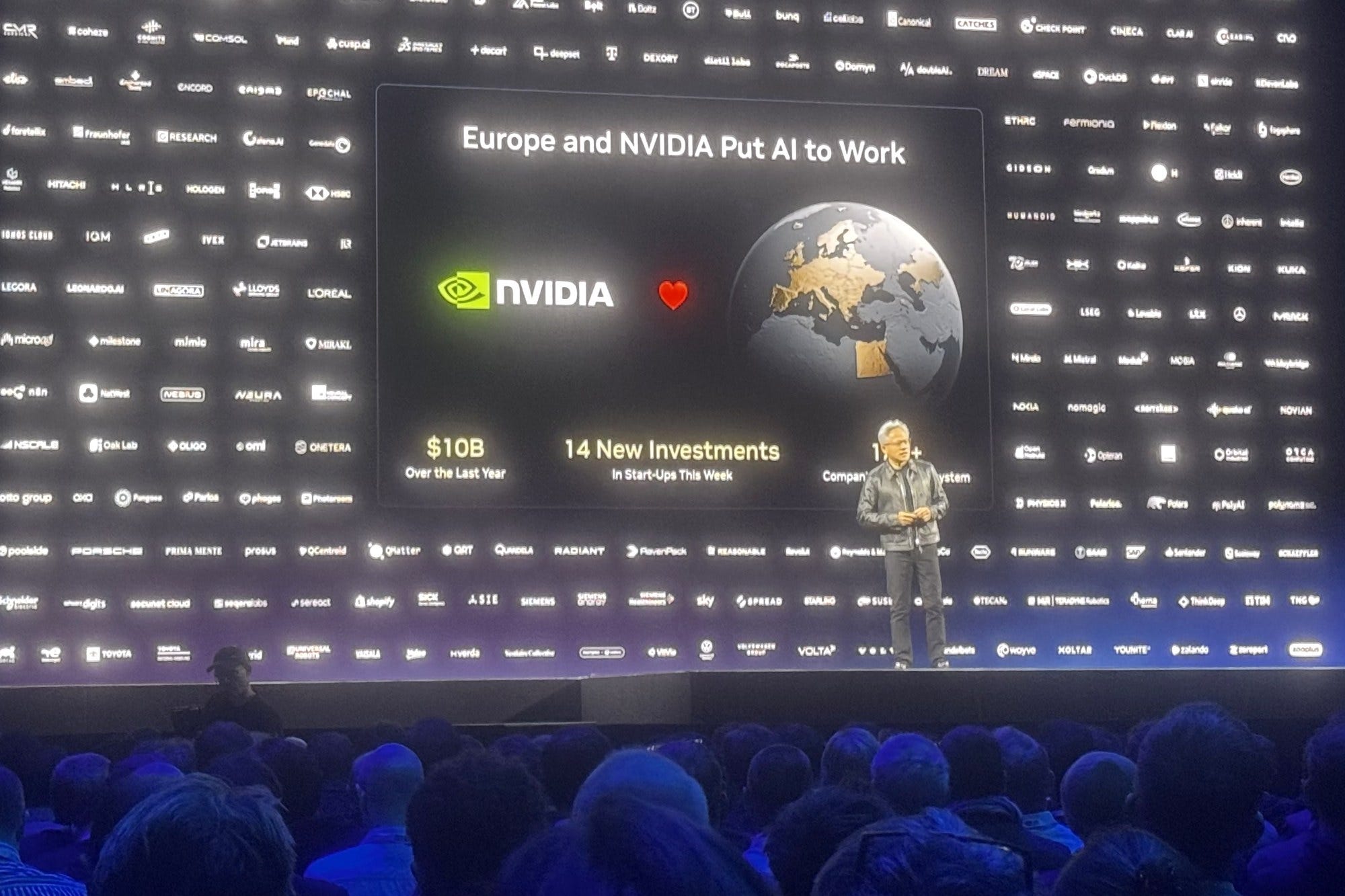
Jensen is the founder and CEO of NVIDIA. And this is NVIDIA's own conference: GTC.
NVIDIA bet on AI before the hype. That made them something like the winner of the AI age.
And they keep getting bigger in the car industry too. Mercedes, Volvo, JLR, Toyota, Hyundai, GM and Xiaomi are among the companies using NVIDIA. Uber plans to run robotaxis with NVIDIA technology.
That's reason enough to take a closer look at this company:
How a small graphics card startup became the world's most valuable company
How NVIDIA got into the car business and what they do there today
And where NVIDIA thinks the car industry is going
The Company That's Everywhere Right Now
In mid-September, Jensen is on stage at a tech conference in Los Angeles. In the middle of the talk, his phone rings. It's Donald Trump. Jensen picks up and puts him on speaker. Then they chat a bit about AI data centers.
Trump calls him often. Usually late at night.
Right now, Jensen seems to be everywhere at once. In October, he's touring Europe. He meets President Macron in Paris and the British prime minister in London.
His final stop is Berlin, where he eats a veggie kebab and meets German Chancellor Friedrich Merz. At an investor summit, they sit on stage together. The moderator asks Merz what he'd do if he were Jensen. Merz's answer: put on the leather jacket, fly to Berlin and invest in Germany. Jensen: that's exactly what I'm doing.
And he means it. NVIDIA is investing almost $10 billion in Europe.
Merz tells the audience what the Mercedes CEO promised him: the new S-Class will drive autonomously in Germany by the end of the year. And NVIDIA is helping make that possible.
There's a simple reason everyone wants to meet Jensen: NVIDIA sells the shovels in the AI gold rush.
In the real gold rush, the big money didn't go to the people digging for gold. It went to the people selling them the shovels. In AI, the shovels are computer chips. That's because AI needs huge amounts of computing power. And most of that comes from NVIDIA.
Business is so good that NVIDIA is often the world's most valuable company. They're worth around $5 trillion on the stock market. That's more than twice as much as all 40 companies in Germany's DAX index combined.
But it all started much smaller. 33 years ago, in a diner in California.
3 Engineers Without an Idea
1993, San Jose. 3 guys sitting in a Denny's. That's one of those diner chains you find on every corner in the US.
They want to start a company. They just don't know what kind yet. Or how to do it. One of them is Jensen Huang. He's 30.
Jensen is born in Taiwan in 1963. When he's 9, his parents send him to the US. At 15, he gets a job washing dishes. At Denny's.
After high school, he studies electrical engineering. He graduates in 1984 and heads to Silicon Valley. First to AMD, then to LSI Logic.
LSI builds chips for other companies. That's how Jensen ends up working on a graphics chip for a computer maker called Sun. And that's where he meets 2 of Sun's engineers: Chris Malachowsky and Curtis Priem. They run graphics at Sun, meaning the chips that put images on the screen.
The project is a success. And the 3 of them realize: we make a good team.
In the early 90s, Chris and Curtis want to start their own company. And they want Jensen in on it.
But Jensen says no. He has a safe, well-paid job. And a family. Chris and Curtis keep pushing, until he finally gives in: okay, let's at least think about what kind of company this could be.
So that's how they end up in that Denny's. Jensen knows the chain well, of course. He just used to work in the kitchen.
Day after day, they meet there, drink one coffee after another and try to come up with an idea.
Back then, more and more people are getting a PC at home. In the US, it's already more than 1 in 5 households. And people can play video games on them too. But most of those games are still simple 2D. For 3D, a normal PC is too weak.
And that's their chance: a chip that brings 3D games to the PC. They know how to design chips. And they know graphics.
That finally convinces Jensen. He quits his job. And in April 1993, the 3 of them start their company: NVIDIA.
30 Days From Collapse
Now all they need is money. But most investors aren't interested. Video games? There's no market for that.
In the end, one investor does say yes: Sequoia.
With that money, they build their first chip. For 3D, they bet on their own technology. It's supposed to be much cheaper than what their rivals are doing.
The chip itself flops. But the idea behind it wins them their first big customer: Sega. At the time, Sega is one of the biggest makers of game consoles. And NVIDIA gets to build the graphics chip for their next console.
For the young company, that's the jackpot. But now everything depends on just one customer.
The problem: while NVIDIA is building for Sega, the market moves in a different direction. Microsoft brings out its own 3D standard for Windows 95. Almost every PC runs Windows, so most rivals quickly switch to that standard. Only NVIDIA's approach doesn't fit.
So NVIDIA is stuck:
If they keep building for Sega, they lose the PC market
If they stop, they lose their only big customer
Either way, it's over.
Jensen looks for a way out. And what he does next makes no sense at first. He goes to Sega's boss and calls off the deal. He admits: our approach is wrong, you should find another partner. And then he asks for money anyway: he wants Sega to invest in NVIDIA.
Sega's boss thinks about it for a few days. Then he says yes: Sega puts around $5 million into NVIDIA. He later puts it like this: “I liked Jensen.”
That money buys them 6 months. NVIDIA uses it for one last big bet: a new chip, this time built for Microsoft's standard.
The chip comes out in August 1997. By then, NVIDIA has only 30 days of cash left. But it's a hit: they sell 1 million in just 4 months. The company is saved.
In 1999, NVIDIA's shares start trading on the stock market. That same year, they launch GeForce. They still sell their graphics cards under that name today.
GeForce is a huge success. In Berlin, Jensen tells the audience who GeForce's biggest customer was at the start: the German electronics retailer MediaMarkt.
What nobody suspects yet: those cards can do much more than run games.
The Bet That Took 20 Years
By the mid-2000s, every gamer knows NVIDIA. The company has found its niche: graphics cards for games.
But then researchers discover they can use those cards for something else: simulations. A normal processor (CPU) is very fast. But it handles one task at a time. A graphics card (GPU) handles thousands of small tasks at once.
There's just one problem: the cards are very hard to program for anything else. And that's where Jensen sees a chance. So NVIDIA builds software that makes it possible. In 2007, it's ready: CUDA.
At that point, Jensen doesn't know what people will end up using it for.
But NVIDIA redesigns every graphics card for it anyway. Even the ones for gamers. That raises costs, so NVIDIA makes less money. And of course, shareholders don't like that. They want Jensen to focus on the core business.
But Jensen believes in CUDA. And to get the word out, NVIDIA starts their own conference in 2009: GTC.
Slowly, people start using it: oil companies, hospitals, physicists.
Then in 2012, AI researchers discover CUDA. With 2 GeForce cards, they teach a program to recognize images. And it does that better than anything before it. Jensen later calls this AI's Big Bang.
From then on, everything at NVIDIA is about AI.
In 2016, Jensen personally takes NVIDIA's first AI supercomputer to San Francisco. To a small startup called OpenAI.
At the end of 2022, OpenAI launches ChatGPT. For Jensen, that's AI's iPhone moment.
We all know what happens next. Suddenly everyone wants AI. And that almost always takes NVIDIA chips.
NVIDIA's stock takes off. In 2024, they become the world's most valuable company for the first time.
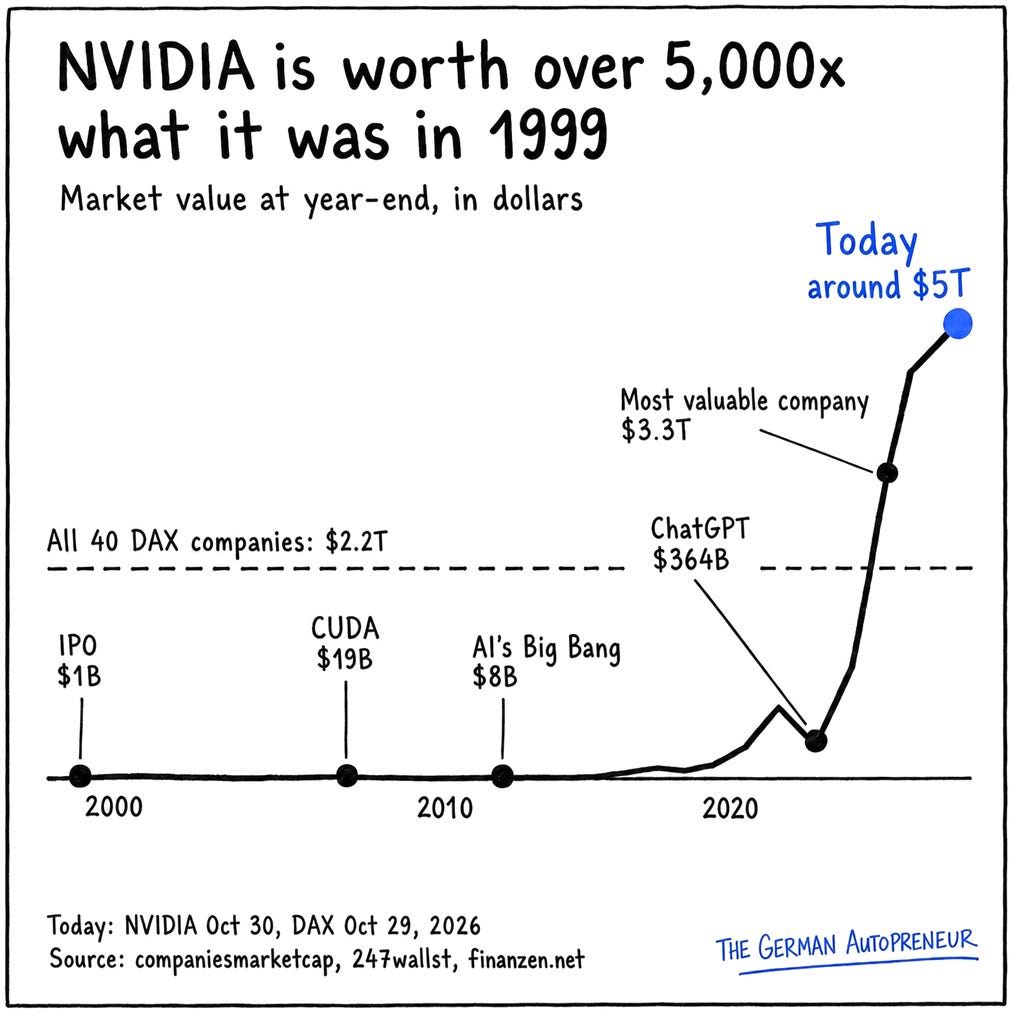
Jensen has stuck with CUDA for almost 20 years. Now that bet is paying off.
And he can already see what's next: AI that moves in the real world. In robots. And in cars.
How NVIDIA Got Into Cars
NVIDIA has actually been in cars for a while. That story goes back to 2005.
That's when they start working with Audi. In 2010, Audi's navigation and infotainment run on NVIDIA chips. Driver assistance comes later.
Then comes Tesla. From 2012, the Model S uses NVIDIA chips for its infotainment. And from October 2016, for Autopilot too. The software for that comes from Tesla.
Meanwhile, NVIDIA has been working on autonomous driving since 2015. A car that drives itself needs a huge amount of computing power. And that's exactly what they do best.
But chips alone aren't enough. You also need software that runs on them and drives the car. So NVIDIA develops the software too.
In 2019, Tesla replaces NVIDIA's chips in its cars with its own. A year later, NVIDIA teams up with Mercedes. Together, they'll build the autonomous driving software for the next Mercedes models. And it'll run on NVIDIA chips.
It's going well in China too. Nio, Li Auto and Xpeng all use NVIDIA for driver assistance. And later, so does Xiaomi.
And in 2026, the result hits the road: the new electric CLA runs on the software Mercedes and NVIDIA built together.
So NVIDIA is in a lot of cars today. But what exactly are they doing there?
NVIDIA Becomes a Platform for Autonomous Driving
I got to see that for myself in Berlin, riding along in the new CLA. The car is at Level 2++. So the driver is still responsible and has to pay attention. But other than that, it pretty much drives itself, like a robotaxi:
First, you enter your destination in the navigation system
The car does the steering and braking and keeps track of everything around it
We drove through Berlin traffic like this for 45 minutes. The driver didn't have to step in once
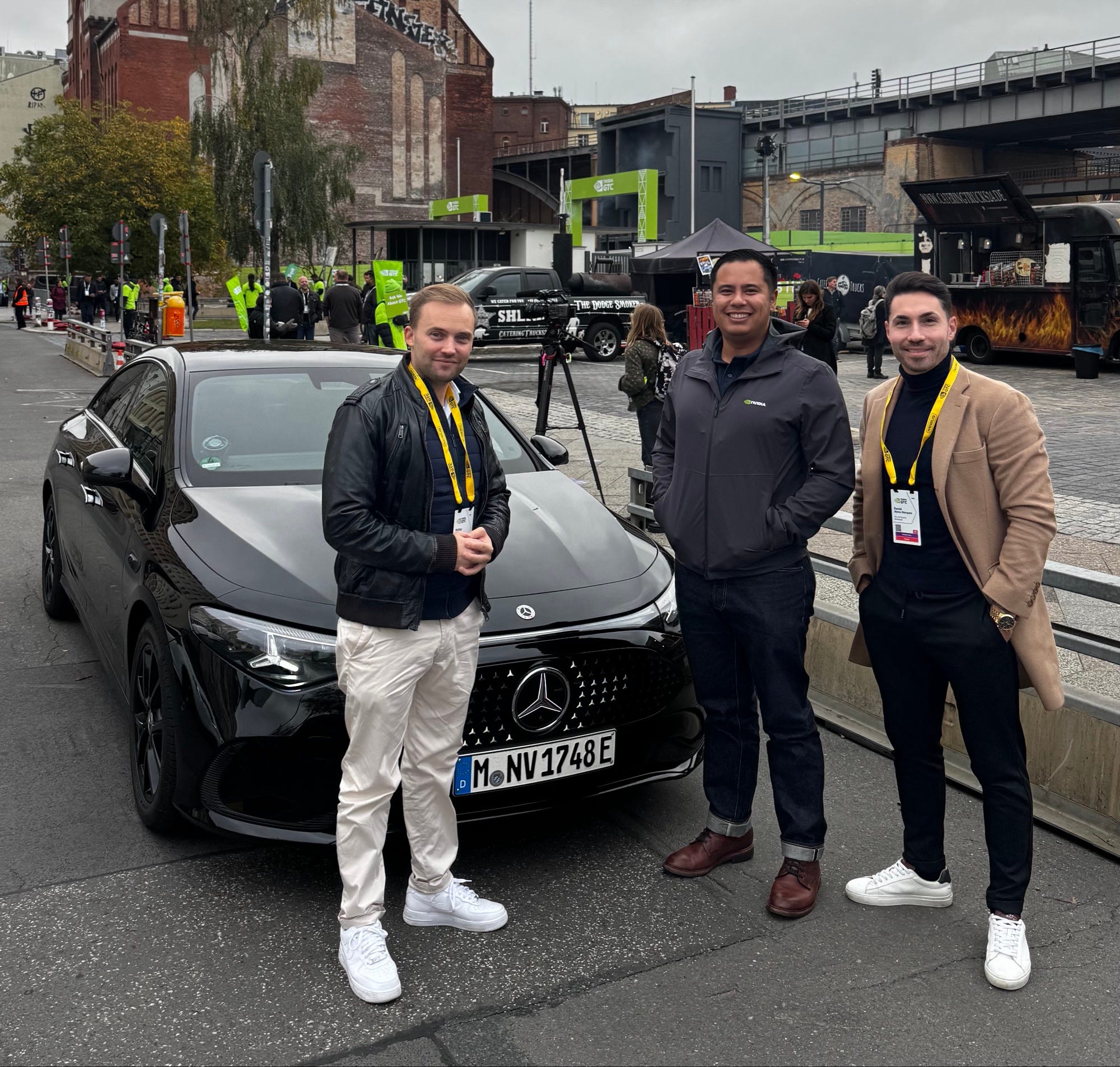
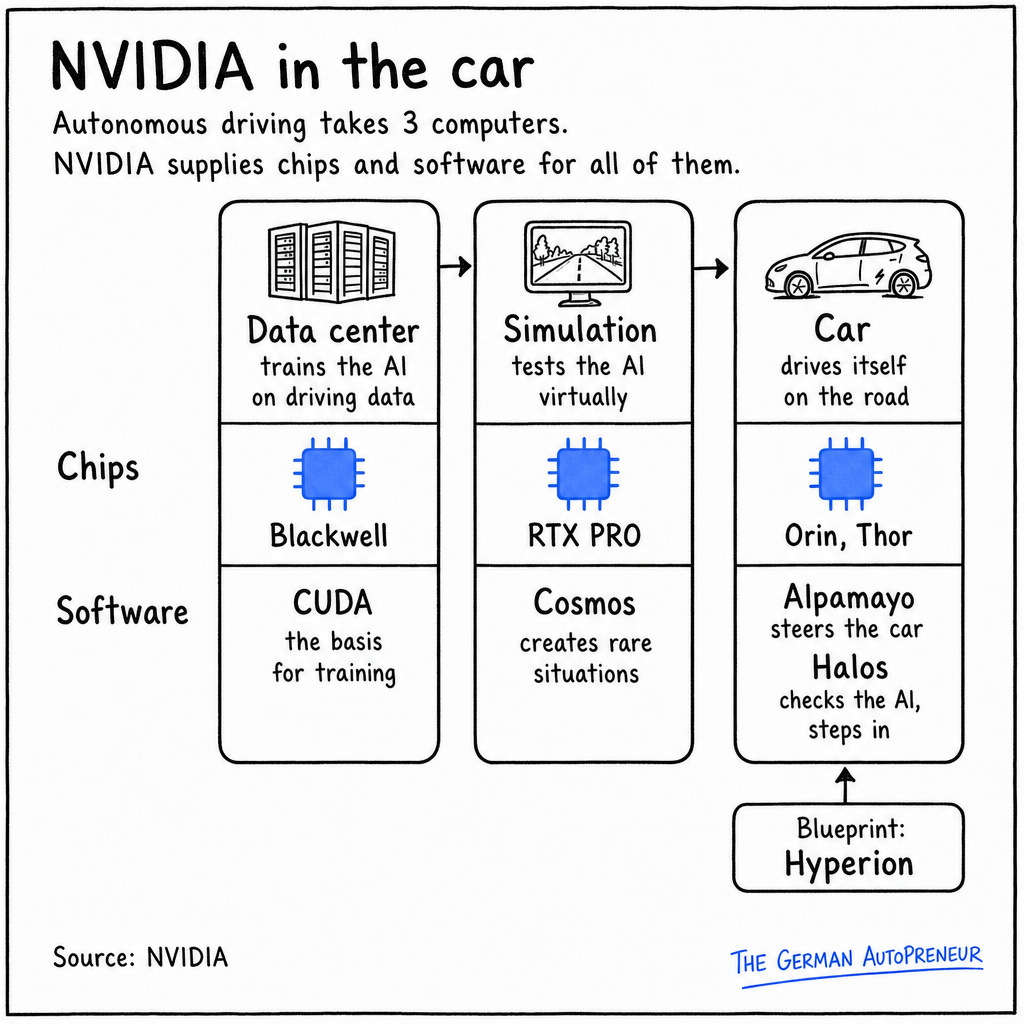
Inside the CLA, 2 systems run at the same time:
The driving AI (Alpamayo): it drives the car using live camera data
The safety system (Halos): it follows fixed rules. And on top of the cameras, it also uses radar data. It checks every situation itself, at the same time as the AI. And if a crash is coming, for example, it can step in
And to make all that work, it takes 3 computers:
The computer in the data center: this is where the AI gets trained, mainly on videos of real driving
The computer for simulations: this is where the AI practices situations that rarely happen in real traffic, like a child suddenly running into the road
The computer in the car: this is the one that actually drives the car. It runs the AI and the safety system
The CLA is built on a design called Hyperion. Think of it as NVIDIA's blueprint for a car: it says which computers and sensors a car needs. If you build a car to that blueprint, you can use NVIDIA's autonomous driving technology. And that goes all the way from Level 2++ to Level 4.
Level 4 is the next step. That's when there's really no driver at all, at least in certain areas.
NVIDIA plans to launch this with Uber by 2028. And the new S-Class is also meant to run as an Uber robotaxi.
Basically, a robotaxi runs on the same technology as my CLA in Berlin. Only 3 things are really different:
The car has more sensors
It runs a bigger AI model
And that needs a bigger computer chip
Xinzhou Wu leads NVIDIA's car business. He says we're heading toward a future where cars drive every mile on their own. He estimates that today it's just 6 out of every 100,000.
For now, cars are a side business for NVIDIA: car chips bring in just 1.1% of revenue. But the plan is bigger. In the future, NVIDIA wants to make money on every mile a car drives itself. They call this Revenue per Mile.
My Take
So what can we learn from NVIDIA's story?
Jensen made 2 risky bets:
First on 3D and the gaming market
Then on AI, long before the hype
Both paid off in the end.
Now comes his 3rd bet: AI in the real world. In the car industry, that means autonomous driving.
And I think it'll happen faster than most people expect. In Berlin, I saw how far the technology has already come.
But what about the carmakers? Right now, we're seeing 2 approaches:
Some build everything themselves: chips, software and AI. That's Tesla and Rivian, for example
Others focus on the car and bring in a partner like NVIDIA for the AI. That's Mercedes, for example
I don't think many will manage to build everything themselves. It takes 3 things:
Lots of money: just training the AI costs more than almost any carmaker can afford
Lots of data: Tesla has been collecting driving data from its entire fleet for more than 10 years
Completely different skills: developing AI just isn't a carmaker's core business
So I think autonomous driving will end up a lot like smartphones. Tesla is something like Apple: they build their own hardware and their own software. But that's the exception. The vast majority of phone makers use the same operating system: Android.
The same will happen with autonomous driving software: a few big platforms will win. And I'm pretty sure NVIDIA will be one of them.
And the funny thing is: even Tesla ends up buying from NVIDIA. To train AI, you need the best chips. And most of those come from NVIDIA. Shovel sellers, remember?
But if the software comes from just a few platforms, what are German carmakers still good at?
Philippe van den Berge leads NVIDIA's car business in Europe. His answer is safety: “A car is something that goes 180 km/h on the Autobahn. You can't let anything go wrong there.”
The AI decides when the car brakes. But the car has to do the braking itself. And it has to do that reliably, even at 180 km/h. In Germany, we've been building exactly that kind of car for over 100 years.
And that's actually pretty good news for us in Europe. As cars move to AI, the thing we're best at suddenly matters more again: mechanical engineering.
Or as Jensen says in Berlin: “Electrons will never replace atoms.”
🔗 247 | fn | nvq4 | gtc | bmwe | seq | mbp | hyp | sk | vg
PS: Reading this in Promotions or spam? Add autopreneur@substack.com to your contacts, or just hit reply. That tells your email provider to deliver it to your inbox.
PPS: Know someone in the car industry who wants to understand where autonomous driving is heading? Send them this issue.
A word from me
You could help Mercedes or Bosch. But they've never heard of you
The German car industry is a closed club. You're either inside or outside. And from abroad, you start outside.
Outside means paying over $20,000 for a trade fair booth. And you leave with 100 business cards and 3 real conversations.
I'm on the inside. I spent almost 10 years at Mercedes-Benz. Every week I reach over 100,000 people in the German car industry through my German newsletter, podcast, YouTube channel and LinkedIn. They trust me. So when I tell them about you, they listen.
An IT services company got 250 webinar signups this way. A consulting firm got 60 new contacts at decision-maker level.
My partnership page shows packages, prices and past campaigns with their results. You can also request a free 30-minute call there. By the end of it, we'll know if it's a fit.
The last open campaign date this year is December 6, 2026.
See you next Wednesday,
Philipp