


Ad
On October 8, Infineon, AWS and Agco lay out where AI really stands
In front of 50 people from the car industry. At the Allianz Arena in Munich, home of FC Bayern.
The 3 companies cover automotive, cloud and farm machinery. And each one shows what it's working on right now.
The host is Cognizant Mobility. Their mission: bringing AI into vehicle development.
From 11:00 to 17:00, with a tour of the stadium in between.
Only 50 people can take part. Signing up gives you a chance at a seat. And if you don't get one, you'll still get the summary.
Welcome to Issue #132 of The German Autopreneur.
When people outside China think of Huawei, they probably picture smartphones, spying, or the US-China trade war.
Hardly anyone thinks of cars.
But today, Huawei is one of the most important players in China's car industry. 25 car brands use its driver assistance systems. And in Huawei's own stores, cars are parked right next to smartphones and smartwatches.
Huawei also leads its own alliance with 5 Chinese carmakers. In 2025, that alliance sold almost as many cars in China as Tesla.
Yet Huawei doesn't build a single car of its own.
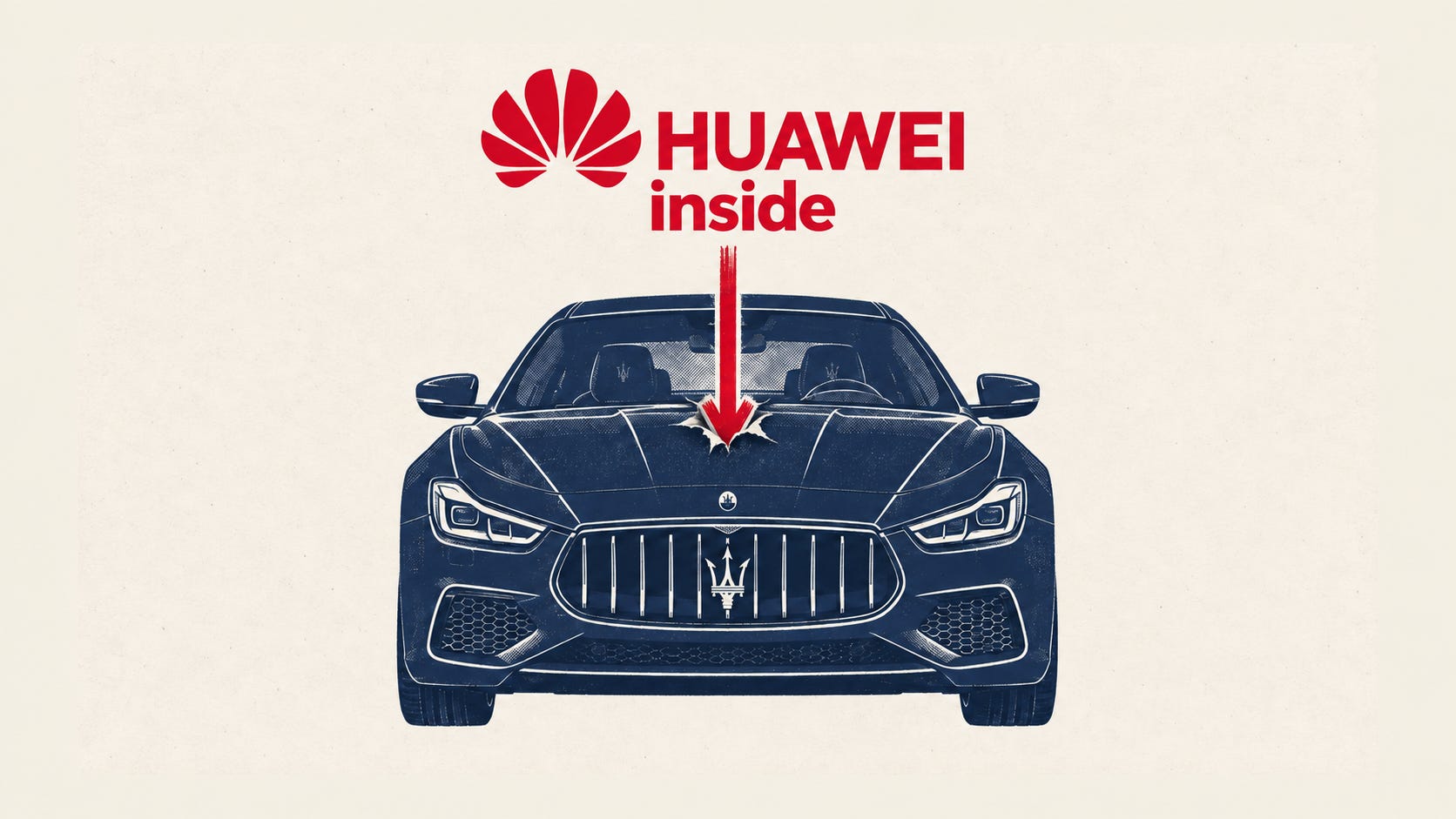
It supplies the technology that goes into other companies' cars. Even Audi uses it in China these days. And now reports say Huawei is going to rescue a historic European car brand.
That's reason enough to take a closer look at this company. Who is Huawei, and how did it pull all this off?
Today we'll look at:
How a startup became a global tech giant in less than 40 years
Why Donald Trump almost destroyed Huawei. And how it rose from the ashes
And how Huawei quietly became a power in the car industry
Huawei is much more than a phone maker
Last October I was in Shenzhen. Huawei showed me around for a whole day.
What stuck with me: everything was perfectly staged. It was a level of perfection and professionalism I haven't come across in Europe.
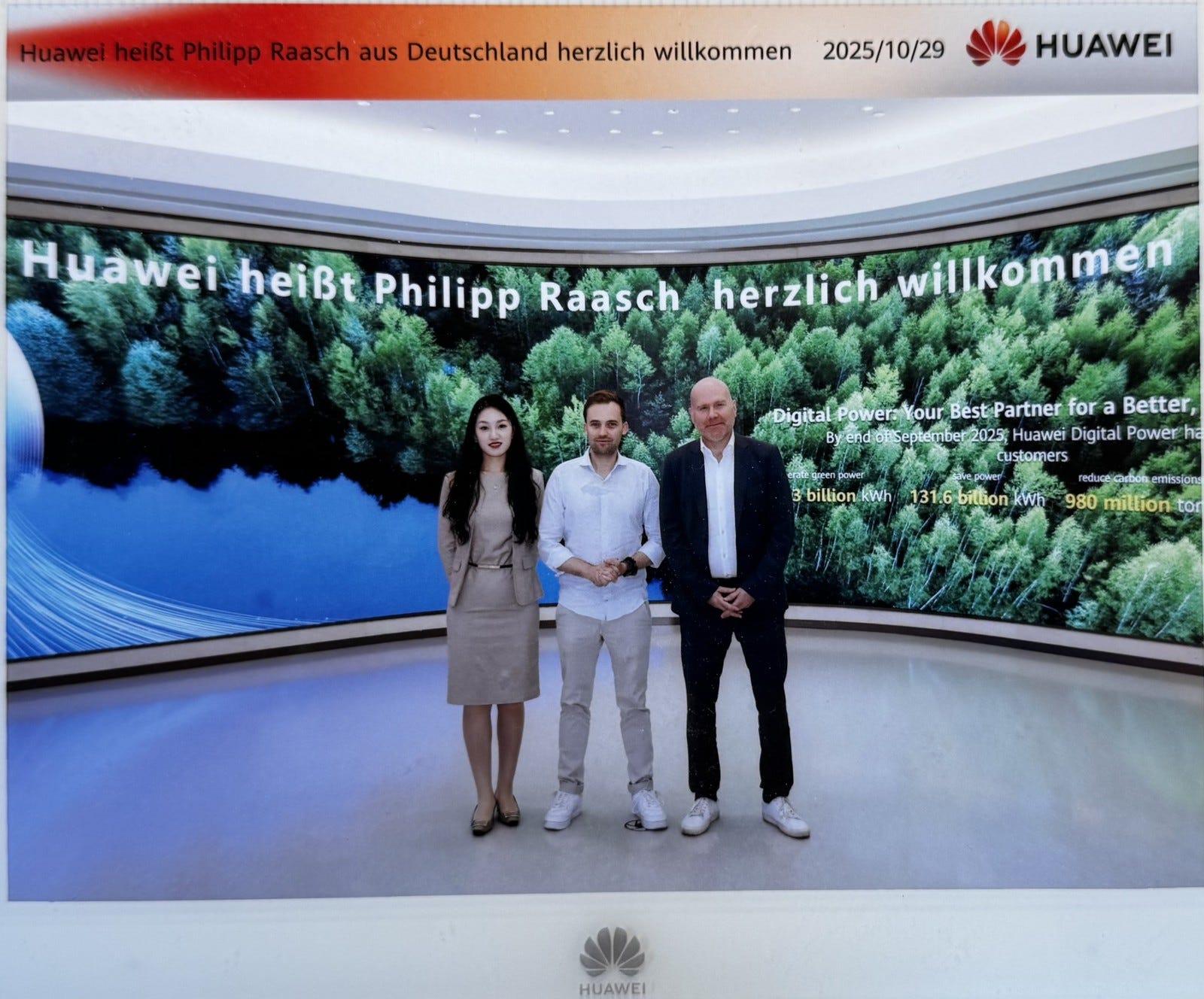
That's when I realized: Huawei is a tech conglomerate. Think of it as Apple, Siemens and Nvidia rolled into one.
In 2025, Huawei made around $126 billion in revenue (for comparison: Bosch made $107 billion).
Here's where that revenue came from:
Mobile and internet networks: 42.6%
Smartphones and other devices: 39.1%
Energy (solar, battery storage and charging): 8.8%
Cloud: 3.7%
And cars: 5.1%
On top of that, Huawei puts 21.8% of its revenue into research and development. That's around $27.5 billion (for comparison: VW spends $22.8 billion).
And Huawei built all of this in less than 40 years. How does a company get this big this fast?
From startup to world leader
In 1987, Ren Zhengfei founded Huawei in Shenzhen. He was in his early 40s and had spent years as an engineer in the army. His starting capital: 21,000 yuan. At today's exchange rate, that's a little over $3,000.
At first, Huawei resold telephone switches. Those were the boxes that connected phone calls back then. In the early 90s, the company started building them itself.
In the big cities, foreign companies like Ericsson and Siemens ruled the market. So Huawei started in the countryside. And from there, it slowly worked its way into the cities. By 1998, it was China's number 1 in telephone switches.
Then mobile phones took off, and Huawei grew with them. It went from telephone switches to the equipment behind mobile networks. Cell towers, for example.
That's what took Huawei to Europe. In 2005, British Telecom and Vodafone bought equipment from Huawei. That same year, more orders came from abroad than from China for the first time.
And then came the product we know Huawei for today: the smartphone.
In 2007, Apple unveiled the iPhone. Huawei was already making phones at the time. But mostly cheap white-label devices that mobile carriers sold under their own name.
In 2011, that changed. From then on, Huawei built high-end smartphones under its own brand. But how do you compete with Apple and Samsung?
One answer came from Germany: the camera maker Leica. From 2016, Huawei and Leica developed the cameras together. And the phones carried the Leica name.
The plan worked. By 2018, Huawei was the third-largest smartphone maker in the world, behind Samsung and Apple. And in network equipment, it was the world leader.
Everything seemed perfect.
Trump vs. Huawei
Huawei's success had one weak spot: the US.
Almost every Huawei product needed chips. Huawei designed some of them itself. But it bought many from US companies like Qualcomm and Intel. And its smartphones ran Google's Android.
As long as the US and China got along, that wasn't a problem. But the US government had distrusted Huawei for a long time. It feared China could spy through Huawei's networks. The company has always denied that.
In 2018, Donald Trump started a trade war with China, and Huawei got caught in the middle. In August, a new law banned US federal agencies from buying Huawei technology.
Then things escalated.
On December 1, 2018, a woman landed in Vancouver. She was supposed to fly on to Mexico. But Canadian police arrested her right at the airport, at the request of the US.
Her name is Meng Wanzhou. She's Huawei's CFO and the founder's daughter. The US accused the company of doing business in Iran despite US sanctions. And it accused Meng of hiding that from banks.
She was released on bail. But she had to stay in Vancouver for almost 3 years, wearing an ankle monitor.
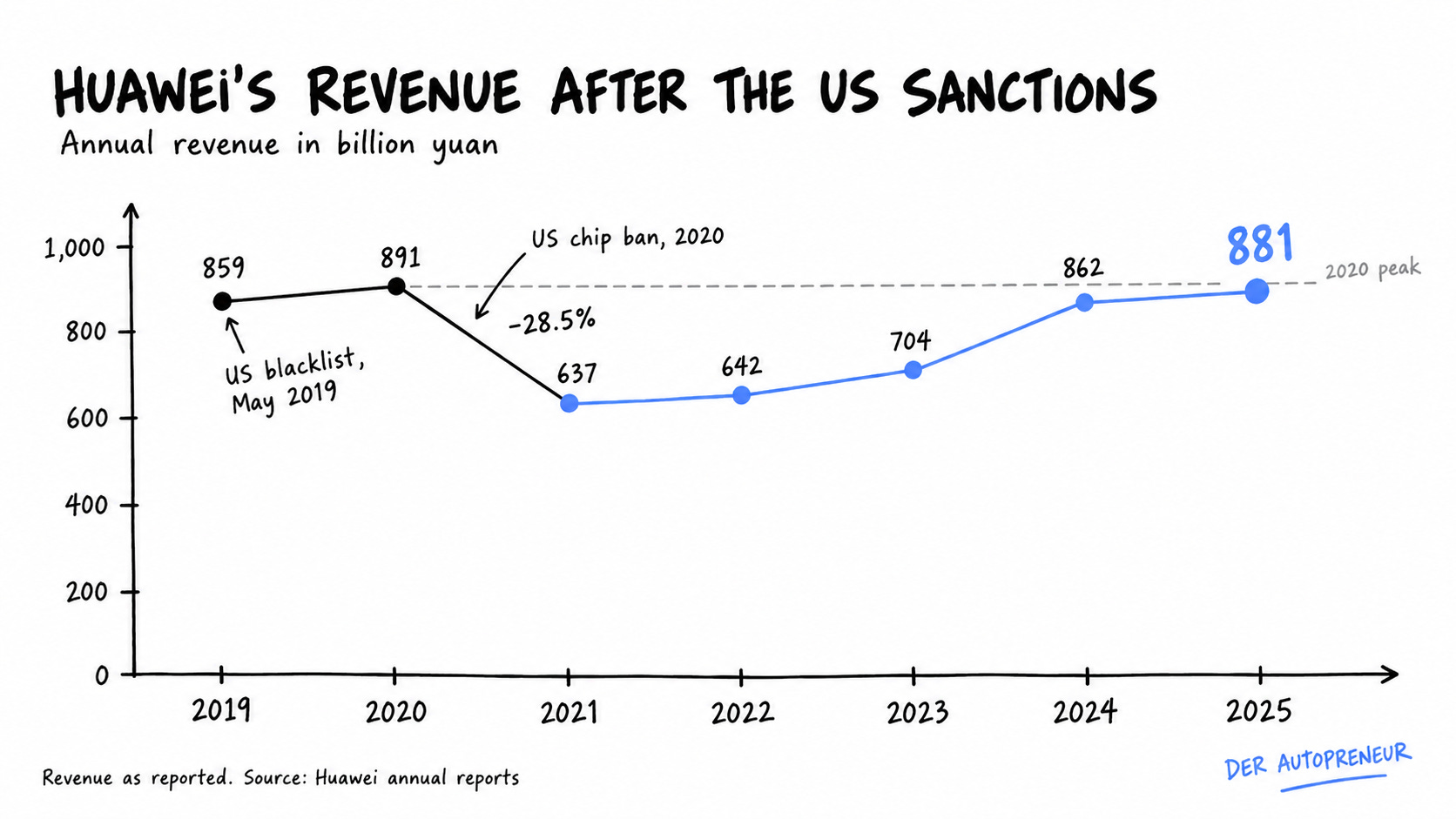
In May 2019, the US put Huawei on a blacklist.
That had 2 consequences:
US companies needed government permission to supply Huawei
New Huawei smartphones no longer came with Google services (Play Store, Maps, YouTube)
The business collapsed.
A month later, Huawei was selling 40% fewer smartphones outside China. Europe was hit especially hard. Huawei was number 2 there at the time, behind Samsung. But without Google, it didn't stand a chance.
And it didn't stop at phones. More and more European countries shut Huawei out of their 5G networks.
For Huawei, this was a black swan moment: a rare event that nobody sees coming and that changes everything.
Nobody sees it coming? Not quite.
The comeback without the US
What many people don't know: at Huawei, the black swan is part of the company culture. Huawei keeps real black swans on its campus. The message: always expect the unexpected.
And in a way, Huawei was prepared.
For years, its own chip unit had been working on replacements for the US chips. Internally, these chips were called "spare tires."
The night after the blacklisting, the head of the chip unit wrote to all employees. Her order: put on the spare tires, starting now.
Huawei had a replacement for Android too. In August 2019, it unveiled its own operating system: HarmonyOS.
But despite all that preparation, the blow hit Huawei hard.
In 2020, the US tightened the rules. Huawei designed its chips itself, but it had them made in other companies' factories. Now any chip factory that used US machines was banned from making chips for Huawei. And almost all of them relied on US machines.
Huawei had no chips left. Not even its own.
That also sank the smartphone business in China. Suddenly, the stores had no phones to sell. In 2021, the whole company's revenue fell by 28.5%.
It wasn't until 2023 that Huawei launched a phone with its own chip again. This time, the chip was made in China. By 2025, revenue was almost back to where it had been before the collapse.
But in the middle of the crisis, something else happened.
Why Huawei went into the car business
In May 2019, Huawei set up a car unit. That was less than 2 weeks after the blacklisting.
At first glance, that makes no sense. Huawei was fighting for survival. Why move into a whole new industry?
Because back then, a new kind of car industry was emerging in China. Buyers wanted more and more software, connectivity and driver assistance. And the traditional carmakers in particular couldn't keep up.
But that was exactly Huawei's core business:
Software and artificial intelligence
Connectivity
The electronics for electric drive and charging
So the move makes more sense than it first seems. The only question: how do you get into the car business?
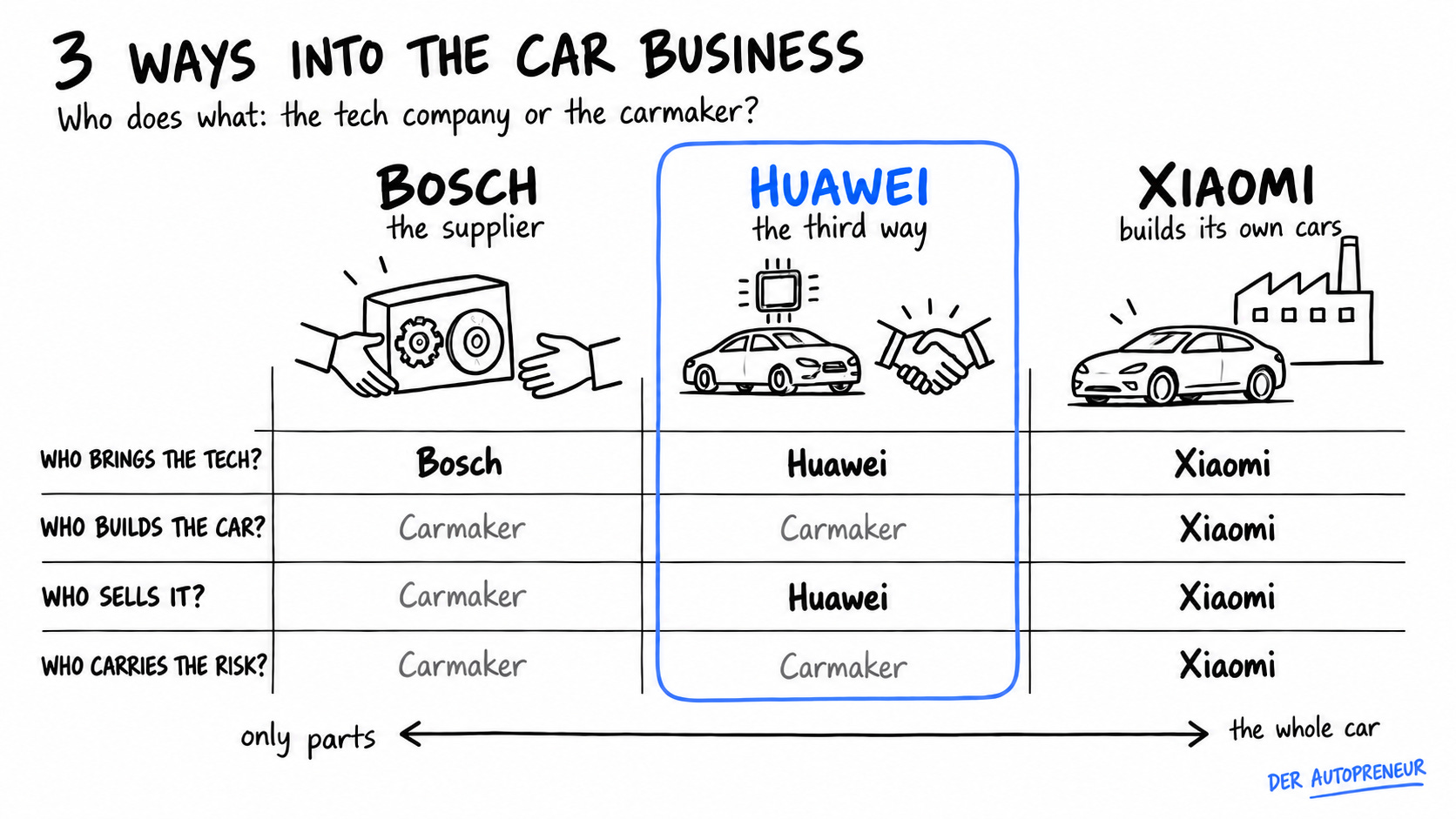
In theory, there are 2 ways:
Build your own cars, like Xiaomi
Become a supplier, like Bosch
Huawei didn't want to build its own cars. That would have meant competing with every other carmaker. As a supplier, it could work with all of them. And that would get its technology into far more cars.
Back then, Huawei summed up its strategy like this:
We don't build cars. We help carmakers build good cars
The car industry needs Huawei. It doesn't need the Huawei brand
So Huawei set out to become a supplier.
There was just one problem: carmakers were afraid of Huawei.
The reason: Huawei would be supplying software, chips and driver assistance. That's the part that increasingly decides what a car is worth and what it's like to drive.
SAIC is one of China's biggest carmakers. In 2021, its chairman was asked whether SAIC would rely on Huawei for automated driving. His answer: that would make Huawei the soul of the car. And SAIC would only be the body. He wasn't going to accept that.
So Huawei had to find another way to get its technology into as many cars as possible.
The birth of Huawei's car alliance
And it found one. Together with Chinese carmakers, Huawei set up completely new car brands. But the name on the front isn't Huawei.
Here's how it works:
Huawei co-develops the car, sells it and supplies most of the technology
The carmaker builds the car. If it sells badly, the carmaker takes the loss
So Huawei took neither of the 2 classic paths. It didn't become a carmaker or a supplier. It somehow became both at once.
And Huawei has something no supplier has: its own stores. There are more than 5,000 of them in China. After the US ban, many of them had no smartphones left to sell. So Huawei started selling cars there instead.
The first joint brand launched at the end of 2021: Aito, together with the carmaker Seres.
The approach worked. So Huawei did the same with 4 more carmakers:
Luxeed with Chery
Stelato with BAIC
Maextro with JAC
And Shangjie with SAIC
Yes, the same SAIC that was afraid of Huawei at the start.
Huawei calls the alliance HIMA. It stands for Harmony Intelligent Mobility Alliance. Harmony is the name of Huawei's own operating system.
Almost everything Huawei can do goes into these cars:
The driver assistance systems, including the chips that run them
The cockpit with Huawei's own operating system
The electric drive from its energy business
Where Huawei stands today
In 2024, Huawei's car unit made a profit for the first time
In 2025, its revenue grew 72% to around $6.4 billion
That same year, the alliance sold around 589,000 cars in China (for comparison: Tesla sold 626,000 there, Xiaomi around 412,000)
So things are going well. In China, at least. The problem is that the alliance sells almost nowhere else. And China's market is consolidating right now. Many car brands are already vanishing.
To survive, you have to expand.
And that's exactly what could happen next. For the first time, a European brand is reportedly going to sell cars with Huawei's technology in Europe.
Maserati sold fewer than 8,000 cars worldwide in 2025. The Huawei alliance sells that many in China in less than 5 days. Now Maserati's parent company Stellantis wants to rescue the brand with Huawei's technology. That's the rumor, at least.
The plan reportedly calls for 2 joint models. The technology would come from Huawei, and JAC would build them. In Europe, they'd be sold as Maseratis.
The irony: after the blacklisting, Huawei was practically shut out of Europe. Now cars could be its way back in.
My Take
Whatever you think of Huawei, it's a fascinating case study. Above all, it's a story about dependence.
Huawei depended on technology from the US. And that dependence is exactly what nearly ruined it.
The shock forced Huawei to develop everything important itself.
Today, it's probably more independent than ever.
And that's now paying off in the car business. Because Huawei has mastered the technologies that are growing more important in cars.
That's why many people call Huawei the Bosch of China. But I don't think that quite fits.
Bosch is a classic supplier. It sells parts to carmakers. And if need be, a carmaker can always replace Bosch with another supplier.
That's the clever part of Huawei's business model: the company found a way to be a supplier that can't be swapped out. Because it co-founded the brands it supplies.
So what can we take away from this?
Let's look at Europe.
Stellantis sells Chinese cars from Leapmotor there. A new Opel (a German brand that belongs to Stellantis) is set to be built on Leapmotor's technology. In China, VW builds models on Xpeng's technology. And sooner or later, I'm sure it'll bring them to Europe too.
In other words, European carmakers are making themselves more and more dependent on technology from China.
And that's where I see the parallel to Huawei. Because its story shows how dangerous that kind of dependence can be.
If the Maserati deal works out, it definitely won't stop at Maserati. Then Europe ends up where SAIC's chairman refused to go in 2021: the soul comes from China. And all Europe gets to build is the body.
Huawei spent years preparing for its black swan moment. And when it came, Huawei moved fast.
I think that's what we can take away from this: recognize the risk of depending on someone else's technology. And be prepared.
Even though that moment will hopefully never come.
🔗 hw | sina | tc | cnev1 | cnev2 | cnev3 | cnev4 | el
PS: Know someone in the car industry who should read this? Send it to them. That helps me a lot.
A word from me
You could help Mercedes or Bosch. But they've never heard of you
The German car industry is a closed club. You're either inside or outside. And from abroad, you start outside.
Outside means paying over $20,000 for a trade fair booth. And you leave with 100 business cards and 3 real conversations.
I'm on the inside. I spent almost 10 years at Mercedes-Benz. Every week I reach over 100,000 people in the German car industry through my German newsletter, podcast, YouTube channel and LinkedIn. They trust me. So when I tell them about you, they listen.
An IT services company got 250 webinar signups this way. A consulting firm got 60 new contacts at decision-maker level.
My partnership page shows packages, prices and past campaigns with their results. You can also request a free 30-minute call there. By the end of it, we'll know if it's a fit.
The last open campaign date this year is December 20.
See you next Wednesday,
Philipp
Unfortunately Huawei came to the game without a real ability to sell enough cars through its own sales network to make its partners money. Series (Aito) is taking over more of the product planning and distribution functions, just detailed the past few days. Xiaomi is facing similar problems. See my substack smitka.substack.com for details.
Note auto sales are down 20% at a time when new EV capacity is coming online. HIMA wouldn't be able to contract out assembly if the industry wasn't laden with excess capacity.