


Ad
How to turn one corner case into as many ADAS tests as you need
A cyclist suddenly swerves in front of your test car. On the road, that moment happens only once. You can't repeat it.
A data logger from b-plus records it. The recording is annotated automatically. Software from IPG Automotive then turns it into a scenario where you can change things like speed or weather. Every variant runs against the real ECU. That way, you get more out of every road test.
In a free webinar on December 3 at 1 pm CET, IPG Automotive and b-plus show you every step from recording to test. By the end, you'll know:
how to find the scenes that matter in your fleet data
how to use them to increase your test coverage
Welcome to Issue #139 of The German Autopreneur.
Fuel prices have gone up quite a bit around the world. And EVs have benefited from that.
In Q3 2026, more fully electric cars (BEVs) were sold in Germany than gasoline and diesel cars combined. That's never happened before. The same was true across the EU.
It feels like EVs are finally winning. But is that really true? Worldwide, EV sales have barely grown this year compared to last year.
I wanted to understand that better. So today, here's a full update on the global EV market:
Why EV sales are falling in China, where most of the world's EVs are sold
Which emerging markets already have a higher share of BEVs than Germany
And what will really decide whether EVs win out in the end
The Global EV Market Today
First, a quick note on the terms:
BEVs are battery-powered and run only on electricity
When I write “EVs” on its own, that also includes plug-in hybrids
In 2025, global EV sales reached just over 20 million:
That's 1 in 4 new cars
Around 2 in 3 of those EVs were BEVs
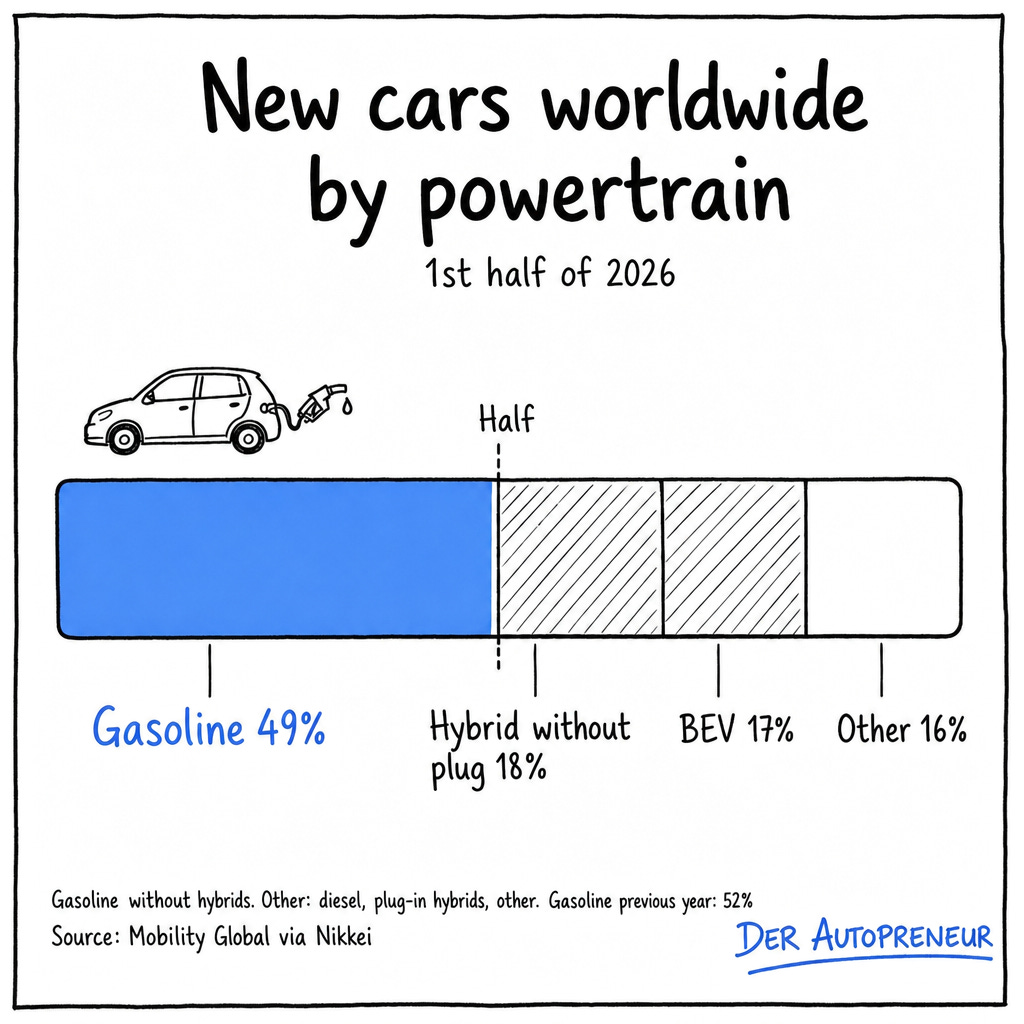
In the 1st half of 2026, BEVs made up 17% of new car sales worldwide. And for the 1st time, less than half of all new cars sold were gasoline cars.
Here's the share of gasoline cars in global new car sales:
1st half of 2025: 52%
1st half of 2026: 49%
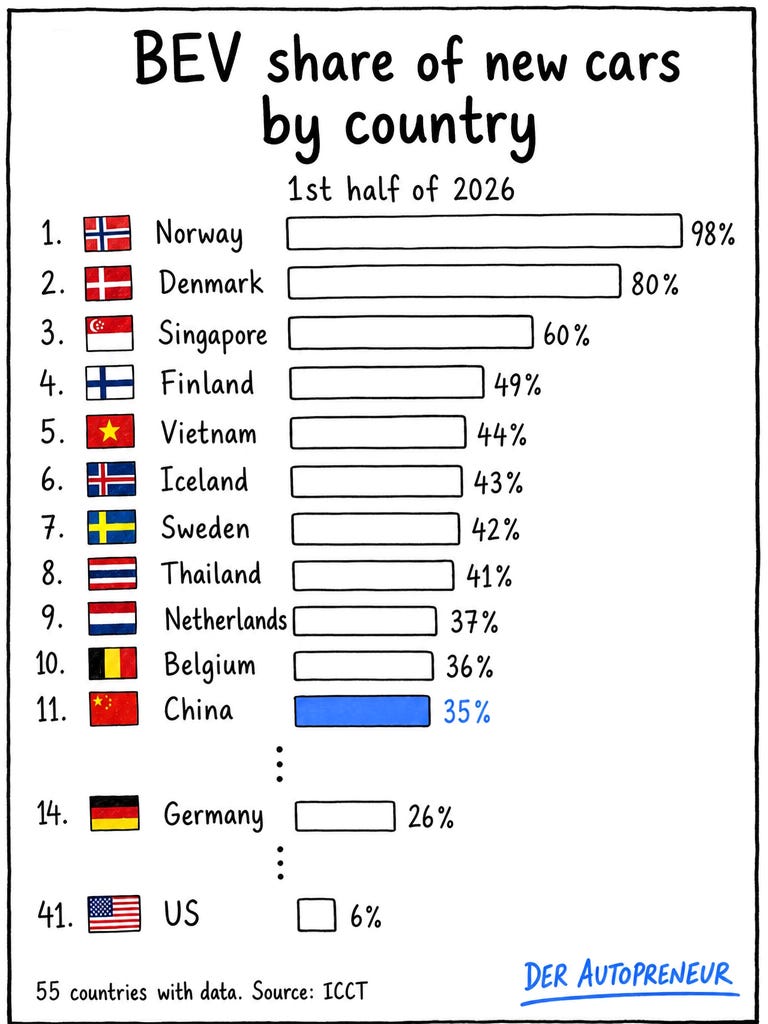
The share of BEVs varies a lot from country to country:
And how fast is the market growing? Here's the change in EV sales from January to September 2026:
Europe: +30% year over year
Worldwide: only +3%, with 15.5 million sold in total
In other words: some regions are growing. Others are shrinking.
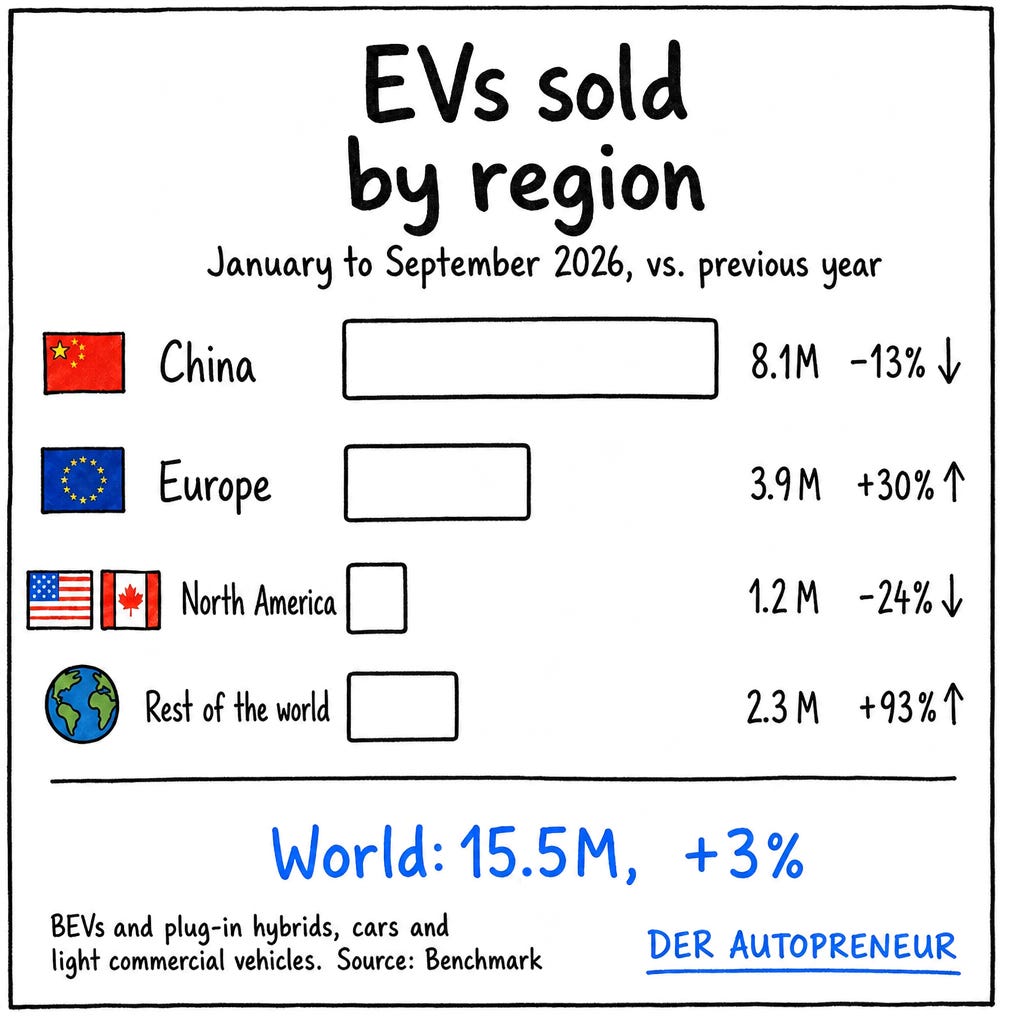
Here's how sales changed compared with a year earlier:
China: around 1.2 million fewer EVs
North America: around 0.4 million fewer
Europe and the rest of the world: around 2 million more combined
So why are EV sales falling in China, where most of the world's EVs are sold?
China's Entire Car Market Is Collapsing
China accounts for just over half of global EV sales:
From January to September: 8.1 million of the 15.5 million sold worldwide
That's 52%
A year earlier, it was still 62%
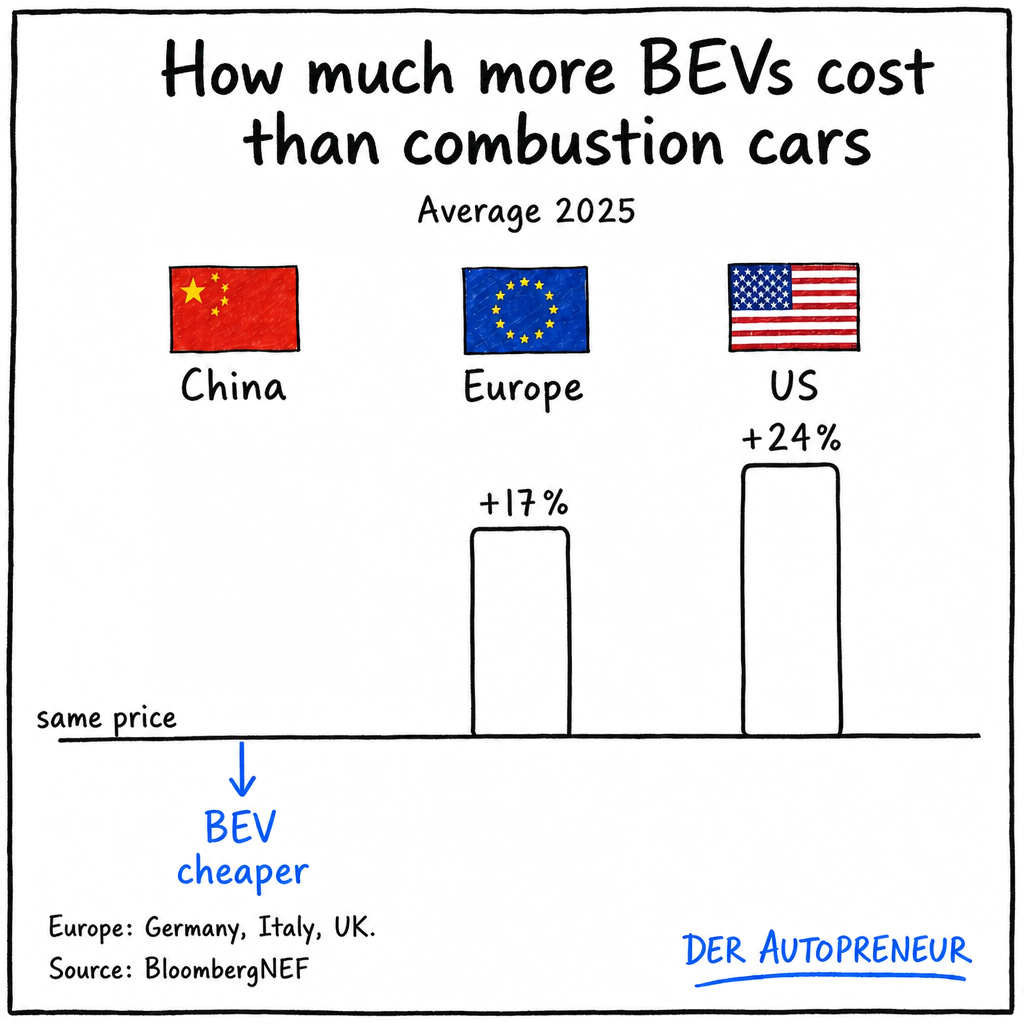
And in China, an EV is usually cheaper than a combustion car. In 2025, nearly 7 in 10 BEVs cost less than comparable combustion models, even without subsidies.
Still, EV sales in China are falling in 2026. That's mainly because the whole car market is collapsing:
From January to September, total car sales fell 22% compared with a year earlier.
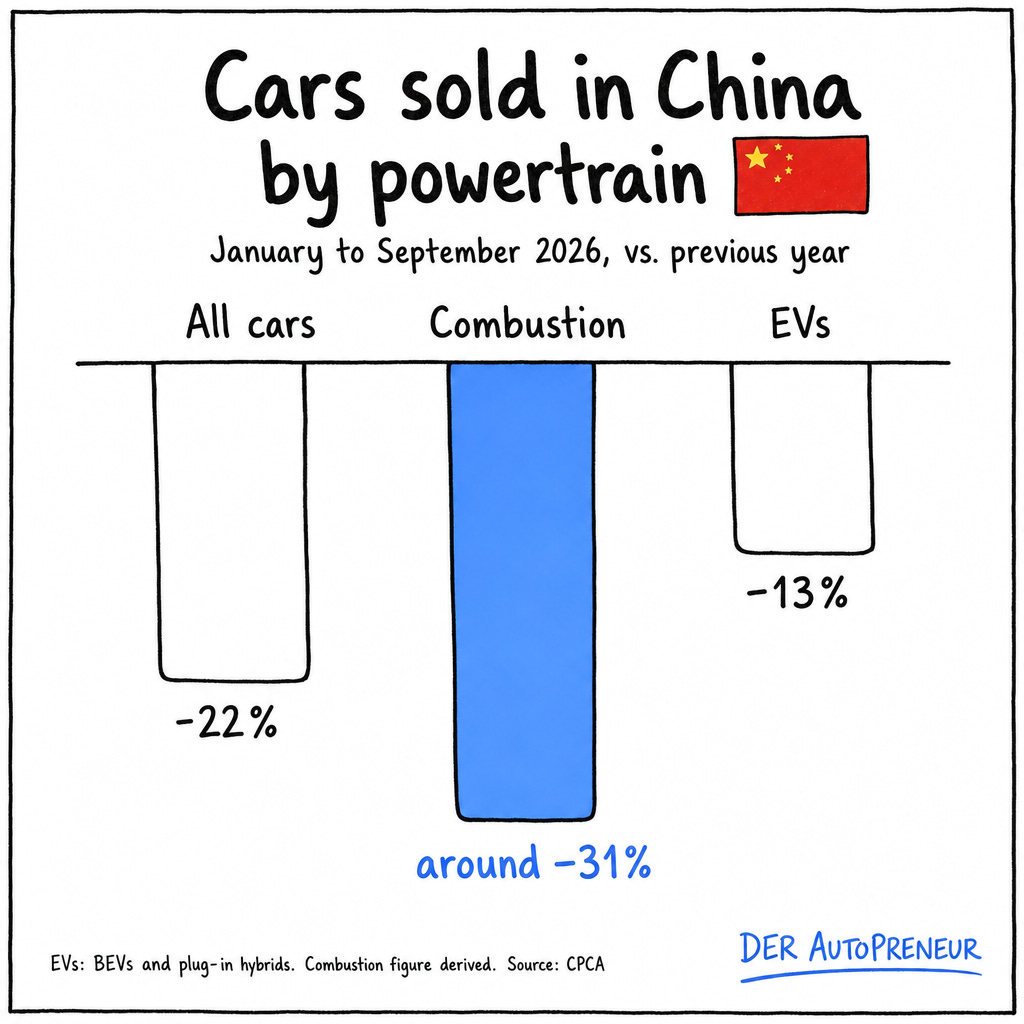
The drop in combustion car sales is even bigger: they're down around 31%.
The main reason the market is collapsing: the government has made buying a car more expensive.
The subsidy for replacing an old car used to be a fixed amount. Since January 2026, it's been a percentage of the purchase price. So buyers of cheaper cars get less money. This affects both EVs and combustion cars
Since January, EV buyers have had to pay a 5% purchase tax. So some people bought their EV in late 2025 to avoid the tax
Combustion cars are also hit by higher fuel prices. That's why their sales have fallen the most:
From January to September, EVs made up 58% of new car sales in China
Combustion cars were down to just 42%
China also builds most of the world's EVs. In 2025, China built almost 3 in 4. And 6 of the world's 10 biggest EV manufacturers are Chinese:
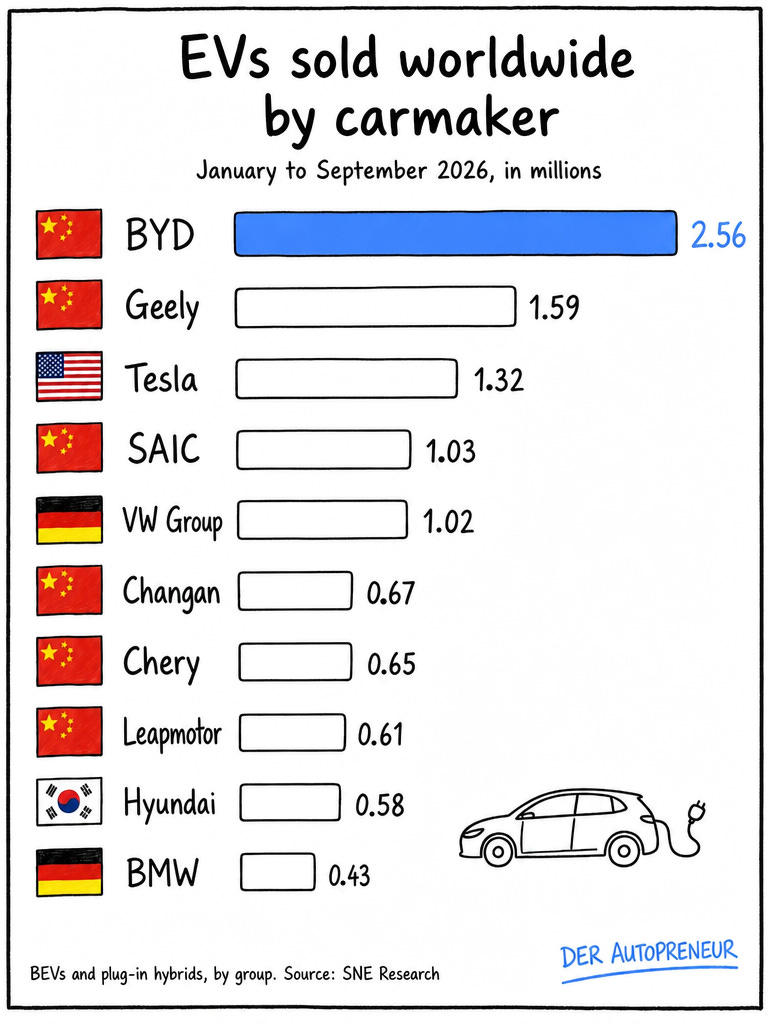
Chinese carmakers sold 60% of all EVs worldwide in 2025. European and North American carmakers each accounted for around 15%.
At the same time, China builds far more EVs than people in China buy. And the cars left unsold at home are exported. That's how Chinese brands make up for the collapse in their home market.
The collapse hits foreign brands harder, because in China they mainly sell combustion cars. From January to September, VW delivered around 30% fewer cars in China than a year earlier.
In total, China exported 8.2 million cars from January to September:
That's 67% more than a year earlier
Almost half were EVs: around 4 million, more than 2x as many as a year earlier
Europe is among the most important markets for these exports.
Why More Europeans Are Buying EVs
EV demand is growing especially fast in Europe right now. The main reason: price.
For a long time, EVs cost much more than combustion cars in Europe. But that price gap shrank sharply in 2025.
Here's how much more BEVs cost on average in Germany, Italy and the UK:
2024: 34%
2025: just 17%
There are 2 reasons for this:
Batteries have become cheaper: prices fell 8% in 2025
There are more small, affordable models, like the Renault 5
And then there are the higher fuel prices.
Here's the share of BEVs in EU new car sales:
January to September: 22.7%. That's almost 7 percentage points higher than a year earlier
Q3: 27%, compared with 25% for gasoline and diesel cars combined
Let's look at individual countries:
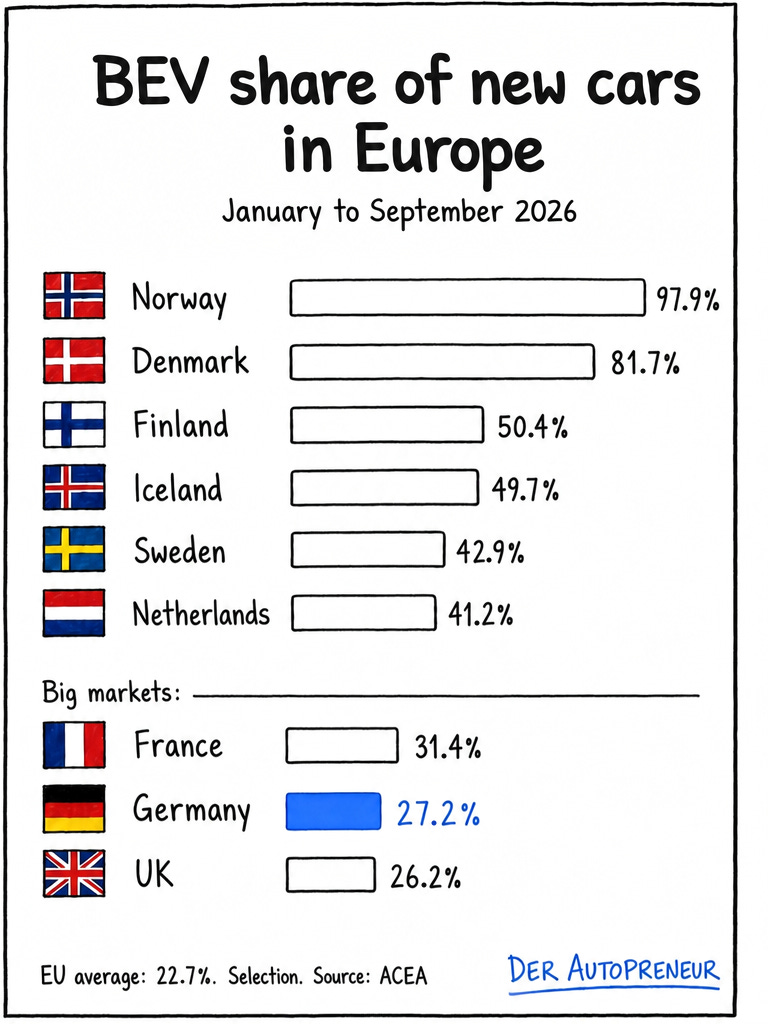
In Germany, the share of BEVs in new car sales is rising fast:
January to September: 27%
Q3: 32%, compared with 29% for gasoline and diesel cars combined
October: 37%
One reason is a new purchase subsidy: since January, BEV buyers get up to about $6,700. Without it, a BEV in Germany still costs more than a comparable combustion car. In October, the price gap for the bestselling models was around $3,300 after all discounts. So with the subsidy, a BEV is often cheaper.
And who's selling the most BEVs in Europe?
Volkswagen Group: around 586,000 BEVs sold from January to September
Tesla is 2nd with around 261,000. VW sold more than 2x as many
But German carmakers now face new competition, because China's exports are arriving in Europe:
In Q3, Chinese brands sold more cars in Europe than Japanese brands for the 1st time (all powertrains)
In September, Chinese brands accounted for 12.7% of all new car sales in Europe
And what's happening in the US?
Why Fewer Americans Are Buying EVs
For a long time, the US government gave EV buyers up to $7,500. The money came as a tax credit. That ended in late September 2025.
Since then, buyers have paid the full difference in price between an EV and a comparable combustion car. And in 2025, that gap was already bigger in the US than in Europe.
In North America (the US and Canada), EV sales fell 24% year over year from January to September. That's the biggest percentage drop of any region.
And fuel prices have also gone up in the US. But that has mostly helped hybrids without a plug.
So EV sales are collapsing in China and the US. Then where are they growing?
The Rest of the World Is Growing Fastest
Outside China, Europe and North America, EV sales grew 93% year over year from January to September. That's 2.3 million EVs in total.
But these countries still buy relatively few EVs for the size of their car markets:
They account for just over 1 in 3 new car sales worldwide
But only around 1 in 7 EV sales
People often say richer countries will switch to EVs first. On average, that's true.
But not everywhere. Many emerging markets have a good reason to buy EVs: they have to import their oil. Rising fuel prices hurt them especially hard.
For a long time, EVs were just too expensive in these countries. That's now changing:
In Thailand, EVs have been as cheap as combustion cars since 2024, mainly thanks to Chinese brands
In Vietnam, local carmaker VinFast builds affordable EVs. VinFast sells almost every EV bought in Vietnam
So in Vietnam and Thailand, BEVs already made up over 40% of new car sales in the 1st half of 2026. In Germany, it was just 26% over the same period. And in China, 35%:
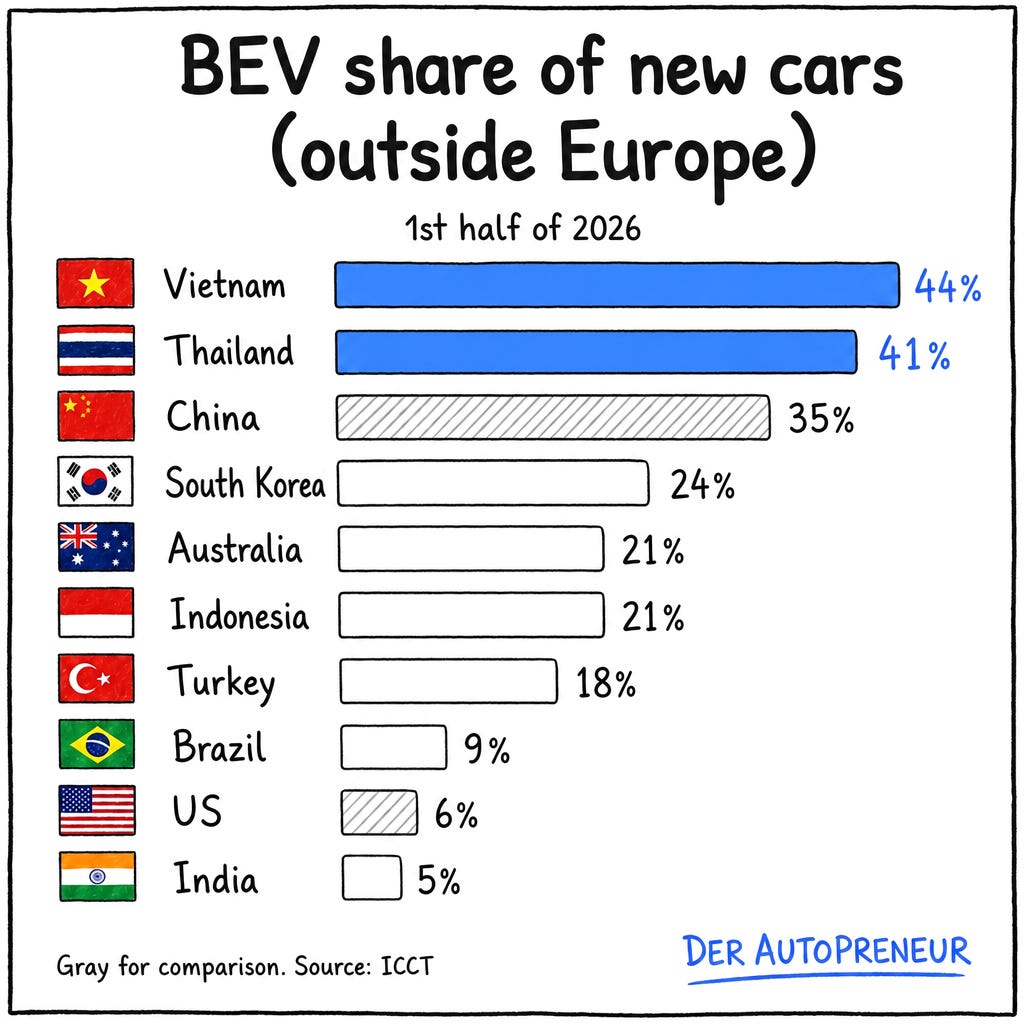
China's exports are also reaching Brazil. Around 1 in 6 new cars sold in Brazil is now an EV. Almost all of those EVs come from Chinese brands.
In India, EVs are still at the very beginning. And that's in a market of around 4.5 million new cars a year. In October 2026, just over 1 in 14 new cars sold in India was an EV. But that's already 2x the share of a year earlier.
So what's next for the global market?
What the Forecasts Say About 2030
EVs are expected to account for around 27% of global new car sales this year. On average, the major forecasts put the 2030 share at 39%:
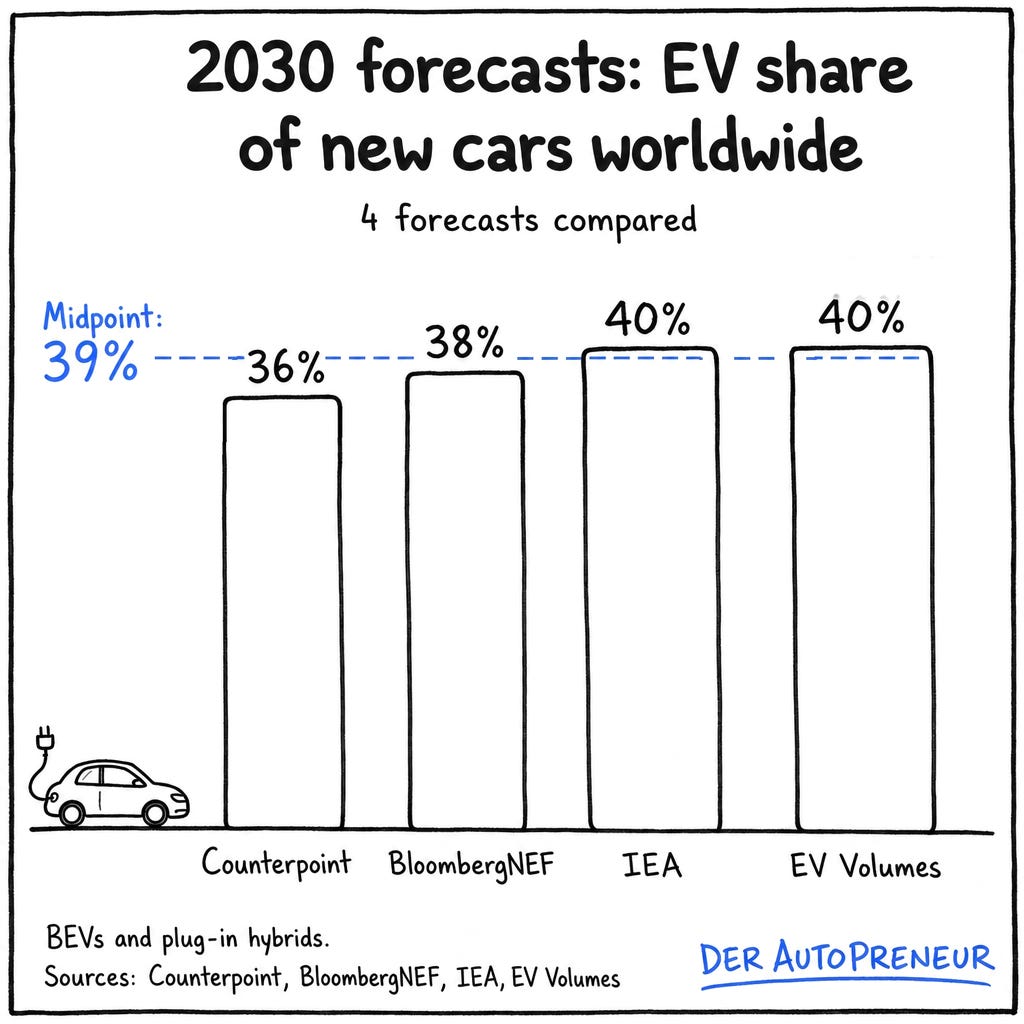
Carmakers' own plans go much further. The International Energy Agency (IEA) added up their announced targets. Based on those targets, EVs would make up around 45% to 65% of new car sales in 2030.
And that's despite many carmakers already lowering their targets, including Audi and Porsche.
My Take
I last covered the global EV market here in June 2025. My conclusion then:
The market will shift to EVs. The question is how fast
And the pace varies a lot by region
That's still true. But one thing is becoming very clear now. And it's actually pretty obvious: price is the deciding factor.
Buyers say so themselves. In a survey by Bain, more people named price than any other factor when choosing a car:
68% in the US
62% in Europe
And around 6 in 10 respondents in the US and Europe don't want to pay more for an EV than for a combustion car.
So the smaller the price gap, the more buyers switch to EVs. And higher fuel prices make switching easier.
3 things have the biggest effect on purchase prices:
Policy: subsidies and taxes make EVs cheaper or more expensive
Battery prices: they're still falling
Affordable models: there's a growing choice of small, entry-level EVs
2026 shows what policy can do:
In China and the US, policy has made EVs more expensive. So EV sales are falling
In Germany, policy has made EVs cheaper. So sales are rising
That's why global EV sales are barely growing in 2026.
Falling battery prices and affordable models take longer to work. But their effect lasts. In China, EVs are already cheaper than combustion cars. One reason: in China, EVs cost barely more to build than comparable combustion cars. Here's the extra cost of building an EV:
China: only around 3%
Europe: around 10%
The US: around 25%
With cheaper batteries and more affordable models, EVs will also get cheaper in Europe and the US. Once they cost less than combustion cars, the market will shift.
For carmakers, that means they can't rely on subsidies. Because subsidies change too often. And you can't make long-term plans with them.
But here's what they can rely on: the technology keeps getting cheaper.
So the math for the car industry is fairly simple: EVs have to be cheaper than combustion cars. Even without subsidies. Whoever manages that wins the market.
🔗 pwc | te1 | ac | nk | iea | icc1 | icc3 | sne | bm | ecr | cev1 | cev2 | cnc | bnf1 | bnf2 | ad | kba | car | icc2 | vw | bl | cox | jmk | cp | jdp | te2 | bn | in1 | in2
PS: I'm traveling in Asia, so there'll be no newsletter for the next 2 weeks. On December 9, it's back as usual.
PPS: Know someone who has to plan their EV business without counting on subsidies? Send them this issue.
A word from me
You could help Mercedes or Bosch. But they've never heard of you
The German car industry is a closed club. You're either inside or outside. And from abroad, you start outside.
Outside means paying over $20,000 for a trade fair booth. And you leave with 100 business cards and 3 real conversations.
I'm on the inside. I spent almost 10 years at Mercedes-Benz. Every week I reach over 100,000 people in the German car industry through my German newsletter, podcast, YouTube channel and LinkedIn. They trust me. So when I tell them about you, they listen.
An IT services company got 250 webinar signups this way. A consulting firm got 60 new contacts at decision-maker level.
My partnership page shows packages, prices and past campaigns with their results. You can also request a free 30-minute call there. By the end of it, we'll know if it's a fit.
The next open campaign date is March 21, 2027.
See you on December 9,
Philipp
Thank you, Philipp - I enjoy the stats, and it raises ideas.
Norway is frequently cited, and of course was the first 'international export' market for China automotive manufacturers who talked of 'exports to Europe'. Norway is not, of course, part of the EU27 - and the new vehicle sales situation has changed sharply as the Norwegian Sovereign Fund subsidy has reduced, as of 2026.
Both Denmark and Norway sales in total are tiny anyway, in the context of EU27 plus UK new vehicle sales. The percentages cited for European countries matter less than the numbers.
Meanwhile China dominates supply of critical processed materials for electrified powertrains and is not afraid to strangle supply, for whatever reason of the day.
From this article it could be said ICE is worthless, yet taking into account all vehicles with an internal combustion engine - ICE, MHEV, HEV, PHEV - it still dominates. Hence every time an opportunity to buy out ICE production arises, China is more than happy to buy. The know the maths.