


Ad
For readers who speak German: a free webinar on PFAS in plain bearings
There's PFAS in your plain bearings, and your customers no longer want it. Specifically, it's the thin PTFE layer inside many bearings.
igus makes plain bearings entirely from plastic, with no PTFE and no lubrication. On Wednesday, October 21, at 14:00 Berlin time, igus is hosting a free webinar in German on PFAS-compliant bearings.
Welcome to Issue #133 of The German Autopreneur.
It's been another busy week:
VW is canceling 10 of its 13 wage agreements with the union
Mercedes is ending its remote work agreement and launching a new severance program
BMW wants to replace 1 in 5 top managers with AI
And VW's software subsidiary CARIAD is cutting jobs again: 1,000 of the 4,300 it still has
We know Germany's auto industry is in crisis. But this feels like a new phase.
What's happening here? And where's this heading?
Today I'm looking at 3 questions:
How many more jobs will go? And will they come back?
Why does Mercedes pay some employees half a million euros each to leave?
And should you take a severance package if you get the chance?

How many jobs is Germany's auto industry losing?
In 2019, around 834,000 people worked directly for automakers and suppliers in Germany.
Today, that number is down to 691,500. That's over 140,000 fewer jobs.
And the pace is accelerating:
2019 to 2024: around 12,000 fewer jobs a year
2024 to 2026: around 41,000 fewer jobs a year
So is the worst over? There are 2 forecasts:
Germany's auto industry association VDA expects another 125,000 jobs to disappear between 2025 and 2035. That's an average of around 13,000 a year
Roland Berger expects 200,000 jobs to disappear over the next 5 years. That's 40,000 a year
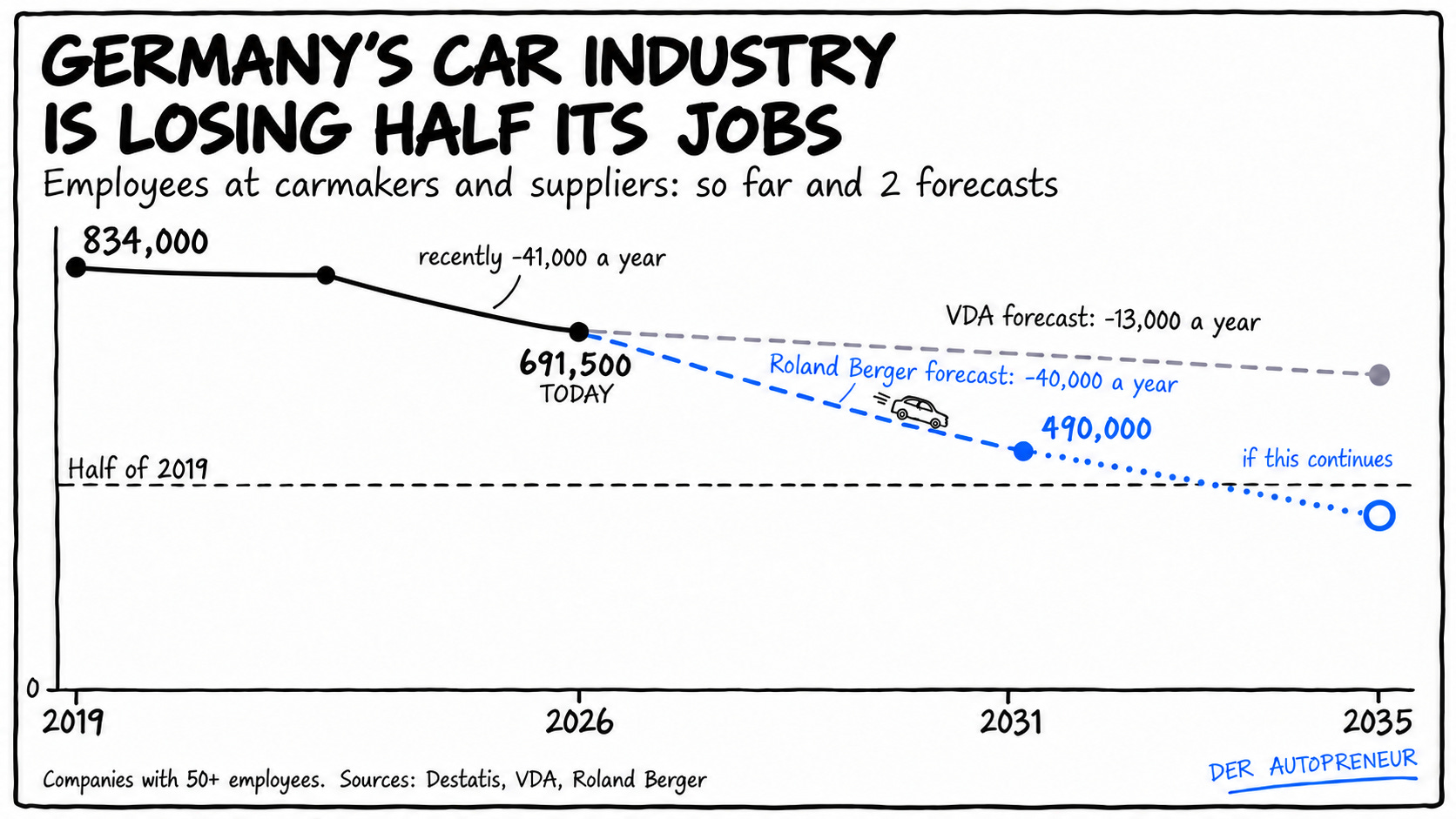
So the VDA thinks the worst is over. I think Roland Berger's forecast is more realistic.
If this goes on, here's what Germany's auto industry will have lost compared with 2019:
4 in 10 jobs by 2030
More than half of its jobs by 2035
Either way, everyone agrees Germany's auto industry will keep shrinking. The only question is how much and how fast.
But first: why are these jobs disappearing?
Why the jobs are disappearing
Roland Berger broke down those roughly 200,000 job losses by cause.
There are 4 reasons:
Around 70,000: More people work in administration and engineering than are needed
Around 60,000: Factories and offices are becoming more productive. They need fewer people to do the same work
Around 50,000: Germany is building fewer cars
Around 25,000: Building an EV takes less work than building a combustion car
Job cuts are nothing new in the auto industry. It has always moved in cycles: in bad years, companies cut jobs, and in good years, they hire again.
Back when I worked at Mercedes, some of my colleagues took a severance package and left. 3 years later, they were back.
So is it the same this time?
Will the jobs come back this time?
There are 2 kinds of crisis. One ends. The other doesn't.
1) An economic downturn:
The economy struggles, and people buy fewer cars for a while. Companies need to save money, so they cut jobs.
Then the economy recovers. Buyers come back, and so do the jobs.
That's what happened in 2009: car sales collapsed in many countries during the financial crisis. Many companies cut working hours through Germany's short-time work scheme rather than laying people off. The auto industry then grew again, adding over 100,000 jobs by 2018.
2) A structural change:
The industry itself changes permanently. Jobs disappear, and they don't come back.
So which one is it now?
This time, a weak economy can't explain the job losses. Around the world, people are buying more cars again: more than 90 million in 2025. And sales are expected to hit around 100 million for the first time in the early 2030s.
So the world is buying more cars. Yet Germany's auto industry is shrinking.
It's the industry itself that's changing.
And that's happening in 3 ways:
1) More competition:
German automakers are losing market share, with the biggest losses in China. That's the world's biggest car market. They sell 1/4 fewer cars there than they did 5 years ago. And that decline is accelerating.
Unfortunately, the trend doesn't stay in China. In August, Chinese brands already accounted for more than 1 in 10 new cars sold in Europe.
Selling fewer cars means less work for automakers and the suppliers that depend on them.
2) The value in a car is shifting:
Until now, engineering was the most valuable part of making a car. And that work was done in Germany. That's where the industry made most of its money.
The value is now shifting to batteries, software and AI. Those aren't developed in Germany. They mostly come from China and the US.
German carmakers are buying more and more of this technology from other companies. So they need fewer engineers of their own.
What Germany was best at is worth less and less.
3) It takes fewer people:
An EV is easier to build than a combustion car. On top of that, AI and automation are taking over more and more work, in factories and in offices. At BMW, AI is now even set to replace top managers.
So companies can do the same work with fewer people.
An economic recovery won't reverse any of these 3 changes.
Germany's auto industry is going through a structural change. Not an economic downturn. The jobs it's losing won't come back. At least not in their current form.
That leaves automakers with more people than they need, so they want to cut jobs. The problem: they can't simply fire people.
Why automakers can't just lay people off
German companies can generally lay people off when the work they do disappears permanently.
But the big automakers have promised they won't do that:
VW until the end of 2030
Audi until the end of 2033
Mercedes until the end of 2034
Porsche until the end of 2035
That's called a job guarantee.
Why would a company promise that?
Because management doesn't decide everything at a German automaker. Employees have a say through 2 channels:
1) The union:
In the auto industry, the union is IG Metall. It negotiates pay and working hours with management, and the result is a wage agreement. And IG Metall can strike.
2) The works council:
Employees elect their works council. It has a say on issues such as remote work and the rules for cutting jobs.
It's hard to cut jobs without agreement from these 2 groups. So management has to negotiate with them.
This is where today's job guarantees come from. The companies wanted to cut costs and jobs. In the end, they made a deal:
Employees give up some pay
The companies can cut jobs
In return, the companies promise not to lay anyone off
Jobs only disappear when people leave voluntarily.
And these guarantees are less than 2 years old. VW signed its agreement in late 2024, Mercedes and Audi in early 2025, and Porsche this July.
So the companies want to cut jobs, but they can't lay anyone off. What can they do?
How management cuts jobs without layoffs
Management does 2 things:
1) Pay people to leave:
Anyone who leaves voluntarily gets a severance package. At Mercedes, long-serving employees could get more than €500,000.
Mercedes still saves money overall. It expects salary savings to cover the severance payments within 2 years.
VW and BMW are doing the same.
2) Make working conditions worse:
Mercedes is ending its remote work agreement and wants 4 days in the office to become standard. It also wants more work for the same pay. VW CEO Oliver Blume is talking about longer working hours without more pay too.
That makes employees unhappy. So they're more likely to leave on their own.
Another effect: those who stay cost the company less.
So how do the works council and the union respond?
How employee representatives respond to the cuts
The works council and IG Metall are doing exactly what they're there to do: protect employees.
They have 2 ways to do that. You can see both at VW right now:
1) Negotiate:
In late 2024, IG Metall and the works council agreed to over 35,000 job cuts by 2030. In return, they got the job guarantee.
So the guarantee doesn't stop jobs disappearing. Since the deal, over 16,300 people have already left VW. That's almost half the planned cuts through 2030.
2) Say no:
Now VW has given notice to end its wage agreements. It wants to negotiate wages and working hours again. The job guarantee still applies.
The works council is fighting back, and its chair calls this blackmail. But IG Metall can't strike there until January. Those agreements still apply until then.
In the end, the works council and IG Metall can't prevent job cuts. They can slow them down and make them more expensive. And they make sure nobody has to leave against their will.
But that leaves a bigger question:
Should Germany save these jobs at all?
Management and the works council are both doing their jobs.
They agree the jobs will go. They're only arguing about when and how fast.
So everyone's arguing about how to manage the decline.
The problem: nobody's debating where new growth and new work will come from.
A job guarantee is a tool for an economic downturn: keep people until the work returns. That's what Germany's short-time work scheme did in 2009.
But this is a structural change, and the work isn't coming back. These guarantees keep people in jobs that otherwise wouldn't exist anymore.
And those are exactly the people that companies building something new are missing.
Meanwhile, management keeps making these jobs worse. Everyone I speak to at VW, Mercedes or Porsche says morale is terrible. And that bad mood spreads from these companies to the rest of Germany. Of course, none of this makes German carmakers any more competitive.
It's a downward spiral.
So for me, the real question is whether Germany should save these jobs at all.
My Take
In short: I don't think Germany should save these jobs.
Works councils and unions defend the status quo. That's their job. But right now, Germany needs change. It can't have both.
And management? It's cutting jobs, but only to save money.
I can even understand that. Managers are judged on next quarter's numbers, and those numbers also determine their bonuses. Not on whether their company leads the industry again in 10 years.
But cutting costs doesn't solve the problem.
German cars have always been more expensive. That worked because their technology was better. Today, it isn't.
So the real problem is the product, not the costs.
If you only focus on costs now, you've given up on winning the technology race.
To me, that's the management of German carmakers admitting defeat. They've accepted that they've fallen behind and won't catch up.
Management and works councils are both fighting over what's left. Neither is building anything new.
Germany's auto industry is busy arguing with itself while its business disappears.
But both sides agree that Germany's auto industry will keep shrinking. So it can no longer be Germany's engine of growth.
That means growth has to come from somewhere else: from other industries and new companies.
That's what Germany should be debating: where will tomorrow's jobs come from?
To create those jobs, Germany needs the people now stuck at the big automakers. In jobs that aren't really needed anymore.
In 2019, I quit my job at Mercedes and started my own business.
The first few years were hard. But I've never regretted it. It was the best decision I could have made.
That's why I want to encourage you: if you get the chance to leave, take it. Especially if it comes with a severance package.
Because morale and working conditions at the big carmakers won't improve anytime soon. Meanwhile, a lot of new things are being built elsewhere.
You can start your own business or join a company that's building something new. And help write a new growth story for Germany.
So let's stop trying to save yesterday's jobs and start building tomorrow's.
🔗 dst1 | dst2 | zdf | fn | wiwo1 | re | vw | por | ah1 | ah2 | audi | wiwo2
PS: Know someone in the car industry who's thinking about taking a severance package? Send this issue to them.
A word from me
You could help Mercedes or Bosch. But they've never heard of you
The German car industry is a closed club. You're either inside or outside. And from abroad, you start outside.
Outside means paying over $20,000 for a trade fair booth. And you leave with 100 business cards and 3 real conversations.
I'm on the inside. I spent almost 10 years at Mercedes-Benz. Every week I reach over 100,000 people in the German car industry through my German newsletter, podcast, YouTube channel and LinkedIn. They trust me. So when I tell them about you, they listen.
An IT services company got 250 webinar signups this way. A consulting firm got 60 new contacts at decision-maker level.
My partnership page shows packages, prices and past campaigns with their results. You can also request a free 30-minute call there. By the end of it, we'll know if it's a fit.
The last open campaign date this year is December 20.
See you next Wednesday,
Philipp