


Ad
You sell to the German automotive industry? But nobody’s listening
Maybe this sounds familiar: good product, good people, real insights. And you still can’t get through to the right decision-makers.
So you go to trade fairs, run a webinar, have strangers cold-messaged on LinkedIn. Lots of effort, little return. That’s rarely about the offer. It’s about the channel and the message.
That’s where I come in. More than 100,000 professionals and executives in the German automotive industry follow me and trust me. When we work together, they listen to you too.
Welcome to Issue #126 of The German Autopreneur.
The world's biggest car market is crashing. In the first half of 2026, car sales fell 20%.
In Germany, the story often goes like this: The bubble has burst. China inflated it with subsidies for years. Now the money is gone. And everything is collapsing.
At the same time, China's auto industry has never been stronger: record exports, record market share at home, record EV share.
How can both be true?
Today I'll break down what's really going on. Where China's car market stands in the summer of 2026. And what's behind the headlines:
Why the crash is no accident
Why German brands barely exist in the market that's growing
And why China's best-selling car isn't a Chinese brand
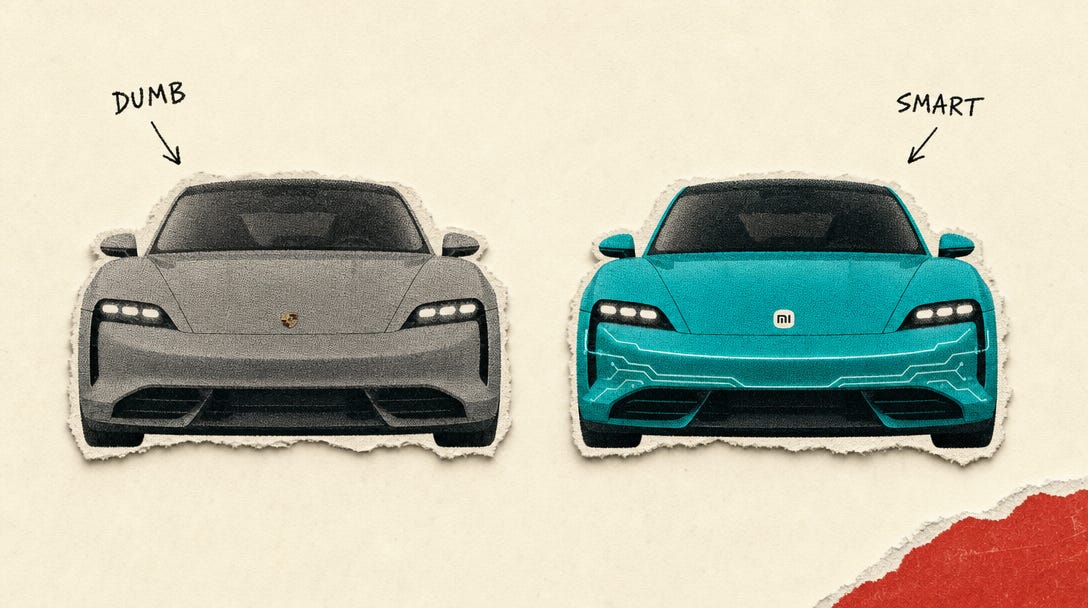
China's Car Market Lost 20% in 6 Months
The first half of 2026 (retail sales to end customers):
8.75 million cars sold. Down 20% from a year earlier
Here's what June looked like:
-21% vs. June last year. The 9th straight month of decline
+9% vs. May
1.04 million NEVs sold in June (-7%). NEV means new energy vehicle: an EV or a plug-in hybrid
62.8% of all cars sold in June were NEVs. The 3rd straight month above 60%
So: 1/5 of sales is gone. In one year.
Sounds dramatic. 2 things are behind it:
The first one is easy to forget. China is still in an economic crisis. It has been since the property bubble burst in 2021 (think Evergrande). Almost 1 in 6 young Chinese still can't find a job. If you're worried about your job, you don't buy a new car. You save. For context: the average urban salary in China is around 6,000 yuan a month. About $850
The second one is the immediate trigger. At the end of 2025, China cut back its car-buying incentives. One example: EV buyers were exempt from the purchase tax for over 10 years. Since the start of 2026, they pay 5%. Anyone who wanted a car anyway bought one in 2025. Those sales are missing now
But the state didn't cut that money by accident. Behind it is China's industrial playbook, a pattern I've covered here many times:
The state pumps subsidies into a market
An oversupply builds up, with far too many manufacturers
The state pulls the subsidies back
The market sorts out the weak
And there's a lot to sort out. China still counts 129 EV brands. AlixPartners expects only about 15 of them to make money by 2030.
So the crash is partly intentional. The low point was in February. Since then, the market has been recovering month by month.
But there's something else: the market didn't crash evenly.
China Has 2 Car Markets
Look at the powertrains: combustion cars fell much harder than NEVs. And that's tipping the whole market toward EVs.
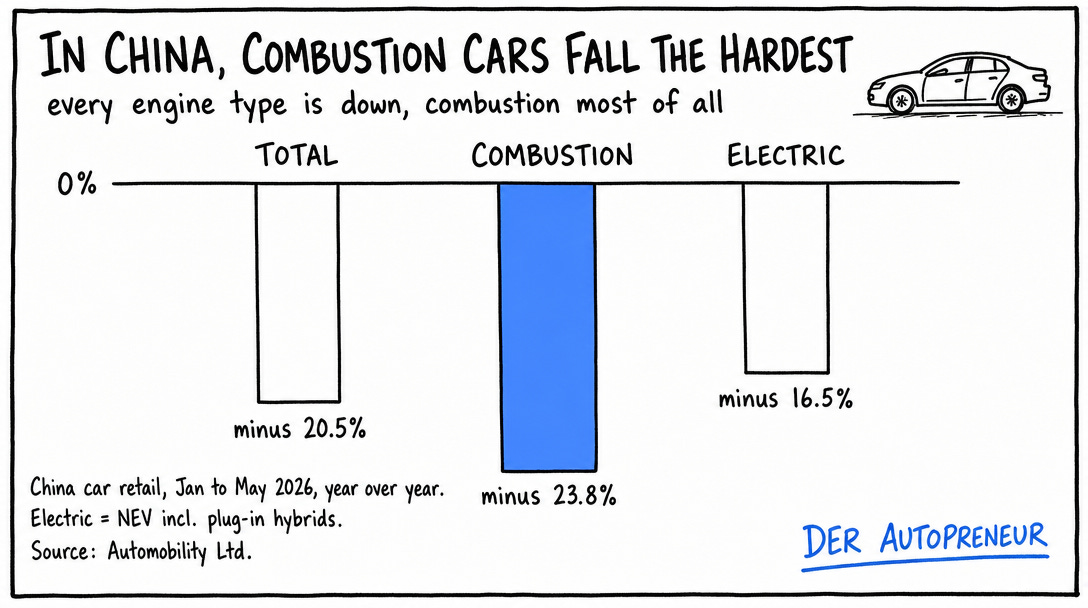
Recently I read: "EVs have overtaken combustion cars in China for the first time."
That confused me for a second. Didn't that happen already?
Here's what actually happened:
NEVs overtook combustion cars back in 2024
Pure EVs (BEVs) only did it in April 2026. For the 1st time, more pure EVs were sold than combustion cars
Plug-in hybrids resolve the apparent contradiction: pure EVs and pure combustion cars are each still below 40%. All NEVs together hit 63%
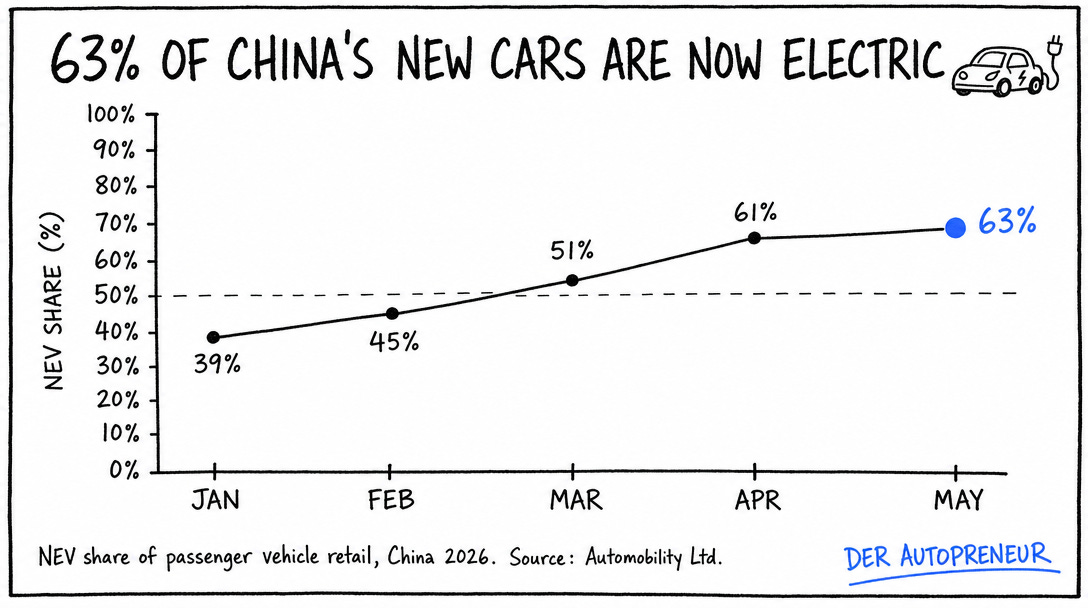
So: the incentives are being phased out. And the EV share keeps rising anyway. The shift to EVs is now self-sustaining.
But here's the real split: in China, combustion and electric split into 2 separate markets, with different players:
The combustion market: home turf of the foreign brands. VW and Toyota fight over a pie that shrinks every year
The NEV market: now the bigger one. And firmly in Chinese hands
At first glance, only the powertrain separates the 2 markets. In reality, it's something else. What defines an NEV in China is software and AI. The Chinese have a name for it: smart car.
That's why the real battle in China is no longer combustion versus electric. It's dumb car versus smart car.
You can see how separate the 2 worlds are in the bestseller lists. Only 3 groups appear in both the combustion top 10 and the NEV top 10: Geely, SAIC, and Chang'an. All 3 Chinese. Not a single foreign brand makes both lists.
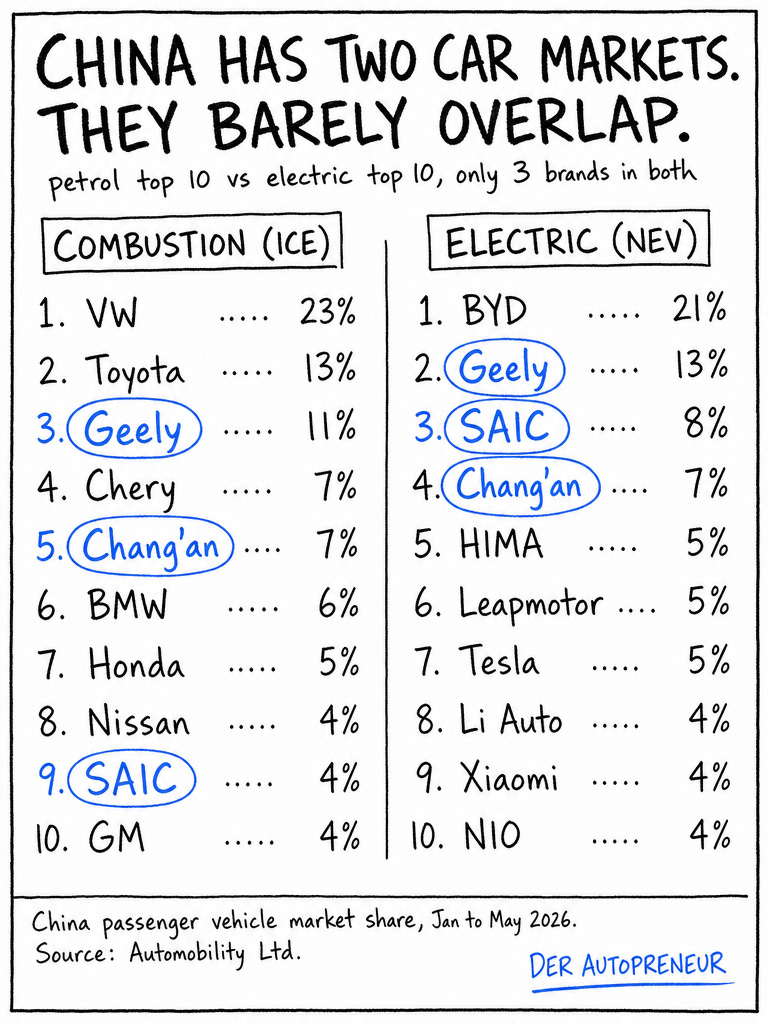
For the German brands, that's bitter. The NEV market is growing. And they barely exist in it.
And even in the shrinking combustion market, they're losing ground: last year, Mercedes was still in the top 10. Now it's not. VW is still the number 1 there. But that's the market that's shrinking. Not a single German brand has made the jump into the growing one.
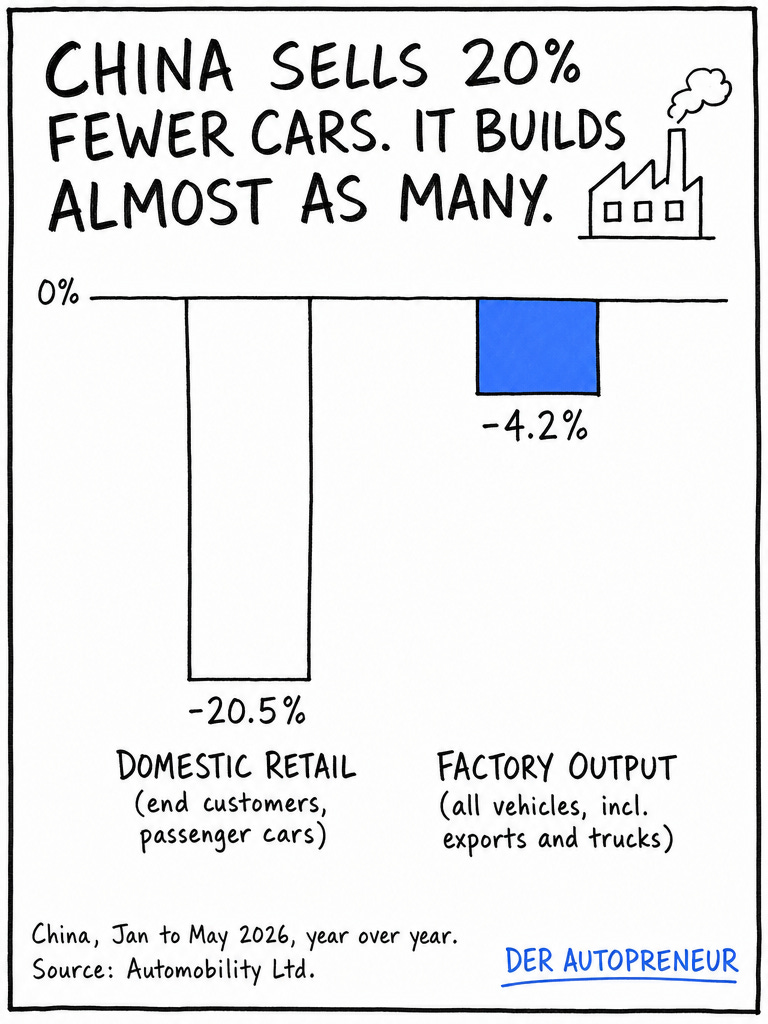
Back to the overall market. One number doesn't fit the picture: retail sales to Chinese customers fell by a good 20% from January to May. But China's factories built only 4.2% fewer cars.
Someone is buying those cars. Just not Chinese customers. So where are they going?
Every 3rd Car Leaves the Country
The answer: the rest of the world. The export numbers, January to May:
4 million vehicles exported (+63%)
930,000 of them in May. A new monthly record
35.4% of all deliveries now go abroad. The 2nd straight month above 35%
45% of exports are NEVs (2021: 15%)
China's biggest car exporter is Chery. Not BYD, as many assume.
The comparison with 2024 shows how fast this shift is moving:
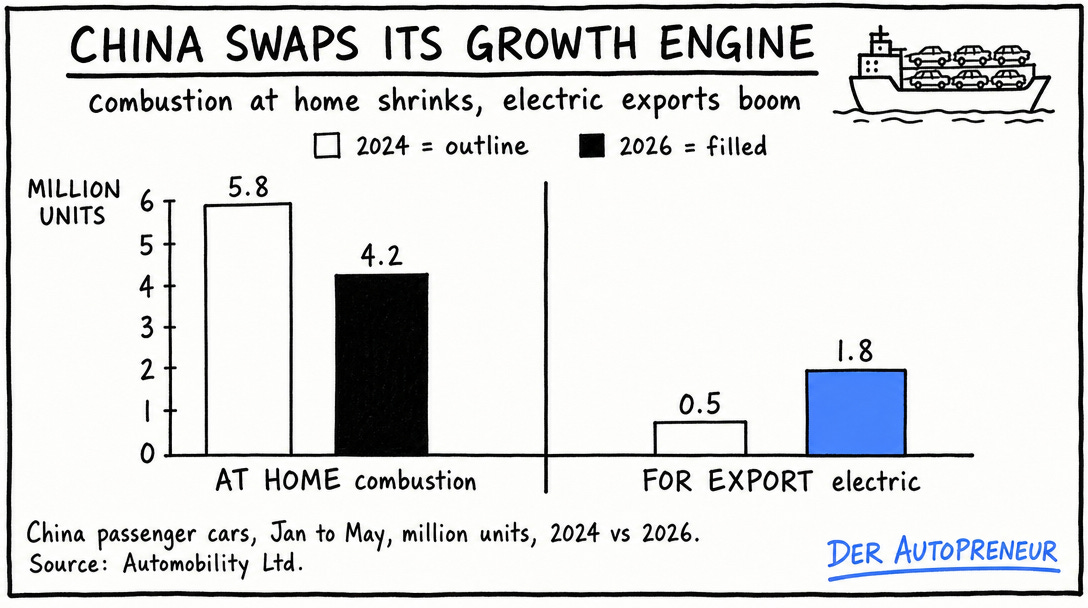
The domestic combustion market shrank from 5.8 to 4.2 million vehicles (January to May, 2024 vs. 2026). More than 1/4 gone. In just 2 years. NEV exports more than tripled over the same period.
In plain terms: China's auto industry has swapped out its growth engine. From domestic sales to exports. That's why it can absorb the crash at home.
The top export destinations (January to May):
Brazil is the new number 1 with 295,000 vehicles (+215%), overtaking Russia
Algeria is up 380%
Europe keeps buying despite EU tariffs: Belgium, Italy, and Spain are near the top. The UK has no tariffs and sits in 3rd place
Only Mexico collapsed, down 37%. The country was long China's backdoor into the US market. Under US pressure, Mexico raised tariffs on Chinese cars to 50%. That door is closed for now
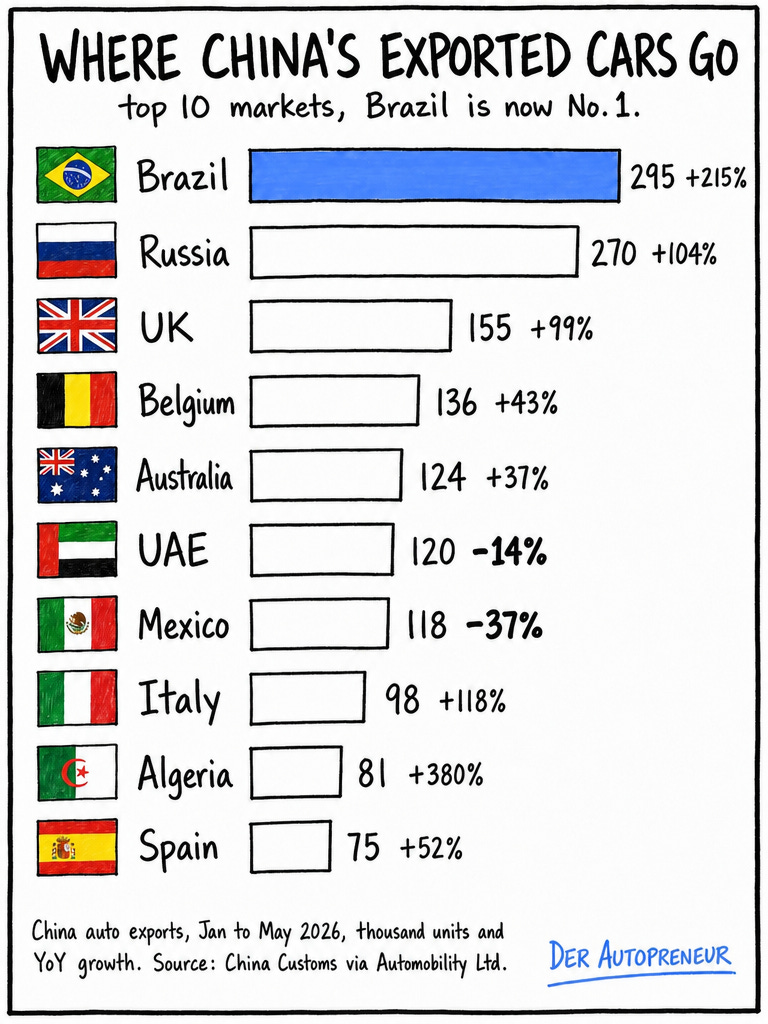
The crash at home is pushing China's carmakers abroad, not slowing them down.
Which leaves the question: how are the foreign brands doing in China?
Only the US Brands Are Still Growing
The honest answer: badly. 6 years ago, Chinese brands held a good 1/3 of their own market. Foreign brands held almost 2/3. Today it's the other way around: 71% is in Chinese hands.
The breakdown by brand origin (factory deliveries January to May, vs. a year earlier):
US brands: +13.2%
Chinese brands: -3.2%
Japanese brands: -14.1%
German brands: -24.9%
For context: these are deliveries from the factory, including exports.
The Germans are losing the most. The US brands are growing in the middle of the crash.
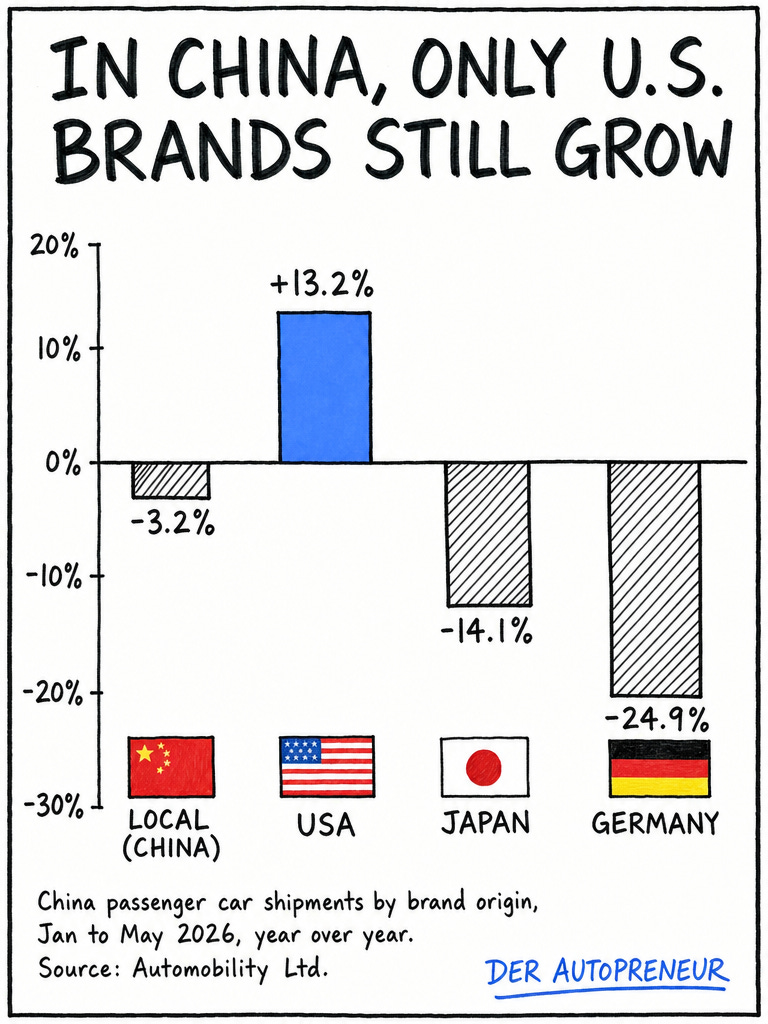
The US growth is mostly Tesla.
In Germany, you often hear: the Chinese simply don't buy foreign cars anymore. Because the state wants it that way.
That's the comfortable explanation. The catch: it's wrong.
The Model Y was China's best-selling car in June. Not the best-selling EV. The best-selling car across all powertrains. And it was the most expensive car in the entire top 10.
So Chinese buyers do buy foreign cars. As long as the product is right.
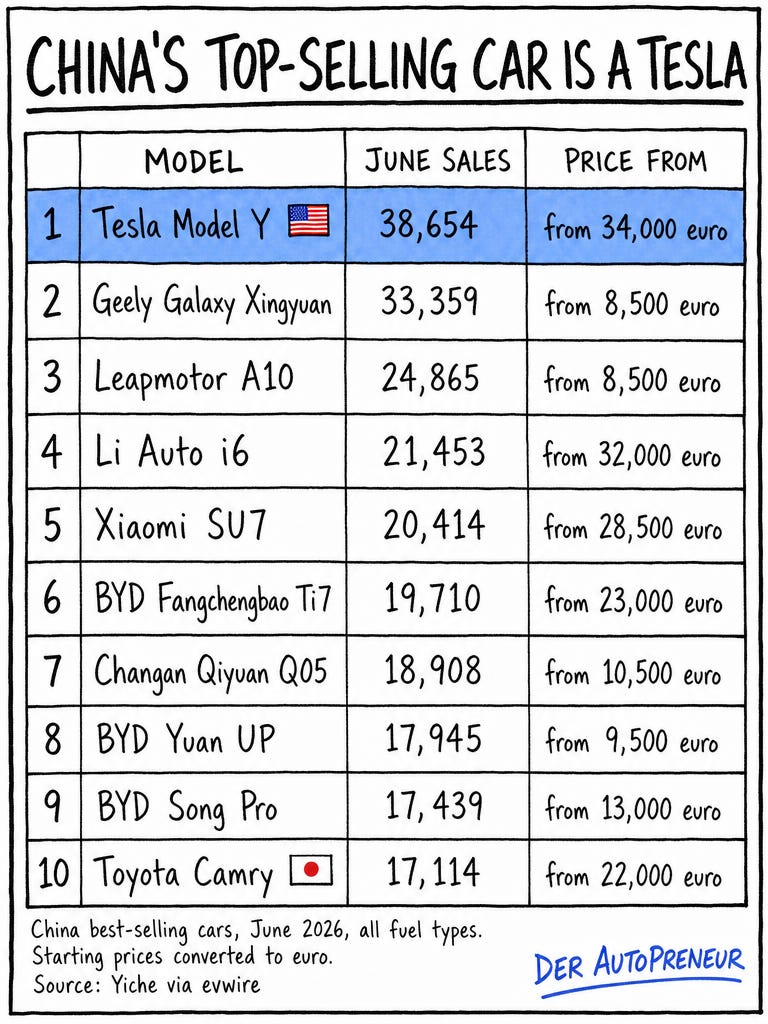
To be fair: Tesla is under pressure too. Sales to Chinese customers are down for the year. Xiaomi in particular is taking its customers. The growth comes mostly from exports out of the Shanghai plant. Around half the cars built there go abroad.
Still: no other foreign brand has an EV the Chinese actually want.
That's the view by model. Who leads the overall market? The top 3 across all powertrains:
Geely
VW
BYD
For years, VW was the number 1. Now Geely leads. BYD had even overtaken VW for a while. Right now, BYD is back in 3rd place, behind VW.
VW being back ahead of BYD says little about VW's strength. It says more about BYD's weakness.
No company got hit harder by the subsidy cuts. BYD builds no pure combustion cars, only EVs and plug-in hybrids. So the subsidy stop hits its entire business.
In China, BYD lost around 40% in the first half. Only exports cushioned the blow: sales abroad grew more than 70%. It's BYD's 1st half-year decline in 6 years.
The Germans Sell the Wrong Car
The German problem is structural. They sell almost nothing but combustion cars. In pure EVs, they hold around 1.6% combined.
And that's despite their EVs catching up on the basics: range and charging times are now competitive. The Achilles heel is what makes a car smart in China: software and AI. That's exactly where German EVs fall short.
The Germans now build good EVs. But for Chinese customers, they're dumb cars. And China doesn't buy dumb cars anymore.
The result: it's going downhill. And it's getting faster, not slower.
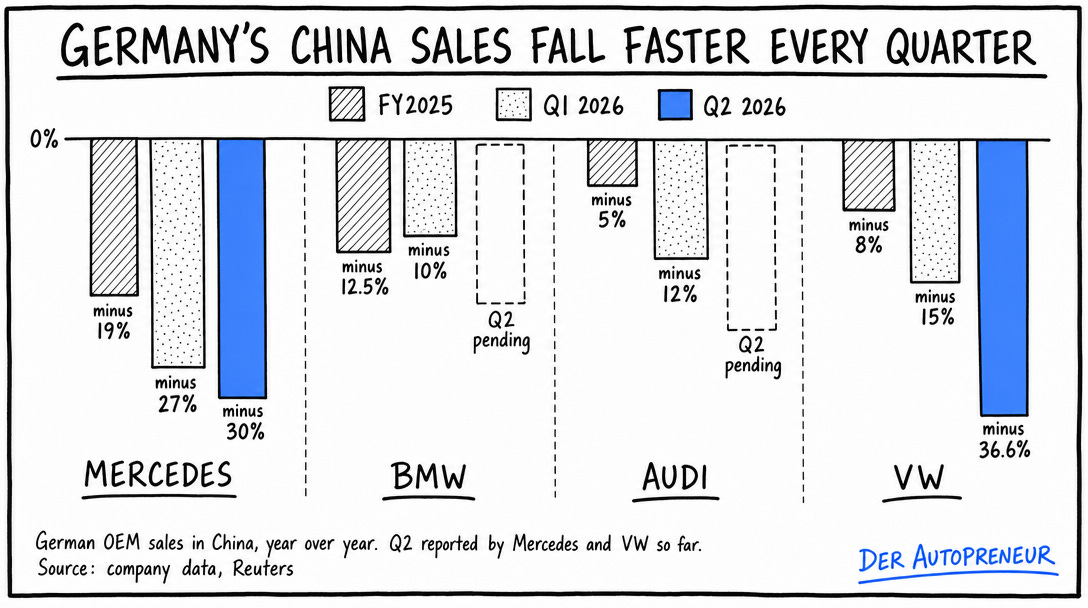
Mercedes and VW reported their half-year numbers this week. Both show the same thing: the decline in China keeps accelerating:
Mercedes: -19% for all of 2025, -27% in Q1 2026, -30% in Q2
VW: -36.6% in Q2 alone. More than 1/3 gone
BMW is holding up best on sales. But it's tipping there too: a few weeks ago, BMW issued a profit warning, mostly because of China.
BMW and Audi haven't reported yet. Right now, nothing suggests the downtrend is stopping.
My Take
For me, the most interesting insight here is the Model Y.
That one car destroys 2 myths we like to tell ourselves in Germany:
1) The Chinese don't buy foreign cars anymore:
Supposedly because the state wants it that way. Except China's best-selling car is a Tesla. Despite all the conflict between China and the US. That should be the end of the myth.
It survives anyway. Because it's comfortable. It shifts the blame away from the product and onto politics. Then nothing has to change.
2) In China for China:
For years, the German industry has told itself: cars for Chinese customers can only be developed in China.
Tesla disproves that too. They develop in California. And they're the number 1 in China.
So it's not about location either. It really is about the product.
The real question is: why can't Germany develop a good product anymore?
Because we've been failing at one thing for 15 years. The thing we call digital transformation. Turning a mechanical engineering organization into a software organization.
A smart car is above all a software product. And you can only build one with a software organization. We don't have one.
And why can't we build one? That's also on us.
We're attempting the rebuild with the very people who made their careers in the old system. They sit in the decision-making positions of the German car groups today.
For them, a real software organization is a threat. It means losing power and authority.
One more time: the biggest transformation of the German auto industry is a software transformation.
And the job of delivering it sits with a massive organization of mechanical engineers, controllers, and MBAs.
I keep coming back to one sentence I heard from Michael Fait, someone who builds car software for a living: "You don't even know what good looks like."
I can't get that sentence out of my head. Because it captures our problem so well.
We're supposed to build a product that's fundamentally software. With people who never really understood software.
Not because they aren't smart. Because they come from a completely different world, shaped by a different system.
And if I don't fully understand what a good software product is. Or what makes a good software organization.
How am I supposed to build one?
How am I supposed to make the right decisions?
That's the biggest problem in the German auto industry.
We have mechanical engineering companies that need to become software companies. And a whole generation of mechanical engineers flailing at it.
And yet, Tesla gives me hope.
They prove it doesn't come down to external conditions or politics. It just comes down to the product.
A good product sells in China. No matter where it comes from.
So this is completely in our own hands.
China is still buying cars. Just not dumb ones.
PS: My partner IPG Automotive just published a whitepaper on modern testing strategies in vehicle development. Read it for free (ad)
🔗 am | cp | ev | nt | rw | nk | re1 | mm | re2
That’s all for today.
Until next week,
Philipp
And as always: If you find value here, share it with someone who should read it too. That helps me a lot.
I worked for Tier 1 suppliers in the past: first Delphi from 1996-2005 and then Siemens VDO from 2005-2007 and have worked with manufacturers all over the world but mainly in Asia.
I left automotive in 2008 because of the aversion to innovate, but ended back in automotive in 2016 on working with a regulator to support a plan towards deployment SEA Level 4 autonomous vehicles. At the moment we see a rapid expansion of these deployments (still trial), mainly of Chinese developed vehicles.
When I started in 1996, the Delphi Luxembourg team was very happy we transferred the Engine ECU program for Daeweoo from Luxembourg to Singapore. Korean customers were too demanding and they rather worked with European customers at a lower pace.
For a long time we were left alone by both Europe and the US because nobody was interested in the Asian market. Asian Customers were too difficult and there were easier pickings within the GM family (del[phi was a part of GM till 1999, but GM was still the main customer till 2005).
In 2000, we started development of an Engine ECU specifically for the Chinese market. It was based on an Opel product, but we had a BOM 1/4th of the Opel BOM, simplified the software and most importantly, used the latest chipsets. That was not possible for European, American and Japanese customers as they saw it as a risk, but for Chinese customers, how we got there was not important, just it had to do what it needed to do and at the lowest cost.
The product met the latest emission standards, the engine started at -40degC (all our other markets were -30degC), it was tested at 5500m altitude in Tibet (no other car was tested above 3500-4000m) and there were no problems in Xinjiang at 50 degC. On top of that it was rock solid: the highest reliability of any Engine ECU in our product line. We had more than 60 car manufacturers as customers, most are gone but some of the big ones like ChangAn, Dongfeng and Chery are still around.
I left Delphi because it got in financial problems and suddenly all US high level managers started to interfere with our programs as we were the only region making profit and they wanted to show that they were working on profitable Asia projects. My work-life balance went to hell.
I really liked working on China projects as they were so dynamic and we could see that once they matured, they would cause a huge problem to the rest of the world. One simple example gif China dynamics: in December 2003 we were informed that all cars sold in Beijing after 1 July 2004 must meet the latest EURO emission standards to ensure clean skies during the 2008 Beijing Olympics. First response by us: "this can not be done". Reply from government: "The Olympic Games are important, your car sales are not. If you cannot do it, you're out of business". 6 Months later every supplier and car manufacturer had only clean cars for sale, and it turned out that the effort was far less than estimated (the basic engine was good enough, it was some sensor changes and and better calibrations but nothing major).
I joined Siemens VDO in 2005 working on global Radio-infotainment platforms and mainly working with European car manufacturers and I hated it.
We needed to do everything as cheap as possible. When the iPod came out, they wanted to do to have the same functionality but based on MP3 CDs, but it also had to behave like a cassette player in the older car models, and it had to do it with a cheap microprocessor, starved of RAM and ROM.
I made on the cheap a prototype of a 2cm thick large display digital radio without CD but with bluetooth for streaming and phone based voice recognition and dialling, all low cost, low weight and very efficient and showed its at 2004 CES. I got criticised by all the Germans that this was not what the market wanted. In 2017 or so CES, Continental (which had taken over Siemens VDO in 2008), showed a similar concept and advertised it as the next best thing. I messaged my ex-boss with the question why it took them 12 years to copy my work and all I got was a "sorry".
In the last few years, I also had the pleasure to host a leadership program from a German car manufacturer for 3 years in a row. Attendees were management at VP level or up, or being groomed for that level. The reason for visiting Asia was that the company realised that too many of the German leadership thought that the world ended at the German border and all international markets were like Germany. When I explained the journey towards a "car-lite" Singapore (make private cars unnecessary by improving public transport), they actually get angry and aggressive. If it is not like Germany, it is wrong even though our context is totally different... I find that always fun as it is quite predictable.
I have seen the same behaviour by European government officials. One of them questioned why Singapore dropped 100% EVs by 2030 target and replaced it by 100% clean (EV or Hybrid) target by 2030. This was changed around 2019 because they realised the vehicle supply and charging systems pipeline might not be sufficient to meet the original 100% EV goal. The Dutch official replied that in Holland that 100% EV target was not a problem. When I asked the official why, it was "in is in the policy and I wrote the policy, therefore it will happen". Now it is pretty clear that it will not happen.
My next car is most likely a BYD or a Deepal (ChangAn).
When I worked with Daewoo in 1996, no way I would have bought a Korean car, especially a Kia. Now, no concerns at all with Korean cars and for me personally, Kia styling, features and price points are the most attractive.
When I started working in 2000 with the Chinese carmakers, I would never think I would buy a Chinese car. Most cars we worked on were terrible but some had promise. But now I am seriously considering a Chinese car as the build quality is there. The same production lines make Volvos, Minis, Smarts and other non-chinese branded cars.
On the other hand I recently rented a brand new Renault and VW as rental cars in Europe and they were highly disappointing and their software was junk. My 9 year old Volvo V40 is still a much better car than either of these 2 rental cars. My Volvo has no ALKS or Adaptive Cruise Control but the Renault ALKS was downright terrible on narrow Scottish Roads (and I could not figure out how to turn it off) and the VW Adaptive Cruise Control was unusable and I stopped using it after a while. The whole VW user interface made no sense and it took us a long time to figure out how to change language from German to English (I hired this car in Hungary).
Final comment: The Europeans are worried about Chinese imports to their home markets. But They should also worry what it does to their export markets. This article only points to China, but in the rest of Asia, South America and Africa, Chinese car sales are increasing at the expense of other brands. In my market Tesla and BMW are holding up ok, VW is becoming a rare sight but more Skoda and Cupra EVs are appearing and the Japanese are slowly being wiped out. If countries put up barriers to their home markets, it is just delay of pain as export markets still will be hit hard. One comfort for the Germans: I believe the Japanese are in far bigger trouble.
Thanks, makes perfect thanks.
German car makers are controlled by mechanical engineers
Chinese successful ones by entrepreneurs