


Ad
For readers who speak German: a free online event on SAP and AI in manufacturing
Many companies still run the old SAP (ECC). From 2028, updates and maintenance cost extra. Yet only about 1 in 7 S/4HANA migrations finishes on time and on budget.
GAMBIT has supported over 200 S/4HANA projects. Their advice: clean up while you modernize. Because AI in production only really pays off with clean data and clear processes.
On November 27, GAMBIT and the consultancy concircle show how to do it in an online event in German.
Welcome to Issue #138 of The German Autopreneur.
The Democrats have just won the US midterms. A little over a week before the vote, here's what happens in Perry, Georgia:
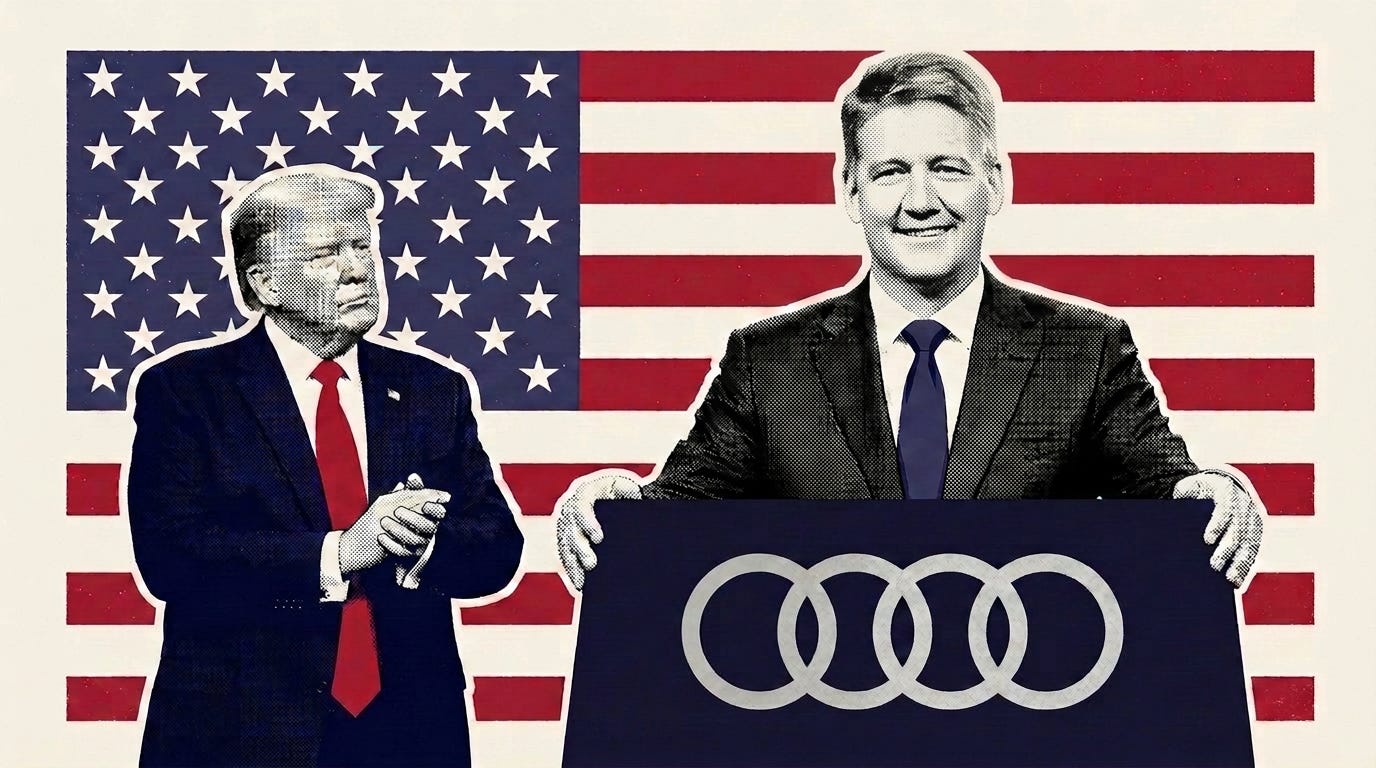
It's a classic Donald Trump campaign rally. A gold Audi Q9 is parked outside the hall. Trump announces:
Audi will build a plant in Georgia
Around $4 billion in investment and about 4,500 new jobs
Then he brings Audi CEO Gernot Doellner onto the stage. And Doellner thanks him for the great opportunity. The crowd cheers.
In Germany, the scene draws a lot of criticism. It's easy to see why. At home, it feels like the world is ending: job cuts and plant closures. Yet in the US, Audi is investing and creating new jobs.
That's reason enough for me to take a closer look at Audi. What's behind all this? And where does Audi stand in the car industry's big shift?
Today, we'll look at:
Why Audi launched a new brand in China
The story behind the new US plant
And what Audi's slogan “Vorsprung durch Technik” (“progress through technology”) is still worth today
Audi Barely Makes a Profit Anymore
Let's start with the numbers. Here are Audi Group's Q3 2026 results (vs. a year earlier):
Revenue: $14.4 billion (-18.5%)
Operating profit: $32 million (-94%)
On its own, the Audi brand made an operating loss of $194 million. Only Lamborghini keeps Audi Group profitable
Here's how the first 9 months of 2026 look:
Operating profit: around $1.3 billion (-26% year over year)
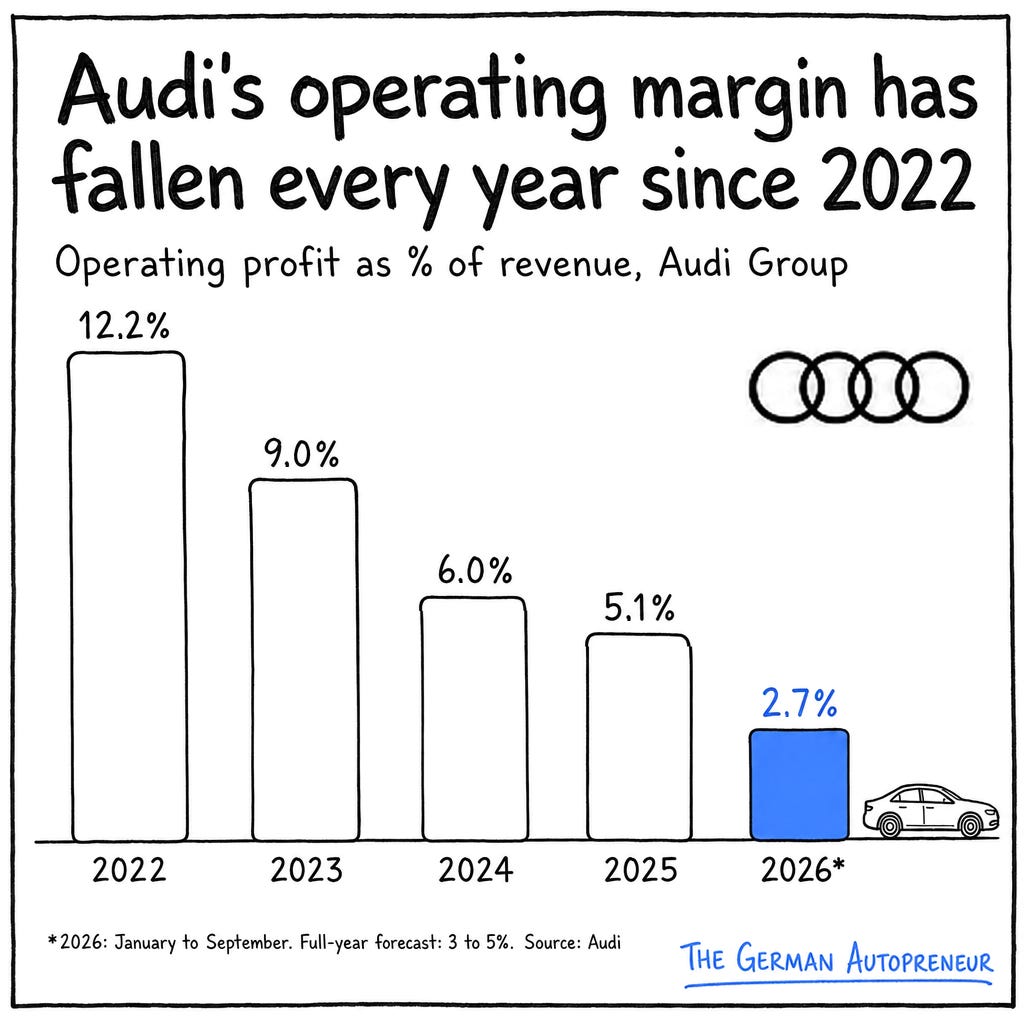
Operating margin: 2.7%
Full-year forecast: cut twice, from a 6-8% margin to 3-5%
Car sales in the first 9 months of 2026 (vs. a year earlier):
Worldwide: -11.4%
China: -24.5%
US: -16%
Europe: +1.4%
So things are going downhill for Audi. And it happened fast:
In 2022, Audi still made more money than ever: a 12.2% operating margin
Today, less than 1/4 of that margin is left
It wasn't always like this. Audi used to be way ahead on technology. Since 1971, their slogan has been “Vorsprung durch Technik” (“progress through technology”). And for years, they delivered:
1980: quattro, Audi's all-wheel drive system
1989: the TDI, a diesel engine that uses very little fuel
1994: the A8, with a body made entirely of aluminum
And for a long time, Audi was the brand for new technology at VW
This was a huge advantage in China. Chinese buyers always want the newest technology. That's how Audi became a status symbol there:
For years, government officials in China were driven around in an Audi A6
And Audi was China's top premium brand until 2018
How did Audi fall so far so fast? It comes down to all 3 big markets: China, Europe and the US.
And as usual, the biggest reason is China.
Audi's Market in China Is Collapsing
Here's how much of Audi's sales go to China:
2020: 43%
2025: 38%
First 9 months of 2026: 31%
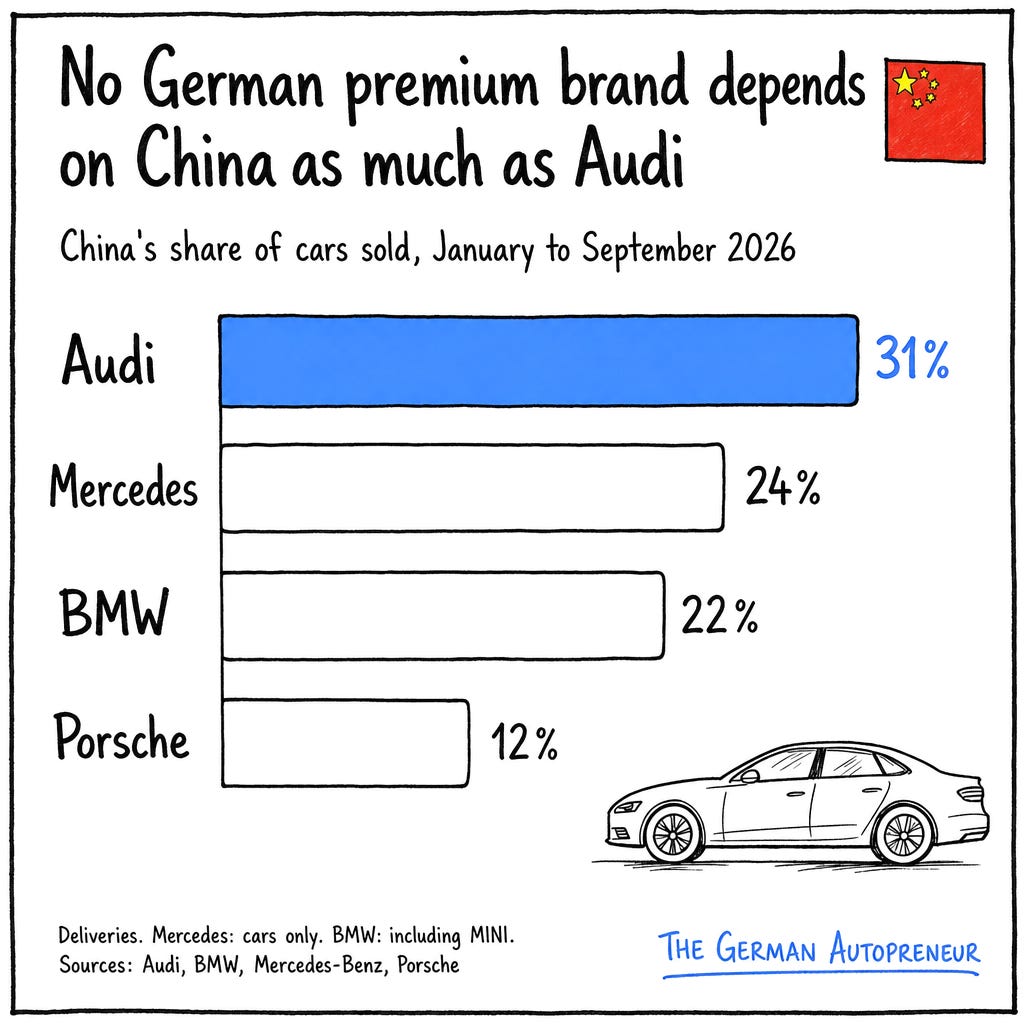
No other German premium brand relies so heavily on China.
And sales keep falling: Audi sold 35% fewer cars in China in Q3 2026 than a year earlier.
I've explained the reason many times: China's car market is shifting from combustion cars to smart cars. These are EVs that people buy mainly for their software and AI.
German carmakers were strong in China's old combustion car market. Audi most of all. But so far, they haven't made it into the new market. In the first 9 months of 2026, fully electric cars made up just 7.4% of Audi's sales in China.
Audi doesn't have the technical base for smart cars. That base is supposed to come from VW: a new platform called SSP. It was originally planned for 2026. But in 2023, VW delayed it to 2029.
Audi can't wait that long in China.
The Audi Without the Rings
So Audi simply buys the technology from a Chinese partner that already has it: SAIC. That's one of China's biggest carmakers.
But there's a risk: buyers might notice that the technology inside an Audi is no longer Audi's own. And that could hurt the brand.
That's when the idea is born: a new brand without the 4 rings. Audi introduces it in November 2024: AUDI in capital letters.
In September 2025, the first car arrives: the E5.
At the press conference, the first question is: why another brand?
Audi's answer: Chinese buyers want both. German luxury and Chinese technology.
Here's what's inside the E5: it's basically an IM L6. IM is an EV brand owned by SAIC.
Platform, motor, battery, electronics and software: from SAIC, as in the IM L6
Driver assistance: from Chinese supplier Momenta
Design and chassis tuning: from Audi
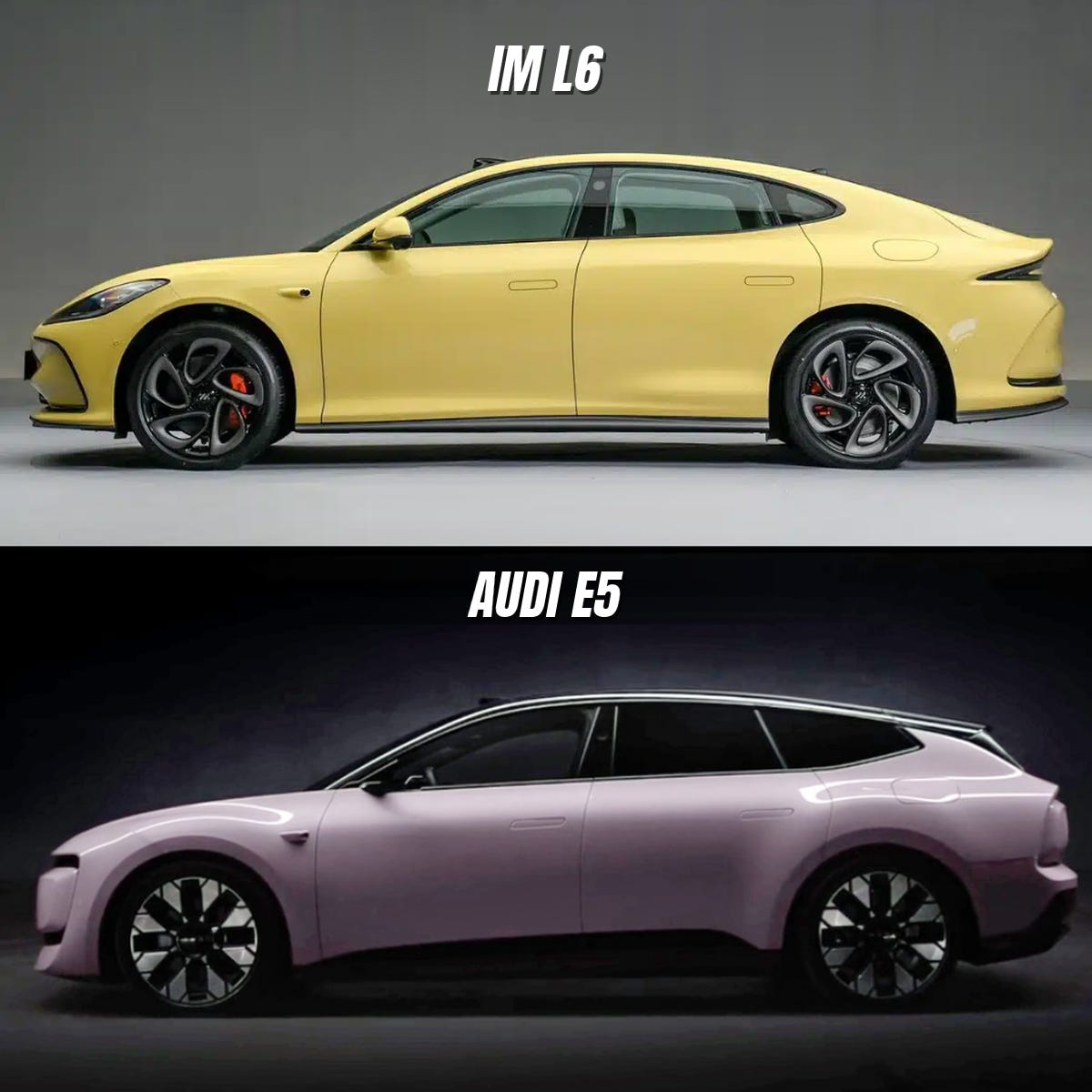
The bet: Chinese buyers will pay more for the same technology if there's a German name on it. At launch, the E5 costs around $2,200-$4,400 more than the IM L6.
But Audi's fear comes true. Buyers realize: it's a Chinese car with a German logo.
The bet doesn't pay off. From October through December 2025, Audi sells fewer than 2,000 E5s a month. In February 2026, Audi cuts the price to match the IM L6.
Even after the price cut, here's how sales in China look from March through September 2026:
IM L6: around 8,700
Audi E5: around 4,800
So without the Audi name, the same car at the same price finds almost 2x as many buyers. And the gap keeps growing. In September, the IM L6 even sells over 5x as many.
The E5's direct rivals sell far more over the same period:
Tesla Model 3: around 89,000
Xiaomi SU7: around 132,000
At the end of May 2026, the 2nd model arrives: the large E7X SUV. This time, Audi tries a different approach:
It costs almost 1/5 less than the comparable IM LS7
Audi says the E7X isn't a modified IM model. They developed a new platform for it together with SAIC
Still, many people in China call it a modified LS7. The reason: both cars are exactly the same length, to the millimeter. And they have the same wheelbase.
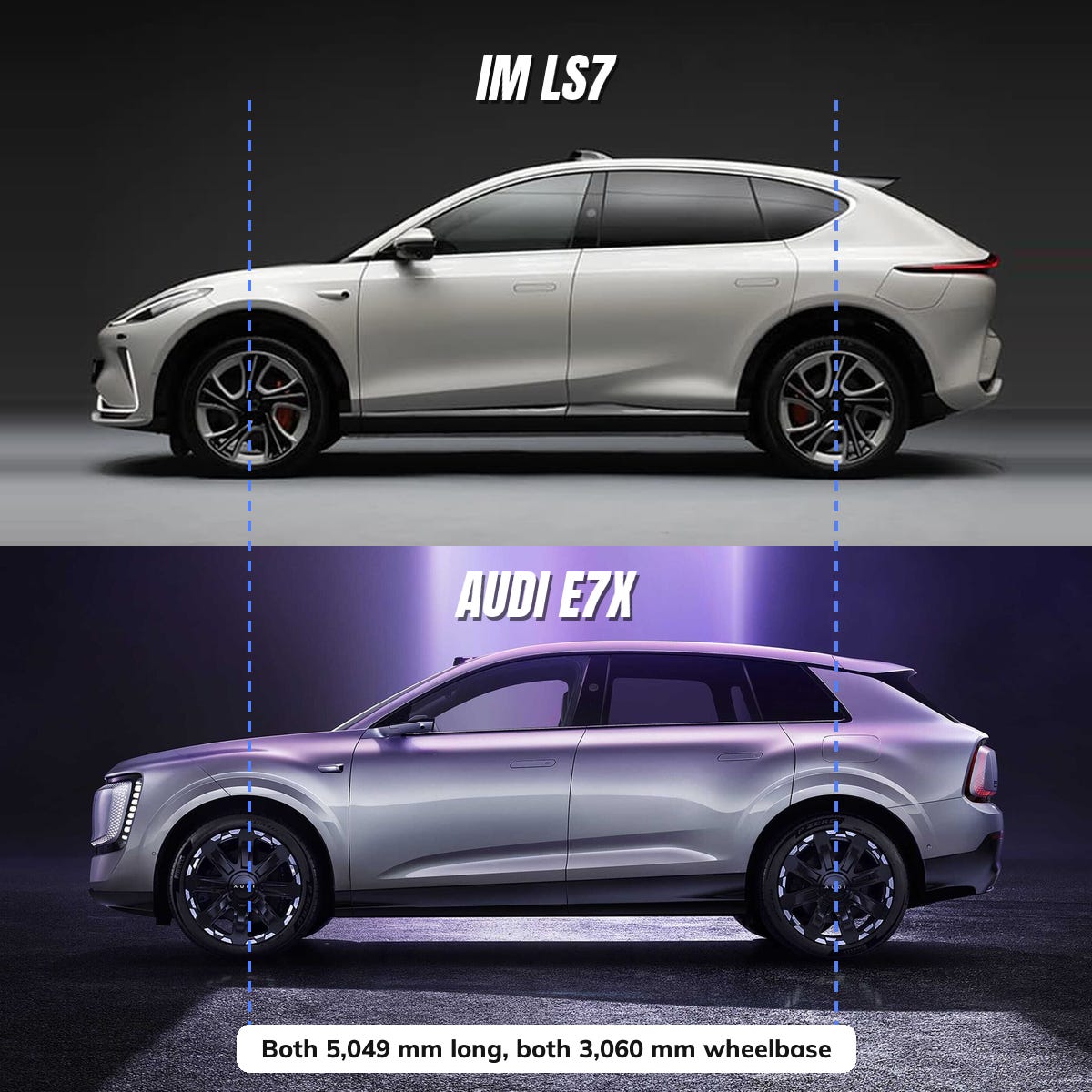
It hardly matters who's right. After the E5, many people think: inside every AUDI, there's a SAIC.
In June, E7X sales start at around 4,000 cars. By September, they're down to around 1,500. The E7X's direct rival is the Xiaomi YU7. In September, the YU7 sells almost 8x as many cars.
So why won't Chinese buyers buy an AUDI, even when it's cheaper?
I think a German name helps and hurts at the same time:
It helps because Chinese buyers have long paid extra for German cars
It hurts because people in China now buy smart cars. German carmakers were late to software and AI. So Chinese buyers see German cars as good, but outdated
A McKinsey survey in China also shows this:
76% of car buyers say: a foreign premium brand matters less in an EV than in a combustion car
Among buyers under 24, it's 83%
But EVs are exactly where the market is going.
Bottom line: the experiment was bold. But so far, it hasn't worked. In just over a year, AUDI has sold around 23,000 cars. A German logo on Chinese technology isn't enough to sell a car.
Still, Audi isn't giving up on the new brand. Gernot Doellner says: building a brand is more of a marathon than a sprint. From 2028, 4 new AUDI models are planned. Audi is developing them with SAIC in a company they own together. And SAIC owns the bigger share.
But in the short term, that won't help Audi in China. So right now, the other 2 markets matter even more: Europe and the US.
Why Audi Cuts Costs at Home and Invests in the US
At first glance, things look better in Europe:
Audi is selling more cars than a year earlier
Audi has launched 8 new models since 2024
A YouGov survey ranks Audi as Germany's most popular car brand, just ahead of BMW and Mercedes
But on technology, things have flipped:
VW's newest technology used to come from Audi
Today, Audi depends on technology from the rest of the group
That's because VW has centralized development. Platforms and software are now built for all brands together.
So Audi's next EVs in Europe also have to wait for SSP. That's the same platform Audi couldn't wait for in China. VW is developing the software and electronics for SSP together with their US partner Rivian. The first Audi on this platform is coming in 2029 at the earliest.
Until then, Audi has to make money with today's technology. And that's barely working right now. So they have to cut costs: up to 7,500 jobs in Germany will go by 2029.
Audi has just ended A8 production at its plant in Neckarsulm, Germany. There's no confirmed successor. By the end of June 2027, the plant has to get cheaper. Otherwise, it could be shut down.
And that brings us back to Doellner and Trump in Georgia.
Audi is cutting costs at home. And in the US, they want to invest $4 billion. How does that make sense?
Audi is the only one of Germany's 3 big premium brands without a plant in the US. For a long time, they just didn't sell enough cars there to build one. So in 2012, they decided to build a plant in Mexico instead. Back then, cars from Mexico could go to the US without tariffs.
Then came Trump and his tariffs:
25% on cars from Mexico
15% on cars from the EU
Audi paid around $1.3 billion in tariffs in 2025. That's roughly what they earned in the first 9 months of 2026.
You can see the effect in Audi's US sales:
2025: 16% fewer cars than in 2024. Because of the tariffs, Audi raised prices. And for a while, they stopped selling some models altogether
First 9 months of 2026: another 16% fewer cars than a year earlier. Over the same period, BMW sold 4.3% more. Mercedes sold about as many as before
So Audi urgently needs to do something about tariffs. And then Georgia makes Audi an offer:
A large plot of land for a plant
Plus around $1 billion in subsidies
If Audi says yes, the US government promises lower tariffs on Audi's cars from Europe: around 10% instead of 15%
For Audi, that's more than tempting. But there's a catch:
Audi must agree quickly and start construction by the end of 2027
Insiders say appearing at the Trump rally is part of the deal. Doellner himself says: the US government asked for it
For this deal, Audi's top management even makes an exception to their own rules. Those rules normally ban campaign appearances in the last 3 months before an election.
Daniela Cavallo leads the employee representatives at VW. 30 hours before the rally, she warns some members of VW's board: this could be a disaster. Doellner goes anyway.
Here's how Germany reacts:
In a YouGov survey, 57% of Germans say the appearance wasn't appropriate
Cavallo accuses Audi of helping Trump's campaign
On social media, people share bumper stickers that say: “I bought this before Gernot went crazy.” We've seen this before with Elon Musk
VW's board still has to give final approval for the plant.
There's another problem: the Republicans have just lost the election. Georgia's next governor is a Democrat. And the plant wouldn't reach full production until 2031. That's 2 years after Trump leaves office.
So the plant would be a risky bet: it only pays off if the tariffs stay after Trump is gone.
My Take
Wherever you look, Audi is stuck in a dilemma.
In China: Audi's old market is disappearing. They don't have the technology for the new market. And buying it from partners damages their own brand
In the US: with Audi's China business collapsing, the US market keeps getting more important. Without a US plant, Audi can barely compete there because of the tariffs. But a new plant wouldn't be ready until Trump is out of office. And the tariffs might disappear with him
Appearing at Trump's rally was a dilemma as well. If Audi had said no, the deal would probably have collapsed. And they would have had Trump against them.
So it was an offer they couldn't refuse. Now they have an image problem at home.
But Audi's biggest dilemma is their own brand:
“Vorsprung durch Technik” is the core of Audi's brand.
But technology in a car means something very different today than it did 10 years ago:
It used to mean mechanical engineering: all-wheel drive, engines and bodywork
Today, it's software, AI and batteries
And that's exactly what German carmakers aren't good at.
Audi no longer develops this kind of technology on its own. It comes from partners like Rivian, SAIC, Momenta and Huawei.
So Audi can no longer deliver what their slogan says. Their brand promise no longer means anything.
Audi can't catch up without partners. But with every new partner, they lose more control over their own cars.
This happens in stages. I call it the Stairway to Hell.
The stairway shows how much a carmaker still controls:
Stages 1 and 2: you buy individual technologies or develop them with partners. Almost everyone does this
Stage 3: you use a partner's platform
Stage 4: you take a partner's car and put your logo on it
Stages 5 and 6: you just license your name or sell the whole brand. We've seen this with Volvo and MG
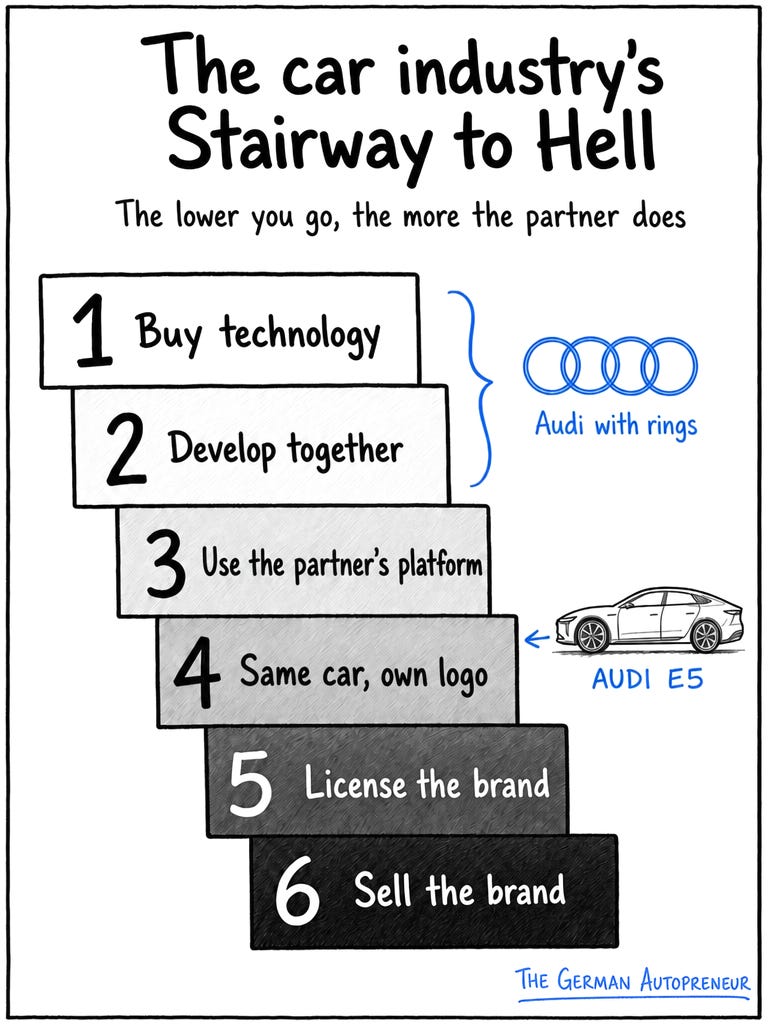
And that's a real risk. If you no longer own the technology in your own product, you'll become irrelevant sooner or later.
And Audi's experiment in China shows what a name is worth without technology of its own.
So the big question is: what does “Vorsprung durch Technik” mean when the technology comes from someone else?
Audi needs an answer to that. Or they need to rethink what their brand stands for.
🔗 au | fp | pca | pc2 | pcs | gc | jm | ne | ahm | sa | mck | cor | ndr | cev | el | an | vw | ahs | bo | aoa | bmw | mb | rtr | rda | hb
PS: Know someone at a carmaker or supplier who decides what to build in-house and what to buy from partners? Send them this issue.
A word from me
You could help Mercedes or Bosch. But they've never heard of you
The German car industry is a closed club. You're either inside or outside. And from abroad, you start outside.
Outside means paying over $20,000 for a trade fair booth. And you leave with 100 business cards and 3 real conversations.
I'm on the inside. I spent almost 10 years at Mercedes-Benz. Every week I reach over 100,000 people in the German car industry through my German newsletter, podcast, YouTube channel and LinkedIn. They trust me. So when I tell them about you, they listen.
An IT services company got 250 webinar signups this way. A consulting firm got 60 new contacts at decision-maker level.
My partnership page shows packages, prices and past campaigns with their results. You can also request a free 30-minute call there. By the end of it, we'll know if it's a fit.
The last open campaign date this year is December 6, 2026.
See you next Wednesday,
Philipp
Even for Europe sales do consider the employee / company registered cars from the new reported retail numbers. Once you minus them then see the actual reality to understand genuine customer deliveries which will be an even abysmal number!!